
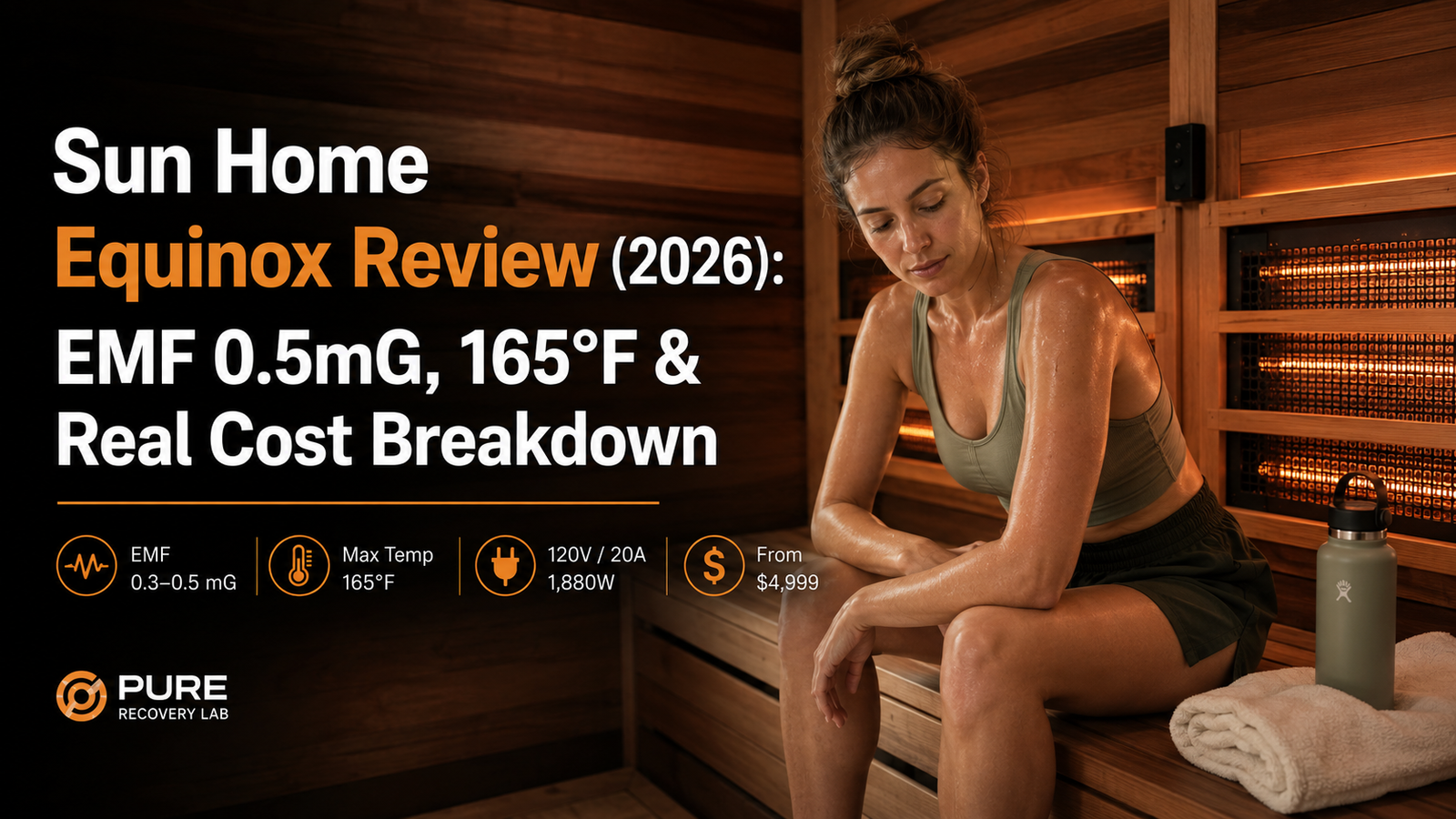
This Sun Home Equinox sauna review covers what most buyers don’t find out until after they’ve ordered — including the one question the brand’s own marketing doesn’t answer clearly: whether you need the 2-Person or the 3-Person.
The Sun Home Equinox is a full-spectrum infrared sauna independently verified at 165°F (Garage Gym Reviews) and 0.5mG EMF (Vitatech Electromagnetics, January 2025). It comes in two sizes — 2-Person (from $6,099, 520 lbs) and 3-Person (from $6,999, 620 lbs) — and both run on a 120V/20A dedicated circuit. The two models are nearly identical except for one extra heater and 11.4 inches of bench length. Right for buyers who want verified low-EMF, full-spectrum heat, and don’t mind the 20A electrical requirement. Not right for first-time buyers, renters, or anyone on a tight budget.
2-Person or 3-Person? Here’s the Real Difference
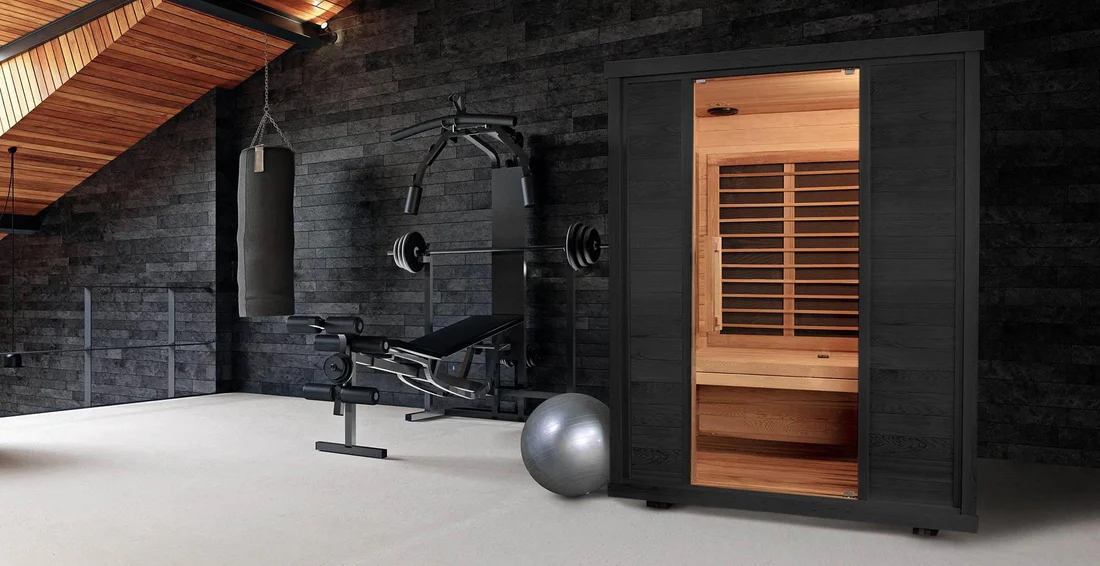
Sun Home sells the Equinox in two sizes. The standard configuration most buyers land on is the Sun Home Equinox 2-Person Full-Spectrum Infrared Sauna — but the gap to the 3-Person is smaller than you’d think.
It comes down to one heater and 11.4 inches of bench. That’s really the whole story. Same depth, same electrical setup, same everything else.
| Spec | 2-Person | 3-Person |
|---|---|---|
| Bench length | 45.2″ | 56.6″ (+11.4″) |
| Bench depth | 20.2″ | 20.2″ (same) |
| Interior width | 45.4″ | 56.8″ |
| Heaters | 4 FIR + 2 Full-Spectrum | 5 FIR + 2 Full-Spectrum |
| Power / Circuit | 1,880W / 120V / 20A | 2,250W / 120V / 20A |
| Weight | 520 lbs | 620 lbs |
| Price | $6,099 | $6,999 |
| Get it | Shop 2-Person → | Shop 3-Person → |
PRL Take: That extra $900 buys you room to not sit shoulder-to-shoulder. Two people sweating hard in a 45.2-inch space means you’re basically touching — not exactly the relaxing wellness moment you signed up for. The 3-Person’s extra 11.4 inches changes that. It also means you can actually shift position — cross your legs, turn sideways, whatever gets you through a full session instead of sitting rigid in one spot. What it won’t do is add legroom, since the depth is identical on both models. If two people are using this regularly, the 3-Person is worth the $900. If it’s mostly solo sessions with the occasional guest, stick with the 2-Person — Garage Gym Reviews, who tested it hands-on, called it a pretty standard footprint for a two-person sauna, and their own testers noted two adults can be a tight fit.
The Equinox is Sun Home’s most popular indoor model. Want outdoor use instead? See the Luminar. Want red light therapy built in, or a lower price point? Sun Home’s Eclipse and Solstice cover those — check Sun Home’s site directly for current specs on those lines.
What Makes the Equinox Different
Most infrared saunas under $4,000 use far-infrared only — carbon or ceramic panels heating the air to 130–150°F. The Equinox runs full-spectrum: near, mid, and far infrared from the same session, each penetrating tissue at a different depth.
Three numbers define this sauna: 0.5mG EMF, 165°F max temp, and a 120V/20A circuit. All three are independently verified, not just claimed.
EMF: What Sun Home’s Own Lab Data Actually Shows
Sun Home commissioned Vitatech Electromagnetics to test the Equinox using fluxgate magnetometers, RMS method, at seated distance. Report reference: VTE-3534.
| Seated distance | Magnetic field (mG, RMS) | Comparison |
|---|---|---|
| 1 foot | 0.6 – 4.0 mG | Lower than a common toaster |
| 2 feet | 0.4 – 1.8 mG | Near background levels |
| 3 feet (typical seated position) | 0.3 – 0.9 mG | Virtually background |
For context: ICNIRP’s public exposure guideline sits at 833 mG. Even at 1 foot, the Equinox runs at under 0.5% of that limit. Full Vitatech report →
Air Quality: The VOC Numbers Most Brands Don’t Publish
Heat accelerates off-gassing — a sauna running at 140–170°F for 20–45 minutes is exactly the kind of environment where trapped VOCs matter. Sun Home had the cabin air independently tested.
Result: 27 µg/m³ total VOC, classified “Low” (under 300 µg/m³), tested April 2, 2026 by VERT Environmental, analyzed by LA Testing (AIHA-accredited), using EPA Method TO-15.
| Compound detected | Result (µg/m³) | Status |
|---|---|---|
| Acetone | 15.0 | Below reference value |
| Ethanol | 4.8 | Below reference value |
| 2-Butanone | 3.4 | Below reference value |
| Isopropyl alcohol | 2.4 | Below reference value |
| Chloromethane | 1.3 | Below reference value |
The assembly adhesive was tested separately by Applied Technical Services (ATS, report #486424) — no formaldehyde detected above 3.0 ppm, no BTEX compounds above 0.001% by weight. Full VOC report →
For comparison: among the brands we’ve reviewed, most — including Heavenly Heat, which markets “zero-VOC” claims — don’t publish a numeric, lab-tested cabin-air result. Sun Home does.
What 165°F Actually Feels Like
At 130–140°F — where most entry-level far-infrared saunas top out — the heat feels warm and gradual. Easy to sit through 30–40 minutes.
At 155–165°F, it shifts. Breathing gets a little heavier. Sweat starts within 5–8 minutes instead of 15–20. It starts to feel closer to a traditional Finnish sauna, even though the mechanism underneath is completely different.
Most Equinox owners don’t actually run daily sessions at the full 165°F ceiling. Most settle into 140–155°F. The higher ceiling matters less for day-to-day use than you’d expect — what it really buys you is a sauna that holds temperature steadily through a longer session instead of fading.
Full Specs
| Spec | Sun Home Equinox 2-Person Full-Spectrum Infrared Sauna |
|---|---|
| Infrared type | Full-spectrum (NIR + MIR + FIR) |
| Heaters | 4 FIR + 2 Full-Spectrum (500W each), 1,880W total |
| Max temperature | 165°F / 74°C (independently verified by GGR) |
| EMF (seated distance) | 0.3–0.9mG (Vitatech, Jan 2025) |
| VOC | 27 µg/m³ (VERT / LA Testing, Apr 2026) |
| Electrical | 120V / 20A dedicated circuit (NEMA 5-20P) |
| Interior dimensions | 45.4″W × 39.9″D × 70.3″H |
| Exterior dimensions | 50.9″W × 45.9″D × 77.7″H |
| Weight | 520 lbs |
| Wood | Kiln-dried eucalyptus |
| Warranty | 7 years (heaters + cabinetry), 3 years (controls) |
| Price | $6,099 (regular $6,799) |
One thing worth knowing: at 520 lbs, the Equinox is genuinely heavy for a 2-person sauna. Kiln-dried eucalyptus is a denser wood than the Canadian hemlock most competitors use — Heavenly Heat’s comparable 2-person model weighs 320 lbs. That’s 200 lbs of difference between two saunas built for the same number of people.
The Electrical Reality Most Buyers Miss
The Equinox needs a dedicated 20A circuit — not the standard 15A outlet in most rooms. If you don’t already have one, you’ll need an electrician.
Cost: typically $150–$400 for a straightforward 20A circuit addition. One detail almost every review skips: ask your electrician to skip the GFCI protection on this circuit specifically. Standard practice is to add GFCI to new circuits, but a GFCI outlet can cause the sauna to trip repeatedly during normal use. Tell them directly: “a dedicated 20A circuit without GFCI protection, for an infrared sauna.”
Heat-Up Time: Real, But Not Fixed
165°F is a solid, repeatable number — independently verified by GGR. How long it takes to get there is a different story.
Sun Home’s own product pages state heat-up time depends on ambient temperature, and that’s not a disclaimer to skip past — it’s the honest answer. A cold garage in winter heats up slower than a climate-controlled bedroom. One verified buyer review on Sun Home’s site put it plainly: assembly wasn’t hard despite the weight, the sauna felt durable, but it took closer to 45 minutes to reach a comfortable temperature — more than the 20–30 minutes on the website. Their takeaway: plan ahead and it’s a non-issue.
That’s the practical lesson here. Don’t count on a fixed number. Turn it on before you plan to use it, not when you’re already standing at the door.
Assembly: Bring a Second Person
Sun Home’s own assembly guide is direct about this: two or more people are required. Not a suggestion — the panels are heavy and awkward for one person to align alone.
One buyer review on Sun Home’s site is a good reminder of what happens when you ignore that: “Definitely listen and use two people to build it. I was stubborn…” Assembly itself isn’t complicated — Sun Home’s tool-free Magne-Seal system means no screws or power tools — but at 520 lbs spread across large panels, a second set of hands makes the difference between an hour of setup and a frustrating afternoon.
Heater Layout: No Floor or Calf Panel
The Equinox’s 6 heaters are all wall-mounted: 4 far-infrared panels plus 2 full-spectrum panels in the front corners, angled at your seated chest and torso. There’s no separate floor heater or bench heater listed anywhere in the official specs — unlike JNH or Dynamic, which both include dedicated floor and bench emitters.
In practice, this means your calves and the floor area don’t get direct heat the way they would in those competitor models. We think the higher-output front-corner panels partly offset this — more wattage, broader coverage — but Sun Home hasn’t made that claim itself, so treat it as our read, not an official design explanation.
One more practical note: the full-spectrum heater panels have a protective cover over them rather than exposed elements — the kind of design that’s generally more forgiving to lean against than bare heating panels. Sun Home hasn’t made a specific safety claim about direct contact, though, so treat your first session as a test: sit against it briefly before committing to a full 30-minute lean.
Full-Spectrum: What It Actually Means
Near-infrared peaks at shorter wavelengths and is associated with light-therapy-style effects. Mid and far infrared drive the deeper heat penetration most sauna research focuses on. In practice, a full-spectrum session feels different from far-infrared alone — the surface warming happens faster while deeper heat builds more gradually.
Where the marketing gets ahead of itself: Sun Home markets its built-in chromotherapy lighting as delivering “therapeutic benefits.” The honest version: this is decorative mood lighting, not clinical light therapy. Real red light therapy needs specific wavelengths — typically 630–850nm — delivered at a controlled distance. The Equinox’s colored LEDs aren’t tuned or positioned for that. It’s a genuinely nice feature for ambiance, just not a treatment — that’s what the Eclipse is built for.
Same goes for the “60% deeper sweat” claim on full-spectrum heating. The underlying principle — broader wavelength coverage than far-infrared alone — is real. The specific number is brand language, not a peer-reviewed finding. Don’t make a $6,000 decision based on it.
What It Costs to Run
At 1,880W and the U.S. average electricity rate of $0.16/kWh, a daily 45-minute session runs roughly $7–$10 a month. The 3-Person, at 2,250W, runs about 20% higher.
Want your exact number based on your local rate and how often you’ll actually use it? → Infrared Sauna Electricity Cost Calculator
Real User Experience
Most of this Sun Home Equinox sauna review so far has leaned on lab data. Here’s what actual owners and testers say.
Garage Gym Reviews tested the Equinox hands-on. Tester Lindsay Scheele, CPT, CNC, gave it a strongly positive verdict overall, with a clear list of what worked and what didn’t:
What GGR liked: no power tools needed for assembly, genuine full-spectrum heat, kiln-dried eucalyptus construction, standard 120V outlet, 7-year warranty.
What GGR flagged: expensive, heavy, and 2-person capacity can be a tight fit for two adults.
Buyer reviews on Sun Home’s own site echo the same pattern: solid, durable construction; heat-up time running longer than advertised; and a strong recommendation to have two people on hand for assembly. A few reviewers specifically mention noticing more sweat and a deeper heat compared to lower-temperature saunas they’d used before — consistent with the higher wattage and full-spectrum design.
“Cannot believe that we were suckered into a low-temperature infrared sauna before this.”
— Verified buyer, Sun Home direct
How It Compares
| Factor | Sun Home Equinox 2P | Clearlight Sanctuary 2 | JNH Joyous 2P |
|---|---|---|---|
| Infrared type | Full-spectrum | Far-infrared | Far-infrared |
| Max temp | 165°F (GGR verified) | ~150°F | ~141°F |
| EMF (seated) | 0.3–0.9mG (Vitatech) | ~0.3mG (Vitatech) | <8mG (Intertek + Vitatech) |
| Electrical | 120V / 20A | 120V / 20A | 120V / 15A |
| Warranty | 7yr heaters, 3yr controls | Lifetime (select parts) | 3 years |
| Price | From $6,099 | $4,000–$6,000+ | ~$1,200–$1,500 |
Who Regrets Buying the Equinox
The most common regret isn’t the sauna breaking — it’s expectations that didn’t get checked before ordering.
Buyers who expect it to feel like a 195°F Finnish sauna are disappointed; infrared heat is a different mechanism entirely, and that’s not a flaw, just a different product. Buyers who forget to budget for the 20A circuit installation feel the real landed cost is higher than the sticker price. And a few specific groups tend to regret the purchase outright:
- Renters or frequent movers — at 520 lbs with a dedicated electrical requirement, this is a semi-permanent installation, not something you move between apartments.
- Buyers without 20A access who didn’t plan ahead — the electrical upgrade is real and non-negotiable.
- Buyers expecting red light therapy — the Equinox doesn’t include it. The Eclipse does, at a higher price.
Before You Order: A 5-Minute Checklist
- ✅ Electrical: Check for a 20A outlet (T-shaped slot). If you only have 15A, budget $150–$400 for an electrician — and tell them to skip the GFCI.
- ✅ Space: The 2-Person is roughly 51″W × 46″D × 78″H exterior; the 3-Person needs 11.4″ more width. Add 4–6″ clearance on all sides.
- ✅ Indoor only: The Equinox is built for indoor installation. If you want an outdoor sauna, look at the Sun Home Luminar instead — that’s the model actually engineered for it.
- ✅ Privacy: The front door and side panel are clear glass, not frosted or tinted. Fine for a private basement corner, worth a second thought for a shared home gym or a window-facing room.
- ✅ Delivery: Ships as freight, not standard parcel. Confirm your delivery address can handle that.
- ✅ HSA/FSA: Check Truemed eligibility before paying — it can meaningfully reduce your effective cost.
Who Should Buy the Sun Home Equinox
Buy it if you want full-spectrum infrared with independently verified low EMF, and you’re prepared for the 20A circuit. If two people will use it regularly, spend the extra $900 for the 3-Person — the bench space is worth it.
Skip the Equinox if you’re budget-conscious, buying your first sauna ever, or specifically want far-infrared only rather than full-spectrum. At $6,099+, this is a premium purchase for people who already know sauna sessions will become a habit — not a place to start experimenting. Full-spectrum also means you’re paying for near- and mid-infrared alongside the far-infrared wavelength that does most of the actual sweating and detox work. If you just want solid far-infrared heat without the premium, JNH and Dynamic get you there for $1,200–$1,500.
See our picks: Best Infrared Saunas Under $2,000 and Best Infrared Saunas Under $3,000.
Bottom Line: This Sun Home Equinox sauna review comes down to one thing: the sauna is the most credibly documented full-spectrum infrared sauna in its price range — every major claim (165°F, 0.5mG EMF, 27 µg/m³ VOC) is independently verified, not just stated. The 2-Person and 3-Person are nearly identical; the only real question is whether you’re sharing the sauna regularly, in which case the extra 11.4 inches of bench is worth $900. The 20A circuit is the main practical hurdle for either size. If that’s sorted, there isn’t a stronger full-spectrum option at this price. If you just want to sweat, a JNH at $1,500 will do that for a lot less.
FAQ
What’s the difference between the Equinox 2-Person and 3-Person?
One extra heater (5 FIR vs 4) and 11.4 inches of bench length. Everything else — depth, electrical, price per person’s worth of space — scales proportionally.
What is the Sun Home Equinox EMF level?
0.3–0.9mG depending on seated distance, independently tested by Vitatech Electromagnetics in January 2025.
Does the Equinox need a special outlet?
Yes — a dedicated 120V/20A circuit (NEMA 5-20P), not a standard 15A household outlet.
How long does it take to heat up?
It varies with room temperature — Sun Home doesn’t publish a fixed number, and real-world reports range from 20 minutes to 45+ minutes depending on conditions.
Does the Equinox include red light therapy?
No. It has chromotherapy mood lighting, not clinical red light therapy panels. The Sun Home Eclipse includes that, at a higher price.
Related Reading
Best Infrared Saunas 2026 — see how the Equinox stacks up across every budget.
What to Know Before Buying an Infrared Sauna — start here if you haven’t assessed the basics yet.
Infrared Sauna Accessories — what to actually buy once your sauna arrives.
Sun Home Equinox EMF Levels — the full Vitatech methodology breakdown.
Sun Home Equinox Heat-Up Time — real-world heat-up performance in depth.
Sun Home Equinox Maximum Temperature — is 165°F worth paying more for?
Sun Home Luminar Review — the outdoor-rated alternative.
Sun Home Equinox Price — full cost breakdown including installation.
Sun Home vs Clearlight — full comparison if you’re deciding between the two.
JNH vs Sun Home — the real gap between budget and premium.