
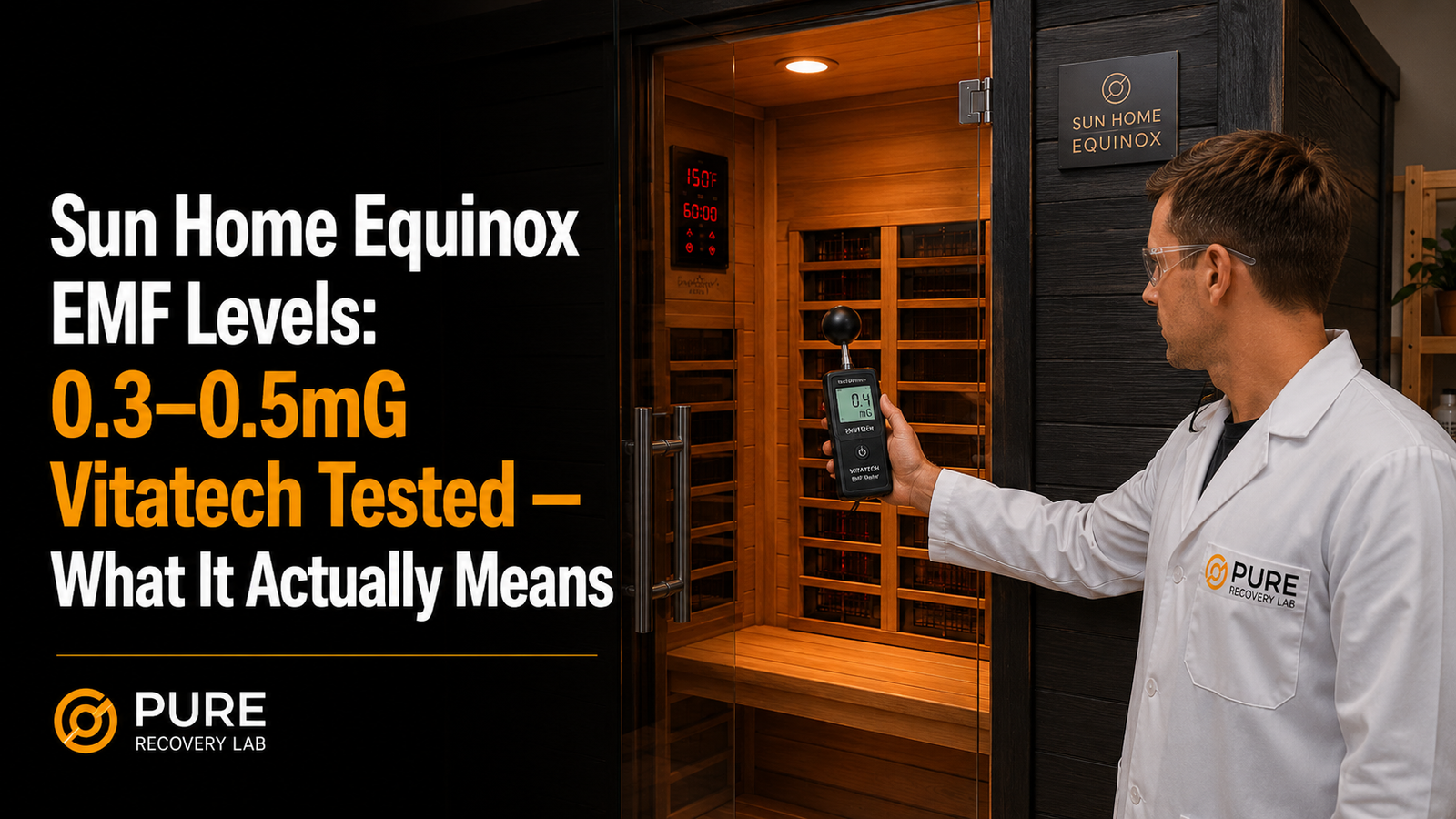
The Sun Home Equinox EMF levels measures 0.3–0.5mG EMF at seated distance, independently tested by Vitatech Electromagnetics in January 2025. This places it in the ultra-low EMF tier — the same category as Clearlight, and well below budget brands like Dynamic (5–10mG) and JNH (<8mG). The ICNIRP international safety guideline references 833mG as a threshold. At 0.5mG, the Equinox runs at 0.06% of that limit. The short answer: yes, it’s safe. The more useful question is whether the EMF data is verified — and in this case, it is.
The Equinox 3-Person model uses the same heater technology and Vitatech-verified EMF shielding — published EMF readings are identical at 0.3–0.5mG. The only difference between the 2P and 3P on EMF is cabin volume, which has no meaningful effect on per-heater emission levels.
EMF: 0.3–0.5mG (Vitatech, Jan 2025)
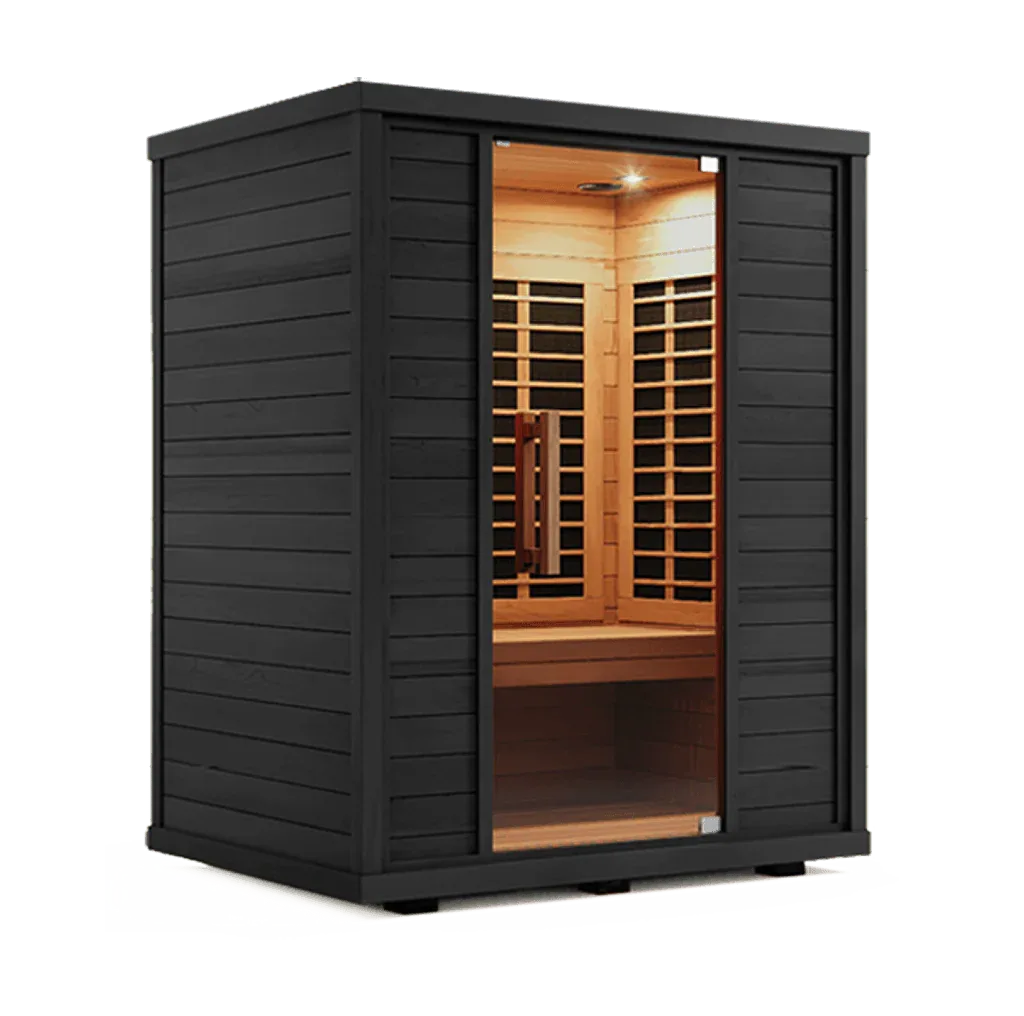
Sun Home Equinox EMF Levels: Where the 0.5mG Number Comes From
Most infrared sauna brands claim “low EMF” without publishing the actual milligauss figure, the name of the testing lab, or the date the test was conducted. Sun Home does all three.
The Equinox EMF data comes from Vitatech Electromagnetics — an independent third-party testing laboratory based in California that specializes in electromagnetic field measurement. Vitatech is not a brand partner or affiliate. They are the same lab used by Clearlight, Sunlighten, and most other premium infrared sauna brands that publish credible EMF data in North America.
The test was conducted in January 2025 — making it the most recent published EMF verification in the category. Finnmark’s data, for comparison, is from December 2019. Testing equipment: professional-grade fluxgate magnetometers. Measurement method: RMS (root mean square). Distances tested: 1 foot from heater panels, 2 feet from heater panels, and typical user seated position. Sun Home publishes full testing methodology on their Safety page. The complete Vitatech RMS test report is publicly available: View Full Vitatech EMF Report (PDF) →
The measurement was taken at seated distance — the position you actually sit during a session, not at the heater panel surface where readings are always lower. This is the figure that reflects real exposure. Full test data: Sun Home Vitatech RMS Report (PDF).
Sun Home Equinox EMF at Three Seated Distances (Vitatech, January 2025)
| Distance from Heater | Magnetic Field Range (mG RMS) | Context |
|---|---|---|
| 1 Foot | 0.6–4.0 mG | Lower than a common kitchen toaster |
| 2 Feet | 0.4–1.8 mG | Near-background levels |
| 3 Feet (Typical Seated Position) | 0.3–0.9 mG | Virtually zero — within normal background range |
Source: Sun Home Saunas Vitatech RMS Seating Distance Summary (PDF). Values measured in milliGauss (mG) RMS. Testing conducted January 2025 by Vitatech Electromagnetics, San Diego, CA using professional-grade fluxgate magnetometers.
The three-distance data reveals an important pattern: EMF drops rapidly as you move away from the heater panels. At 1 foot, readings reach up to 4.0mG — still well within the low-EMF tier. At typical seated distance of 3 feet, the range drops to 0.3–0.9mG — virtually indistinguishable from normal household background EMF levels. This rapid drop-off with distance is why seated-position measurement is the only figure that reflects real user exposure.
EMF Level at Seated Position — Brand Comparison
All readings at seated position. Sources: Dynamic (brand-stated) / JNH (Intertek) / Finnmark (NTS, Dec 2019) / Clearlight (Vitatech, date not published) / Sun Home (Vitatech, Jan 2025).
What These Numbers Actually Mean: International Standards + Real-Life Context
EMF numbers without context are meaningless. Here’s the context that matters:
The international reference standard: The ICNIRP (International Commission on Non-Ionizing Radiation Protection) references 833mG as the threshold for public exposure to power-frequency magnetic fields. This is the figure most governments use as a baseline. No infrared sauna — even the highest-EMF budget models — comes anywhere close to this threshold.
At 0.5mG, the Sun Home Equinox operates at 0.06% of the ICNIRP reference level.
Everyday household comparison:
| Source | EMF at Close Range | vs Sun Home Equinox |
|---|---|---|
| Hair dryer (in use) | 300–700mG | 600–1,400x higher |
| Microwave oven | 100–500mG | 200–1,000x higher |
| Electric shaver | 100–600mG | 200–1,200x higher |
| Laptop computer | 4–20mG | 8–40x higher |
| Finnmark FD-2 | 1.17mG | 2.3x higher |
| Clearlight Sanctuary 2 | <1mG | Similar tier |
| Sun Home Equinox | 0.3–0.5mG | — |
| ICNIRP safety guideline | 833mG | 1,666x higher than Equinox |
Household appliance figures from US EPA published data. Sauna figures from named independent testing sources.
You use a hair dryer for 2 minutes every morning at 300–700mG. You sit in the Equinox for 45 minutes at 0.5mG. If EMF exposure is a genuine health concern for you, the hair dryer warrants more attention than the sauna.
PRL EMF Classification Standards
The infrared sauna industry uses “low EMF” as a marketing term with no standardized definition. Any brand can call their sauna “low EMF” without publishing a single milligauss figure. PRL uses the following classification to make comparisons meaningful:
| PRL Classification | EMF Level | Requirement |
|---|---|---|
| ⭐ Ultra-Low EMF | <1mG | Independent third-party verification required |
| ✅ Low EMF | 1–3mG | Independent third-party verification required |
| ⚠️ Borderline | 3–8mG | Use caution — verify measurement methodology |
| ❌ Not Low EMF | >8mG | Do not use “low EMF” label for marketing purposes |
PRL classification based on industry research literature and independent testing standards. Not an official regulatory framework.
By this standard, the Sun Home Equinox at 0.3–0.5mG qualifies as Ultra-Low EMF — the highest tier, alongside Clearlight. Dynamic and JNH, despite their “low EMF” marketing, fall in the Borderline and Not Low EMF categories respectively.
Why “Seated Distance” Is the Only Number That Matters
EMF drops rapidly with distance — this is basic physics. A reading taken directly at the heater panel surface will always look better than a reading taken where you actually sit. The difference can be significant: a sauna that measures 0.5mG at the panel might measure 3–5mG at 2–3 inches from the panel surface.
When a brand publishes EMF data without specifying the measurement distance, that’s a red flag. Sun Home specifies “seated distance” — the measurement position that reflects real-world exposure during a session.
This is why comparing EMF figures across brands requires knowing the measurement methodology. A brand claiming “0.1mG” measured at the heater panel is not comparable to Sun Home’s “0.5mG” measured at seated distance. The Sun Home figure may actually represent lower real-world exposure.
What Real Owners Say About EMF
Verified Sun Home owner reviews consistently highlight the heat intensity and session quality. EMF is rarely mentioned specifically by owners — which is itself a signal: when EMF is genuinely problematic, owners notice and complain. Sun Home reviews don’t show this pattern.
“Cannot believe that we were suckered into a low-temperature infrared sauna before this. After only a few weeks, my body has never felt this good after sauna sessions.”
— Verified buyer, Sun Home direct
“My local health spa is going to be upset because I’m never going back to use their sauna!”
— Verified buyer, Sun Home direct
Pro Tip: If you want to verify EMF levels yourself after purchase, the Trifield TF2 meter (~$180 on Amazon) is the instrument most independent sauna reviewers use. Measure at seated position — approximately 18–24 inches from the nearest heater panel — for a reading comparable to Vitatech’s published data.
Who Should Prioritize EMF
EMF-sensitive individuals. If you experience symptoms you associate with electromagnetic field exposure — headaches, fatigue, or sleep disruption — verified ultra-low EMF is worth paying for. The gap between Dynamic’s 5–10mG and Sun Home’s 0.5mG is real and meaningful in this context.
Long-session, high-frequency users. Daily 45-minute sessions represent significantly more cumulative exposure than occasional use. If you’re planning daily use for years, the difference between 0.5mG and 5mG compounds over time.
Parents buying for family use. Children’s tissues are more sensitive to electromagnetic fields than adults. Families who plan shared use have additional reason to prioritize verified low-EMF units.
Who Doesn’t Need to Make EMF the Primary Factor
Occasional users. If you’re planning 1–2 sessions per week, the EMF difference between budget and premium brands has minimal practical impact. Spend the budget difference on a model that fits your space and electrical setup instead.
Budget-first buyers. The jump from Dynamic (~$2,000, 5–10mG) to Sun Home Equinox ($6,099, 0.5mG) is $4,000. If EMF is your only reason for the upgrade, that’s a high price for a 10–20x EMF reduction that falls well within safe levels either way.
Buyers whose primary concern is temperature. The Equinox’s strongest differentiator isn’t EMF — it’s 165°F verified temperature on a full-spectrum system. If heat performance matters more than EMF precision, prioritize the temperature and wattage specs over the EMF figures.
The Sun Home Equinox’s 0.3–0.5mG EMF reading is independently verified by Vitatech Electromagnetics (January 2025) — the most current named third-party EMF data in the consumer infrared sauna category. It qualifies as Ultra-Low EMF by any reasonable industry standard, running at 0.06% of the ICNIRP international safety guideline. For buyers who want the strongest available combination of verified low EMF, full-spectrum heat, and recent independent testing, the Equinox is the strongest evidence package under $7,000.
Check Price — Equinox 2P →
Check Price — Equinox 3P →
Read Full Review →
Frequently Asked Questions
What is the Sun Home Equinox EMF level?
0.3–0.5mG at seated distance, independently tested by Vitatech Electromagnetics in January 2025. This is the most current published independent EMF measurement in the consumer infrared sauna category. The reading places the Equinox in the ultra-low EMF tier alongside Clearlight, and 10–20x lower than budget brands like Dynamic and JNH.
Is 0.5mG EMF safe?
Yes. The ICNIRP international safety guideline references 833mG as the threshold for public exposure. At 0.5mG, the Equinox operates at 0.06% of that limit. For context, a standard hair dryer produces 300–700mG — 600 to 1,400 times higher than the Equinox at your seated position.
How does Sun Home Equinox EMF compare to Clearlight?
Both are in the ultra-low EMF tier with Vitatech independent verification. Clearlight measures under 1mG (Vitatech, date not published). Sun Home measures 0.3–0.5mG (Vitatech, January 2025). The practical difference between these figures is negligible — both are well within safe exposure levels. Sun Home’s data is more recent; Clearlight offers a lifetime warranty that Sun Home doesn’t match.
What is “seated distance” EMF testing?
Seated distance refers to the measurement position that reflects where you actually sit during a session — typically 18–24 inches from the nearest heater panel. EMF drops rapidly with distance, so a measurement taken at the heater panel surface will always appear lower than one taken at seated distance. Reputable brands like Sun Home publish the seated-distance figure. When a brand only lists EMF without specifying measurement distance, ask before you buy.
Does Sun Home publish the Vitatech EMF test report?
Sun Home references Vitatech testing in their product materials but does not publish the full raw report publicly. You can request the report details directly from Sun Home customer service before purchase. The January 2025 test date and 0.3–0.5mG reading are the figures Sun Home has made available for independent verification.
Which infrared sauna has the lowest EMF?
Based on published independent testing, Sun Home Equinox (0.3–0.5mG, Vitatech 2025) and Clearlight (<1mG, Vitatech) have the lowest independently verified EMF readings in the consumer infrared sauna category. Sun Home has the most recent test data. SaunaSpace uses a different technology (incandescent bulbs rather than carbon panels) and claims lower EMF, but uses a different measurement methodology that is not directly comparable.
- Sun Home Equinox Full Review — complete specs, real cost breakdown, and who should buy
- Sun Home Equinox 2-Person Deep Dive — detailed review of the 2-person model specifically
- Sun Home Equinox Heat-Up Time — 10 min or 45 min? what controls warm-up speed
- Sun Home Equinox Maximum Temperature — 165°F verified by GGR, what it means in practice
- Sun Home Equinox Price Breakdown — full cost including 20A electrical installation, HSA/FSA eligibility
- Infrared Sauna EMF Explained — complete guide to understanding mG numbers before you buy
- Best Low-EMF Infrared Saunas — how Sun Home ranks against all verified low-EMF options
- Clearlight Sanctuary Review — the closest competitor on EMF verification