EMF is one of the most polarizing topics in the infrared sauna market.
On one side, you have brands charging thousands of dollars for “near-zero EMF” saunas and implying that anything less is dangerous. On the other, you have dismissive content saying EMF doesn’t matter at all and buyers are being manipulated.
Neither position is accurate. And both cost buyers money — either through unnecessary fear-driven upgrades, or through ignoring a factor that is genuinely worth understanding.
The problem isn’t EMF itself — it’s how brands use it to sell you the wrong upgrades.
This guide gives you the actual numbers, the actual science, and a practical framework for deciding how much EMF should factor into your purchase decision.
What EMF Actually Is — and What Type Saunas Produce
EMF stands for electromagnetic field. It is a form of energy produced by electrically charged particles, and it exists everywhere — from the Earth’s own magnetic field to the wiring in your home.
Not all EMF is the same. The spectrum spans from extremely low frequency (ELF) fields produced by power lines and appliances, all the way up to X-rays and gamma rays at the high-energy end. These are fundamentally different types of radiation with very different biological effects.
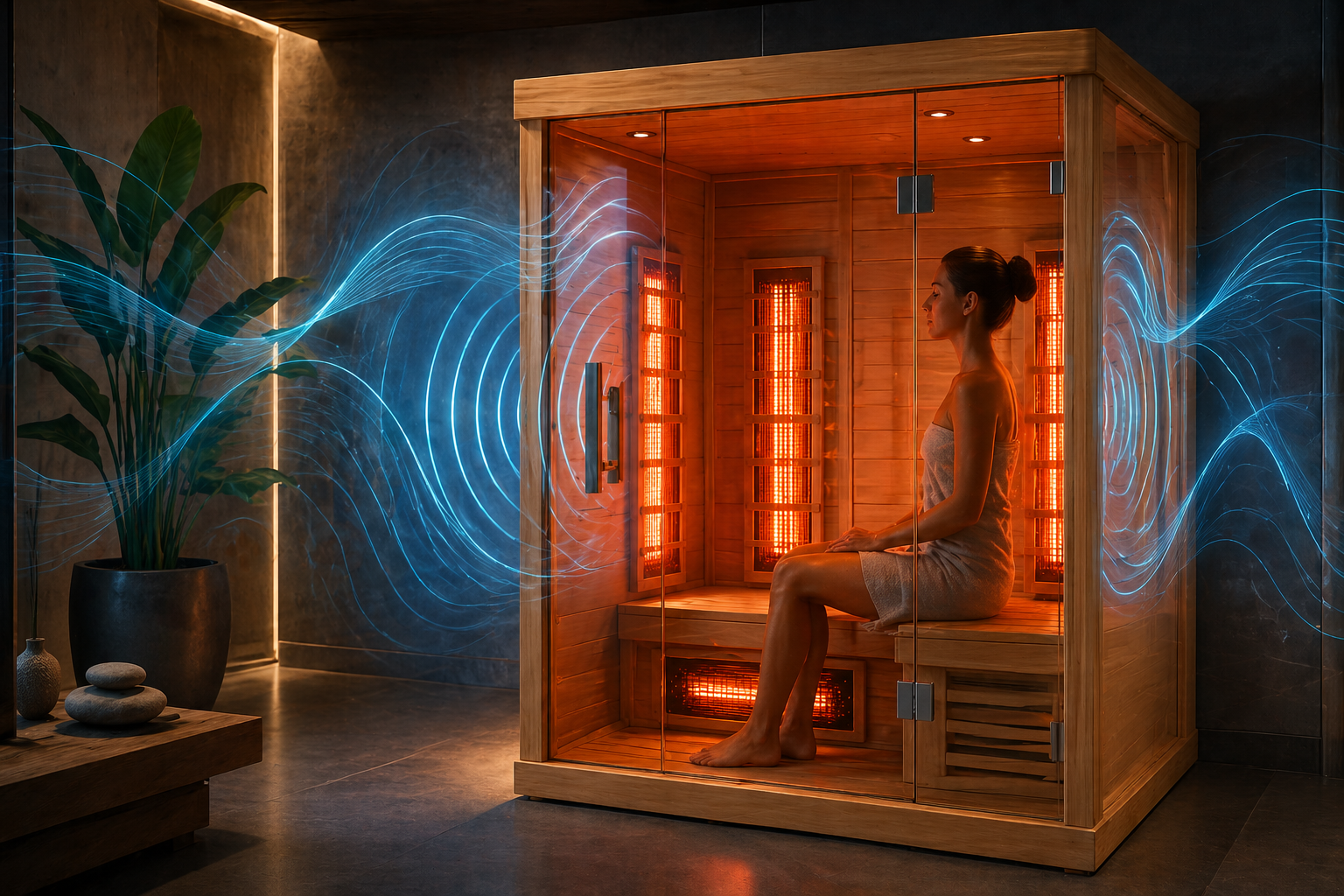
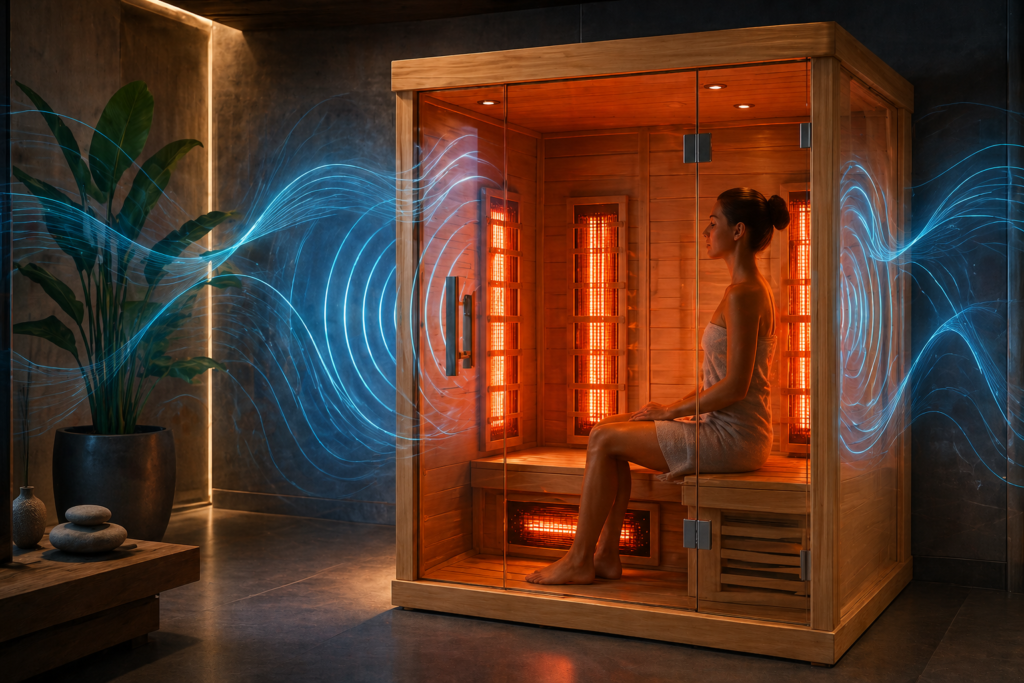
Infrared saunas produce ELF-EMF — extremely low frequency electromagnetic fields — generated by the AC electrical current running through their heating elements and wiring. This is the same category of EMF produced by your refrigerator, electric blanket, and hair dryer.
This distinction matters because much of the fear around EMF conflates very different types. Ionizing radiation (X-rays, gamma rays) carries enough energy to break chemical bonds and damage DNA. Non-ionizing radiation — which includes ELF-EMF, radio waves, visible light, and infrared — does not carry enough energy to ionize atoms or break molecular bonds. Infrared sauna EMF is firmly in the non-ionizing category.
Key distinction: The EMF from an infrared sauna is ELF (extremely low frequency), the same category as the field from your kitchen appliances. It is non-ionizing radiation — it cannot break chemical bonds or damage DNA through direct ionization. This is physically different from X-rays or UV light, despite the shared word “radiation.”
EMF strength is measured in milligauss (mG) for magnetic fields and volts per meter (V/m) for electric fields. In the sauna context, the magnetic field measurement (milligauss) is the figure most commonly cited by manufacturers and most relevant to the discussion.
The Real Numbers: What Infrared Saunas Actually Emit
Before evaluating whether sauna EMF is a concern, you need actual reference points — both for what saunas produce and what international bodies consider safe.
International safety guidelines
Two major international bodies publish guidelines for ELF-EMF exposure:
- ICNIRP (International Commission on Non-Ionizing Radiation Protection), recognized by the WHO: general public reference level of 100 microteslas (µT), equivalent to 1,000 mG, at 50–60Hz
- IEEE (Institute of Electrical and Electronics Engineers): similar reference levels for the general public
The WHO’s position, based on its 2007 Environmental Health Criteria monograph on ELF fields and subsequent reviews, is that exposures below ICNIRP reference levels do not appear to have any known consequence on health.
What 1,000 mG means in context: The ICNIRP general public reference level is 1,000 milligauss. A well-designed infrared sauna at the seating position typically reads 1–10 mG. That’s 1% of the reference level at most — and often much less.
What infrared saunas actually produce
EMF measurements in infrared saunas vary significantly depending on two factors: the type of heating element and where the measurement is taken.
| Measurement point | Typical range | Why it matters |
|---|---|---|
| At the heater panel surface | 20–100+ mG | Not relevant — no one touches the panel |
| At seating position (6–12 inches from panels) | 1–15 mG depending on design | This is your actual exposure during use |
| Low-EMF / ultra-low-EMF designs | Under 3 mG at seating | Achieved through shielding and panel design |
| Premium “near-zero” designs | Under 1 mG at seating | Best available; verified by third-party testing |
For context, here are the typical EMF readings of common household devices at typical use distances:
| Device | Typical EMF at use distance |
|---|---|
| Hair dryer (in use) | 60–20,000 mG at 1 inch |
| Microwave (at 1 foot) | 100–500 mG |
| Electric blanket (in contact) | 5–100 mG |
| Laptop computer (on lap) | 1–25 mG |
| Infrared sauna (at seating position, standard design) | 3–15 mG |
| Infrared sauna (at seating position, low-EMF design) | Under 3 mG |
| Background level in typical home | 0.5–4 mG |
This is why “full spectrum” saunas or ceramic-element units without EMF shielding often measure higher — and why seating-position measurement is the only number that matters for your actual exposure.
The Five Biggest EMF Myths in the Sauna Market
The sauna industry has produced a remarkable amount of misleading content on EMF — from both directions. Here are the most common claims, and what the evidence actually shows.
Myth 1: “Infrared sauna EMF is dangerous and linked to cancer”
❌ The Claim
Some brands and content sites suggest that the EMF from infrared saunas poses a meaningful cancer risk, citing studies on ELF-EMF and childhood leukemia or other conditions.
✅ What the Evidence Shows
The WHO, ICNIRP, National Cancer Institute, and National Institute of Environmental Health Sciences all conclude that evidence for a causal link between low-level ELF-EMF exposure (at the levels produced by household devices and saunas) and cancer is not established. The studies on childhood leukemia and ELF-EMF typically involve exposure to fields near power lines — levels dramatically higher than any home sauna. The NCI’s 2024 review of ELF-EMF states that the evidence does not support a causal relationship. Infrared sauna EMF at seating distance is well below the thresholds studied for any potential health effects.
Myth 2: “If it’s certified (ETL/UL), the EMF is safe”
❌ The Claim
Safety certifications like ETL, UL, and CSA prove that a sauna’s EMF levels are acceptable.
✅ What the Evidence Shows
This is one of the most important things to understand: electrical safety certifications test for shock hazards and fire safety — not EMF emissions. A sauna can be fully ETL- or UL-certified and still have high EMF readings at the seating position. These are entirely separate standards. If EMF matters to you, you need separate EMF testing documentation, ideally from an independent third-party lab.
Myth 3: “Low EMF, ultra-low EMF, and near-zero EMF are standardized terms”
❌ The Claim
When a brand says “low EMF” or “ultra-low EMF,” it means the sauna meets a defined standard.
✅ What the Evidence Shows
None of these terms are regulated or standardized. Any manufacturer can use them without independent verification. “Low EMF” from one brand might mean 8 mG at seating; from another it might mean 2 mG. “Near-zero” is a marketing term, not a technical specification. The only meaningful information is the actual milligauss reading at the seating position, from a third-party test. Labels without numbers are not evidence.
Myth 4: “Carbon panels always have lower EMF than ceramic heaters”
❌ The Claim
Carbon fiber panels are inherently lower-EMF than ceramic tube heaters, so choosing carbon panels means lower EMF.
✅ What the Evidence Shows
Heater type is a factor, but it is not the determining factor. EMF levels at the seating position are primarily determined by the shielding design, wiring layout, and distance from the heater — not the element material alone. A carbon panel sauna without EMF shielding can produce higher seating-position readings than a well-shielded ceramic unit. The heater type tells you about heat distribution and efficiency; it does not guarantee a specific EMF outcome. Only testing reveals actual levels.
To understand how heater type affects heating performance — not just EMF — see our full infrared sauna science guide, which covers carbon vs ceramic element differences in depth.
Myth 5: “You should ignore EMF entirely — it’s just a marketing tactic”
❌ The Claim
EMF concern is manufactured by brands to charge more. It is not a real issue and should be dismissed.
✅ What the Evidence Shows
This overcorrection is also inaccurate. EMF is a legitimate engineering consideration, particularly for a device used in close body proximity for 30–45 minutes at a time, multiple times per week. While current evidence does not establish harm at typical sauna EMF levels, the precautionary principle is reasonable, especially given that reducing EMF through better shielding design is achievable and increasingly common. Dismissing EMF entirely is as misleading as fearmongering about it.
Why EMF Is Worth Considering in a Sauna — Even If It’s Not Dangerous
The reason EMF deserves attention in a sauna context — even if the absolute risk is low — comes down to exposure characteristics that differ from most other devices.
Most high-EMF devices in your life involve brief exposure at distance. A microwave runs for two minutes while you stand a foot away. A hair dryer operates for five minutes. Your phone, while close, emits RF-EMF rather than ELF-EMF.
An infrared sauna session involves 30–45 minutes of close, full-body proximity to the heating panels — often just 6–12 inches away — with the goal of achieving a sustained thermal response. The combination of duration and proximity is different from most household EMF exposure scenarios.
This does not mean sauna EMF is dangerous. The numbers make clear it is well within international safety guidelines. But it does mean that if you are going to use a sauna regularly over years, understanding and minimizing EMF exposure is a reasonable preference — not paranoia.
The relevant question is not “Is this dangerous?” — current evidence says no, at these levels. The relevant question is “Given that I’m choosing between products anyway, is it worth choosing one with better EMF design?” In most cases, yes — especially since the gap between standard and low-EMF designs is not always a significant price difference.
→ See our top-rated infrared saunas for 2026 · How infrared saunas actually work: the full science guide
How to Actually Evaluate a Brand’s EMF Claims
Given that EMF terminology is unregulated and self-reported figures are unreliable, here is a practical framework for evaluating any sauna’s EMF performance.
Step 1: Ask for the seating-position measurement, not the panel measurement
Many brands report EMF readings taken directly at the heater surface. These numbers are meaningless for your actual exposure. The only measurement that matters is the reading taken at the seated user position — typically 6 to 12 inches from the panels. Always ask specifically for this figure.
Step 2: Require third-party test documentation
Manufacturer self-reported EMF numbers are not verifiable. Look for test reports from independent third-party labs — not internal testing conducted by the brand itself. Reputable brands at the premium end of the market publish these reports; if a brand cannot or will not provide them, that is informative.
Step 3: Check whether multiple measurement points are included
EMF is not uniform throughout a sauna cabin. A single measurement taken at one point near the back panel does not capture the reading near the side panels, under-bench heaters, or near the control panel. A credible report includes readings at multiple points within the cabin.
Step 4: Compare the actual mG number against reference levels
Once you have a seating-position figure, you can evaluate it:
| Reading at seating position | Assessment |
|---|---|
| Under 1 mG | Near-zero — best available design; comparable to background home levels |
| 1–3 mG | Low EMF — well-designed; significantly below safety thresholds |
| 3–10 mG | Standard — within safety limits but not optimized for EMF reduction |
| Above 10 mG | Higher exposure — still well below ICNIRP limits, but worth questioning design quality |
| ICNIRP general public limit | 1,000 mG — the regulatory threshold; typical saunas are 1–2% of this |
Step 5: Recognize that “zero EMF” is physically impossible
Any device that uses electricity generates some electromagnetic field. “Zero EMF” claims are physically impossible and should be treated as a red flag for credibility, not a positive feature. The realistic goal is minimization — getting seating-position readings as low as the design allows, ideally under 3 mG.
Watch for this specific tactic: Some brands measure and report EMF in volts per meter (V/m) for electric fields rather than milligauss for magnetic fields, because the numbers appear smaller and sound better. Both measurements are valid, but comparing V/m to mG figures across brands is meaningless. Make sure you are comparing the same measurement type and the same measurement distance.
How Much Should EMF Factor Into Your Purchase Decision?
After reading the science, the honest answer is: it depends on your priorities, and it should not be the only factor — but it should not be ignored either.
If you are choosing between two otherwise equal saunas
Choose the one with verified lower EMF at the seating position. The difference in engineering quality that produces lower EMF often correlates with other quality indicators — better shielding, more careful wiring design, and higher manufacturing standards overall.
If a “low EMF” model costs significantly more
Evaluate what you are actually getting. If the price premium is for a credible third-party verified reading under 3 mG versus an unverified “low EMF” claim, it may be worth it. If the premium is purely for marketing language without verifiable documentation, it is not.
If you are considering a budget sauna with no EMF data
This is where the concern is most legitimate. Budget saunas often skip EMF shielding entirely, have higher seating-position readings, and provide no documentation. While the absolute risk at any of these levels is not established, the lack of transparency is itself a quality signal worth considering.
What actually matters more than EMF alone
EMF is one of several engineering quality indicators. Before making it the primary factor, make sure the sauna also delivers on:
- Sufficient power-to-cabin-volume ratio for effective heating
- Heater panel placement that provides full-body coverage
- Cabin construction quality and seal integrity for heat retention
- Low-VOC wood and adhesives that do not off-gas at operating temperatures
A sauna with near-zero EMF that cannot heat your body effectively has not made a good trade. EMF optimization should come alongside — not instead of — performance fundamentals. For a full breakdown of what actually determines heating performance, see our infrared sauna science guide.
The EMF Buyer’s Checklist (Before You Buy)
- Ask for seating-position EMF readings — not panel-surface readings
- Request third-party lab documentation — not manufacturer self-reports
- Confirm multiple cabin measurement points are included in the test report
- Treat “low EMF / ultra-low EMF / near-zero EMF” labels as unverified until backed by specific mG numbers
- Understand that ETL/UL/CSA certifications do not address EMF — they cover electrical and fire safety only
- Compare milligauss to milligauss at the same measurement distance — do not mix units or distances across brands
- Do not let EMF be the only factor — evaluate heating performance, construction, and value as a complete package. See our ranked comparison of top infrared saunas for how these factors play out across real products.
Before you buy — check this first
Infrared sauna EMF is real, measurable, and worth understanding — but it is not the crisis some brands suggest, nor is it something to dismiss entirely. At typical seating-position levels, well-designed saunas produce EMF readings that are a fraction of international safety thresholds. The bigger issue is not the physics — it’s the lack of standardization in how brands measure and report these figures.
The buyers who get this right are the ones who ask for specific numbers, from independent sources, at the right measurement distance — and who evaluate EMF alongside performance, not instead of it.
→ See our top-rated infrared saunas for 2026 · How infrared saunas work: the complete science guide
About Pure Recovery Lab
Pure Recovery Lab focuses on breaking down real performance factors behind recovery equipment — especially what most brands don’t explain clearly.
Transparency
This article may contain affiliate links. We may earn a commission at no extra cost to you.