
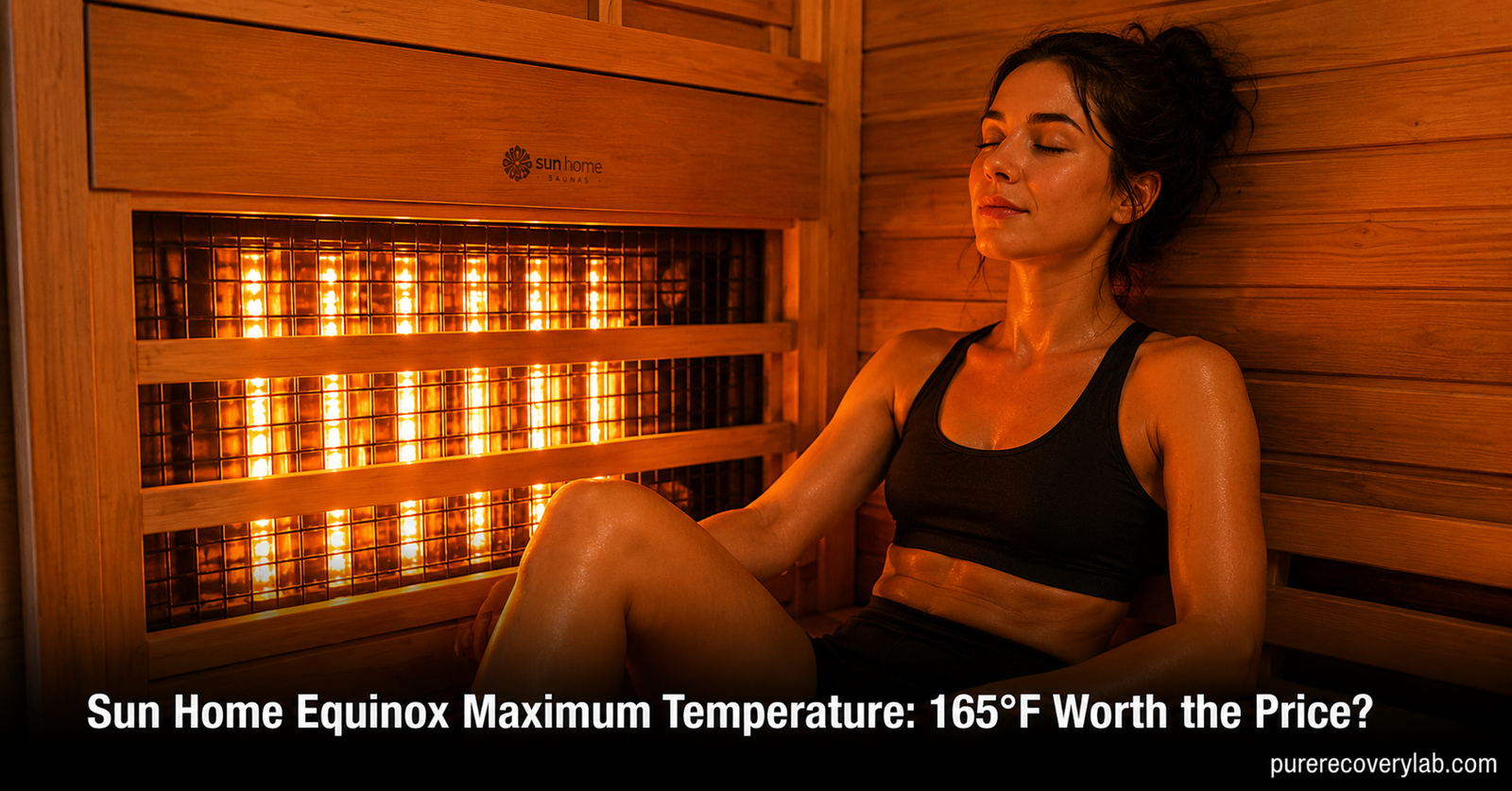
The Sun Home Equinox maxes out at 155°F / 68°C, per Sun Home’s current official specs (updated August 2026). That’s 5–20°F hotter than most infrared competitors, depending on which one you’re comparing it to. Most users run it at 130–150°F. Earlier units were independently verified by Garage Gym Reviews at 165°F — Sun Home has since revised the published spec downward. Whether the ceiling matters to you depends on why you’re buying.
Check Current Equinox Pricing →
When we first published this article, Sun Home’s Equinox was rated at 165°F and independently verified at that ceiling by Garage Gym Reviews. Sun Home’s current product page now lists the Equinox 2-Person and 3-Person at 155°F. We don’t know why the published max changed — it may reflect a running production change, a more conservative safety rating, or something else Sun Home hasn’t explained publicly. We’re updating this page to reflect the number Sun Home currently publishes, and flagging the change rather than quietly editing it away.
“I specifically wanted something hotter than my old sauna. Hit 165°F on day three. Most sessions I run it at 145°F — that’s plenty.” — Reddit r/Sauna, 2025 (unit predates Sun Home’s spec revision)
Sun Home used to call it “the only infrared sauna on the planet that reaches 165°F.” That claim doesn’t match the brand’s current published spec.
GGR tested an Equinox unit and got 165°F at the time. Sun Home’s own page now says 155°F.
But the temperature number alone doesn’t tell you much. Here’s what actually matters for your buying decision.
How It Compares to Every Major Competitor
| Sauna | Max Temp | Verified? |
|---|---|---|
| Sun Home Equinox | 155°F / 68°C | Brand-stated (Aug 2026); earlier units GGR-verified at 165°F |
| Sunlighten Amplify | 165°F / 74°C | Partial |
| Clearlight Sanctuary | 150°F / 65°C | Brand-stated |
| JNH Lifestyles Joyous | 140°F / 60°C | Brand-stated |
| Dynamic Barcelona | 135°F / 57°C | Brand-stated |
| Traditional Finnish sauna | 175–210°F / 80–99°C | Standard range |
At its current published spec, the Equinox no longer has the highest ceiling in this comparison — Sunlighten Amplify’s 165°F now tops it. The gap between Equinox and other infrared competitors ranges from about 5°F (Clearlight) to 20°F (Dynamic Barcelona), narrower than it was at 165°F.
Sun Home Equinox — Key Specs
Max: 155°F / 68°C
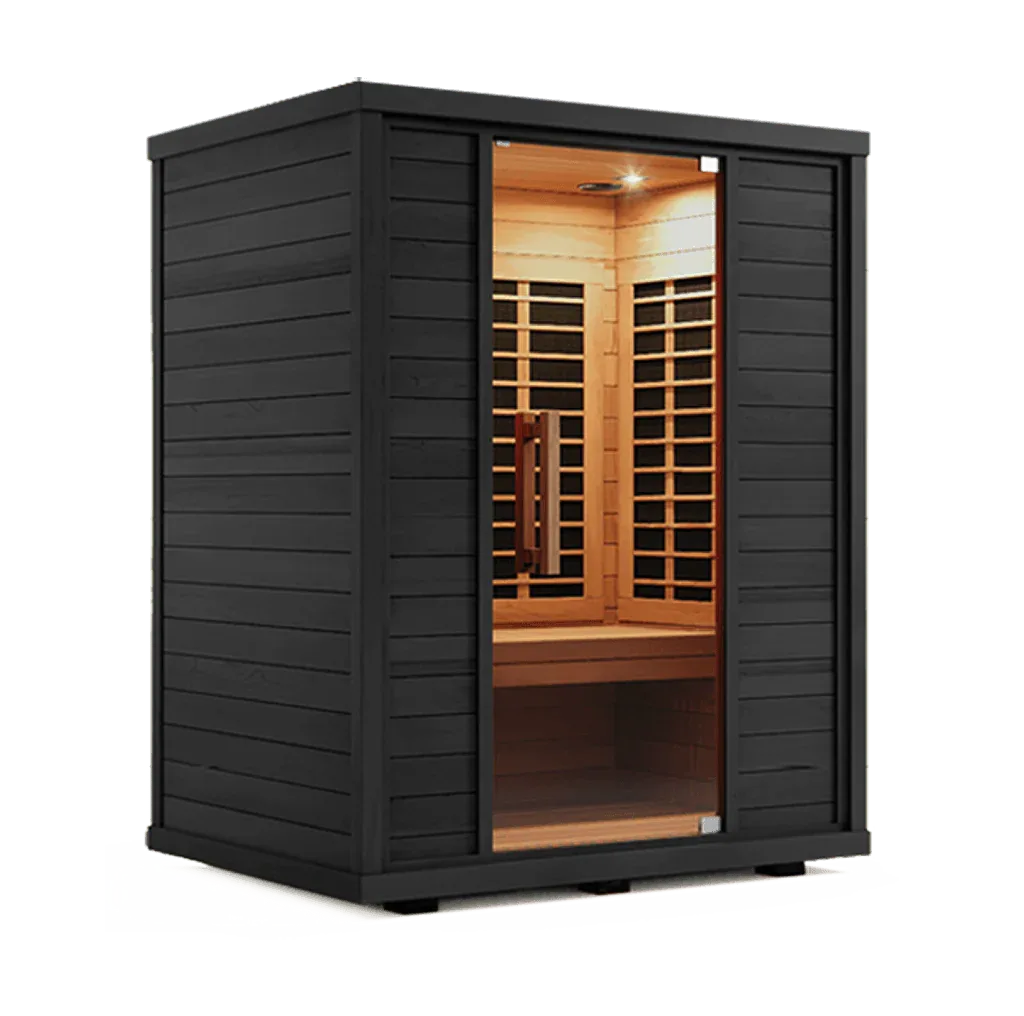
155°F is Sun Home’s current published ceiling, down from the 165°F GGR independently verified in an earlier unit. For high-heat users, it’s still a real advantage over most far-infrared competitors — just a smaller one than it used to be. For buyers running sessions at 130–145°F, the exact ceiling is mostly irrelevant either way — but headroom above your typical session temperature still means the heaters run at partial load, producing more stable heat.
Sun Home hasn’t publicly explained why the published max dropped from 165°F to 155°F. Reaching the ceiling — whichever number is current — also requires a warm room; in a cold garage in winter, you may fall short, and it’s worth reading our guide to infrared saunas not getting hot enough before you assume something’s broken. Sun Home doesn’t publish a heat-up time to maximum under standard conditions — in a 70°F room, expect 45–60 minutes to approach the ceiling. For typical session temperatures of 130–145°F, heat-up is significantly faster. Want the full picture? See our Sun Home Equinox Heat-Up Time breakdown.
| Max Temperature | 155°F / 68°C (Aug 2026 spec) |
| Typical Session Range | 130–150°F / 54–65°C |
| Heater Type | True Wave™ Full-Spectrum |
| EMF (seated) | <0.5 mG |
| Electrical | 120V / 20A dedicated (NEMA 5-20P) |
| Wood | Eucalyptus |
| Certifications | ETL, ETL-C, RoHS, Intertek |
| Warranty | 7yr cabinetry + heaters |
| Assembly | Magne-Seal™ tool-free, 30–60 min |
Do You Actually Need 155°F?
Honest answer: probably not — at least not at first.
Clinical research on infrared sauna benefits — cardiovascular, pain relief, recovery — consistently uses session temperatures of 130–150°F / 54–65°C. (Laukkanen et al., 2018, Mayo Clinic Proceedings). Cardiovascular benefits, pain relief, recovery — all documented at temperatures at or below the Equinox’s current ceiling.
The higher ceiling still matters for two reasons:
- Headroom means stability. A sauna that maxes at 135°F has to run near full load to produce 130°F. The Equinox runs its heaters at partial load during typical sessions — the heat feels more consistent, less like the unit is struggling.
- Adaptation happens. Most users who start at 130°F are pushing 145–150°F within a few months. Having room to grow is genuinely useful over a 5–10 year ownership window — though with a 155°F ceiling, that room is narrower than it used to be.
Who benefits from a higher ceiling: traditional sauna users who find typical infrared underwhelming; athletes wanting high-intensity short sessions; users who have adapted and want to push harder.
Who doesn’t need it: first-time infrared users; relaxation-focused users; anyone heat-sensitive.
Coming From a Traditional Sauna? Read This.
If you’re used to a 190°F gym sauna, your first infrared session at 150°F will feel underwhelming.
That’s normal — and temporary.
Infrared heat works differently. It penetrates tissue rather than heating the surrounding air. By week three of regular use, most traditional sauna converts describe infrared at 145–150°F as feeling more intense than their old 190°F gym sauna did.
At 155°F, the Equinox still closes that gap faster than most far-infrared competitors — just not by as much as it did at its previous 165°F rating.
Sun Home has claimed the Equinox produces “60% deeper sweat” versus competitors. This comes from brand materials, not peer-reviewed research. No independent study has quantified sweat depth differences between full-spectrum and far-infrared saunas at equivalent temperatures. Treat this claim as marketing, separate from the temperature spec itself.
Our Electricity Calculator gives you a real number before you commit.
Sun Home’s Equinox is currently published at 155°F, down from the 165°F Garage Gym Reviews verified in an earlier unit. Most users won’t live at that temperature either way — but the headroom above typical session ranges still makes sessions feel more stable. If you’re coming from a traditional sauna or want room to grow, it’s still a real advantage over most far-infrared competitors, just a narrower one than before.
Read Our Full Equinox Review + Current Pricing →
Frequently Asked Questions
What is the maximum temperature of the Sun Home Equinox?
155°F / 68°C, per Sun Home’s current product page (August 2026). Garage Gym Reviews independently verified an earlier unit at 165°F; Sun Home’s published spec has since been revised down.
Is 155°F hot enough compared to a traditional sauna?
Traditional Finnish saunas run at 175–210°F / 80–99°C — still hotter. But the comparison isn’t straightforward. Infrared heat penetrates differently, and most users adapting from traditional saunas report that infrared at 145–150°F feels comparable in intensity after a few weeks of regular use.
How does the Equinox temperature compare to Clearlight?
Clearlight Sanctuary maxes at 150°F — only a 5°F gap below the Equinox’s current 155°F rating. That’s a much smaller difference than the 15°F gap that existed when Equinox was rated at 165°F. For standard 130–145°F sessions, the difference is negligible in daily use. See our full Sun Home vs Clearlight breakdown for how the two brands compare beyond just temperature.
Why did the Equinox’s published max temperature change?
Sun Home hasn’t publicly explained the change. Garage Gym Reviews independently verified 165°F in an earlier test unit; Sun Home’s product page now lists 155°F for both the 2-Person and 3-Person Equinox. This could reflect a production change, a more conservative rating, or something else — we don’t know, and we’re not going to guess on Sun Home’s behalf.
Will it reach its maximum temperature in a cold garage?
Not reliably. Ambient room temperature significantly affects maximum achievable temperature. In a well-insulated indoor room, the published ceiling is realistic. In an unheated garage in winter, expect to fall noticeably short. Sun Home recommends installation in a conditioned indoor space.
Does higher temperature mean better health benefits?
Not proportionally. Clinical research on infrared sauna benefits — cardiovascular, pain relief, recovery — uses sessions at 130–150°F. There’s no strong evidence that a higher ceiling produces significantly greater benefits once you’re above that range. Higher temperatures do allow shorter sessions to achieve equivalent core temperature rise, which some users prefer.
Related Reading
- Sun Home Equinox Full Review — complete analysis beyond just temperature
- Sun Home Equinox EMF Levels — what <0.5 mG actually means
- Sun Home Equinox Heat-Up Time — how long before you’re sweating
- Sun Home vs Clearlight — full head-to-head including temperature
- Infrared Sauna Not Getting Hot Enough? — troubleshooting guide
- Best Infrared Saunas 2026 — how Equinox ranks across all categories