
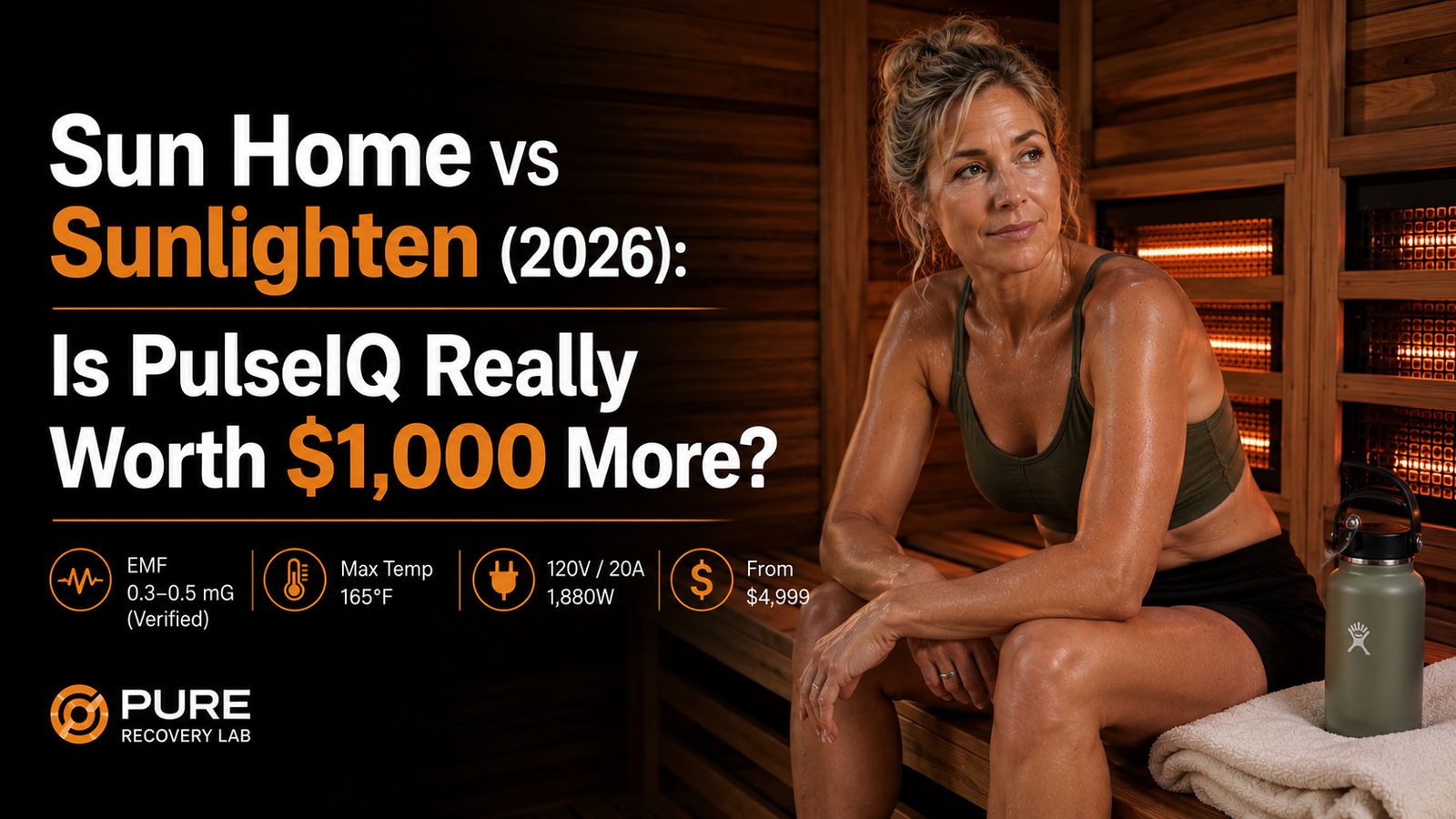
Both Sun Home and Sunlighten make full-spectrum infrared saunas from eucalyptus wood with low-EMF designs. On paper they look like direct competitors — see our full Sun Home Equinox review if you want the complete breakdown on that side. In practice, the Sun Home vs Sunlighten difference that matters most isn’t the technology — it’s the price transparency and what you’re actually paying for.
Sun Home lists its prices publicly — currently $6,099 for the 2-person Equinox (sale pricing varies). Sunlighten doesn’t — you call, get a quote, and the price varies. That single fact shapes the entire buying experience, and it’s worth understanding before you go further.
For most buyers comparing these two: Sun Home Equinox at $6,099 delivers verified full-spectrum infrared, independently tested at 0.3–0.5 mG EMF, with a 7-year warranty and public pricing. Sunlighten mPulse Believe costs approximately $7,000+ (by quote), adds a touchscreen tablet, app control, and smart presets, with EMF under 3 mG by brand claim. Choose Sun Home if transparent pricing and verified EMF data matter. Choose Sunlighten if smart technology features and clinical research backing justify the premium.
How They Compare: Sun Home Equinox vs Sunlighten mPulse Believe
Here’s the full Sun Home vs Sunlighten breakdown, spec by spec.
| Factor | Sun Home Equinox 2P | Sunlighten mPulse Believe 2P |
|---|---|---|
| Price | $6,099 (public, sale pricing may vary) | ~$7,000+ (by quote only) |
| Infrared type | Full-spectrum NIR + MIR + FIR | Full-spectrum NIR + MIR + FIR |
| Heater technology | 500W carbon heaters | SoloCarbon FIR + NIR LED panels |
| Max temperature | 165°F / 74°C | ~150°F / 66°C |
| Wattage | 1,880W | 2,400W |
| Electrical | 120V / 20A dedicated circuit | 120V / 20A dedicated circuit |
| EMF (seated) | 0.3–0.5 mG (Vitatech independent) | <3 mG (brand claim); 0.5–2.0 mG (third-party) |
| Wood | Kiln-dried eucalyptus | Kiln-dried eucalyptus |
| Controls | Digital touch panel | Tablet touchscreen + smartphone app |
| Smart presets | No | Yes — Cardio, Detox, Pain Relief, Relaxation, Weight Loss, Anti-Aging |
| Audio | Bluetooth speaker | Blaupunkt sound system |
| Assembly | Tool-free Magne-Seal | Tool-free Magne-Seal |
| Warranty | 7 years (heaters + cabinetry) | 7 years (heaters + cabinetry) |
| Clinical studies | Not cited | 37 third-party clinical studies |
| Made in | USA | USA (Kansas) |
Public Pricing / No Quote Required
The Technology Difference: Similar but Not Identical
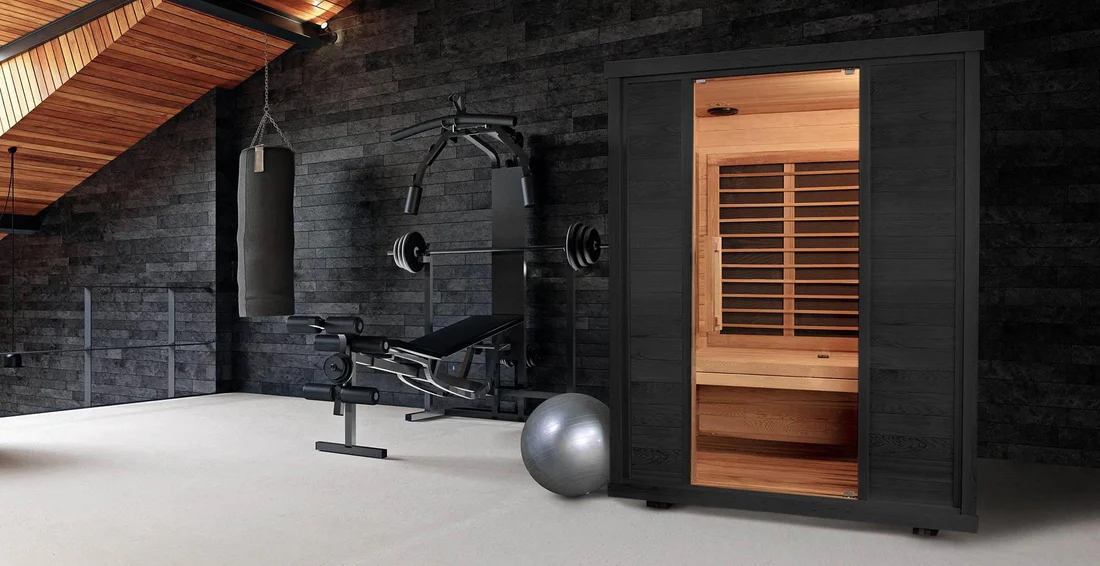
Both saunas deliver full-spectrum infrared — near, mid, and far — but through different heater designs. Sun Home uses high-wattage carbon heaters that produce full-spectrum output. Sunlighten uses SoloCarbon far-infrared panels combined with separate NIR LED panels — a more targeted approach where each wavelength has its own dedicated source.
The max temperature difference is real but often misunderstood. At 150°F, most casual users are already sweating hard and ready to get out. The Equinox’s 165°F ceiling mostly matters for experienced sauna users who want an aggressive session — closer to traditional Finnish sauna intensity. If you’re new to infrared, you’ll probably never push either sauna to its maximum anyway.
Sunlighten’s PulseIQ system is the bigger differentiator. Their touchscreen lets you select preset programs — Cardio, Detox, Pain Relief, Relaxation, Weight Loss, Anti-Aging — and the sauna adjusts infrared balance automatically. Sun Home doesn’t offer this. You set a temperature and session time, that’s it.
Honest take on PulseIQ: most buyers will pick a program they like and never change it. But if you’re the type who will actually switch between Cardio mode on training days and Relaxation mode on rest days — that’s a feature worth paying for. If you’ll use it the same way every session, it’s a premium you won’t notice.
The EMF Difference: Verified vs Claimed
This is where the two brands diverge in a way that matters if EMF is a genuine health priority for you — and where you need to read carefully rather than take marketing language at face value.
Sun Home publishes independent third-party test results from Vitatech Electromagnetics showing 0.3–0.5 mG at seated distance. That’s a verified number from an independent lab — not the brand’s own claim.
Sunlighten says EMF is reduced to “virtually undetectable” levels and claims less than 3 mG at sitting position. Independent reviewers who tested the mPulse with a TriField meter measured 0.5–2.0 mG in real sessions — higher than Sun Home’s verified range, but still far below any established safety guideline. ICNIRP public exposure guidelines reference 833 mG as a threshold. A standard hair dryer at 6 inches produces 300–700 mG. Both saunas are operating in a completely different category of exposure.
Sun Home’s 0.3–0.5 mG is independently verified. Sunlighten’s “virtually undetectable” is marketing language — their actual measured range (0.5–2.0 mG) is still very low. For most people, the practical difference between 0.5 mG and 2.0 mG during a 30-minute daily session is negligible. For EMF-sensitive individuals who want a documented independent number, Sun Home provides that. Sunlighten doesn’t publish equivalent third-party test data.
If EMF is the deciding factor in your search more broadly — not just between these two brands — our best low-EMF infrared saunas guide ranks every verified option we’ve tested against brand-only claims.
The Price Difference: ~$1,000 and What You Get For It
At ~$6,099 vs ~$7,000+, you’re paying roughly $1,000 more for Sunlighten. Here’s what that buys:
- PulseIQ smart presets — six clinically-backed programs that adjust infrared output automatically
- Tablet touchscreen controls — more intuitive than a standard panel, includes app control from your phone
- Blaupunkt audio system — higher quality than Sun Home’s built-in Bluetooth speaker
- 37 clinical studies — Sunlighten has invested heavily in research backing for their technology
- Brand heritage — Sunlighten has been manufacturing infrared saunas since 1999; Sun Home is newer
What you don’t get for that $1,000 extra: better temperature ceiling (Sun Home’s 165°F beats Sunlighten’s ~150°F), better independently verified EMF numbers, or a meaningfully different build material (both use eucalyptus).
Sunlighten’s “request a quote” model means prices vary by region, sales rep, and timing. Promotional discounts of 10–15% are common. The $7,000 estimate is a baseline — you may pay more or less. Sun Home’s $6,099 is what you actually pay on their website today. This is not a minor detail when you’re spending five figures on a wellness purchase.
Is Sunlighten Worth the Extra Money?
Buy the Sun Home Equinox if: you want independently verified EMF data, a higher max temperature, and full-spectrum performance without paying for smart features you may not use. The $6,099 price is genuinely competitive for what it delivers — and you know exactly what you’re paying before you pick up the phone.
Buy the Sunlighten mPulse Believe if: the smart preset programs are features you’ll actually use, you value 25 years of brand heritage and 37 clinical studies behind the technology, and you’re okay with quote-based pricing. If you’re a serious daily wellness user who wants to optimize sessions for specific goals — recovery, cardio, sleep — Sunlighten’s ecosystem is genuinely more sophisticated.
Neither is right if: you’re budget-conscious. Both require a 20A dedicated circuit and start at $5,000+. If you primarily want heat therapy and sweating, JNH or Dynamic saunas at $1,500–$2,500 on a standard 15A outlet will do that for a lot less.
The honest answer most comparison articles won’t give you: Sunlighten is not overpriced for what it is. It’s just solving a slightly different problem than Sun Home. If the problem you’re solving is “I want the best-documented low-EMF full-spectrum sauna at a transparent price” — Sun Home. If the problem is “I want a smart sauna system I can optimize for different health goals with a brand that’s been doing this for 25 years” — Sunlighten, assuming the price works out.
Verified EMF / Higher Max Temp / No Sales Call
The Bottom Line on Price
The ~$1,000 price gap between these two is real — but it’s not the most important number. The more important question is whether you’ll actually use what Sunlighten charges extra for.
If you’re a biohacker or serious wellness user who will rotate through PulseIQ programs based on your training schedule — pay the premium. Sunlighten has earned its reputation over 25 years and the clinical research behind their technology is legitimate.
If you want a full-spectrum sauna with verified independent EMF data, a higher temperature ceiling, and no sales call — Sun Home Equinox at $6,099 is the cleaner choice.
Bottom Line
The short version of this Sun Home vs Sunlighten comparison: Sun Home Equinox and Sunlighten mPulse are the two most credible full-spectrum infrared saunas in their price range — but they’re not equal. Sun Home wins on price transparency, verified EMF data, and max temperature. Sunlighten wins on smart technology, clinical research depth, and brand track record. The ~$1,000 price gap is real and the question is whether PulseIQ and 25 years of sauna expertise are worth it to you personally.
FAQ
Is Sun Home better than Sunlighten?
On the Sun Home vs Sunlighten question, it depends on what you prioritize. Sun Home Equinox has better independently verified EMF numbers (0.3–0.5 mG vs Sunlighten’s claimed <3 mG), a higher max temperature (165°F vs ~150°F), and transparent public pricing ($6,099). Sunlighten mPulse has smarter technology, app control, clinical research backing, and 25 years of brand heritage. Neither is objectively better — they serve different buyer priorities.
How much does Sunlighten mPulse cost vs Sun Home Equinox?
Sun Home Equinox 2-Person: $6,099 (publicly listed, sale pricing varies). Sunlighten mPulse Believe 2-Person: approximately $7,000+ by quote — pricing varies and isn’t published publicly. You need to contact Sunlighten directly for a current price.
Which has lower EMF — Sun Home or Sunlighten?
Sun Home Equinox has independently verified EMF of 0.3–0.5 mG at seated distance (Vitatech Electromagnetics). Sunlighten claims “virtually undetectable” EMF with less than 3 mG at sitting position — third-party reviews have measured 0.5–2.0 mG. Both are well within safe limits by any established guideline. Sun Home’s data is from an independent lab; Sunlighten’s primary claim is self-reported.
Do both Sun Home and Sunlighten require a 20A circuit?
Yes. Sun Home Equinox runs at 120V/20A (1,880W). Sunlighten mPulse Believe runs at 120V/20A (2,400W). Both require a dedicated 20A circuit — not a standard 15A household outlet. See our infrared sauna installation cost guide for what a dedicated circuit typically runs — budget $150–$400 for an electrician if you don’t already have one.
What wood does each brand use?
Both use kiln-dried eucalyptus. This is relatively unusual — most budget saunas use hemlock or cedar. Eucalyptus has a lower natural VOC profile, denser grain, and a cleaner aesthetic. On this dimension the two brands are essentially identical.
Does Sunlighten mPulse have better technology than Sun Home?
In terms of smart features — yes. Sunlighten’s PulseIQ system offers six clinically-backed preset programs (Cardio, Detox, Pain Relief, Relaxation, Weight Loss, Anti-Aging) that automatically adjust infrared wavelength intensity. The tablet touchscreen and smartphone app integration are more sophisticated than Sun Home’s digital panel. Sun Home has no equivalent smart preset system.
How much does a Sunlighten sauna actually cost?
Sunlighten doesn’t publish prices — you get a quote after contacting them directly, and the number varies by region, sales rep, and timing. Based on third-party sources, a 2-person mPulse Believe typically runs approximately $7,000+, with promotional discounts of 10–15% common. Compare that to Sun Home’s publicly listed $6,099 for the equivalent 2-person Equinox — no call required.
Related Reading
- Sun Home Equinox Review (2026) — full specs, real EMF data, and our complete analysis
- Sun Home Equinox EMF Levels — Vitatech 0.3–0.5 mG data in detail
- Sun Home Equinox Maximum Temperature — is 165°F worth the premium?
- Sunlighten Sauna Review (2026) — our full Sunlighten analysis
- Clearlight vs Sunlighten — comparing the two premium inquiry-based brands
- Best Infrared Saunas Under $5,000 — how both brands fit the premium tier
- Infrared Sauna Installation Cost — the 20A circuit cost both brands require
- Best Low-EMF Infrared Saunas — every verified low-EMF option compared
- Best Infrared Saunas Under $3,000 — budget alternatives to both brands