
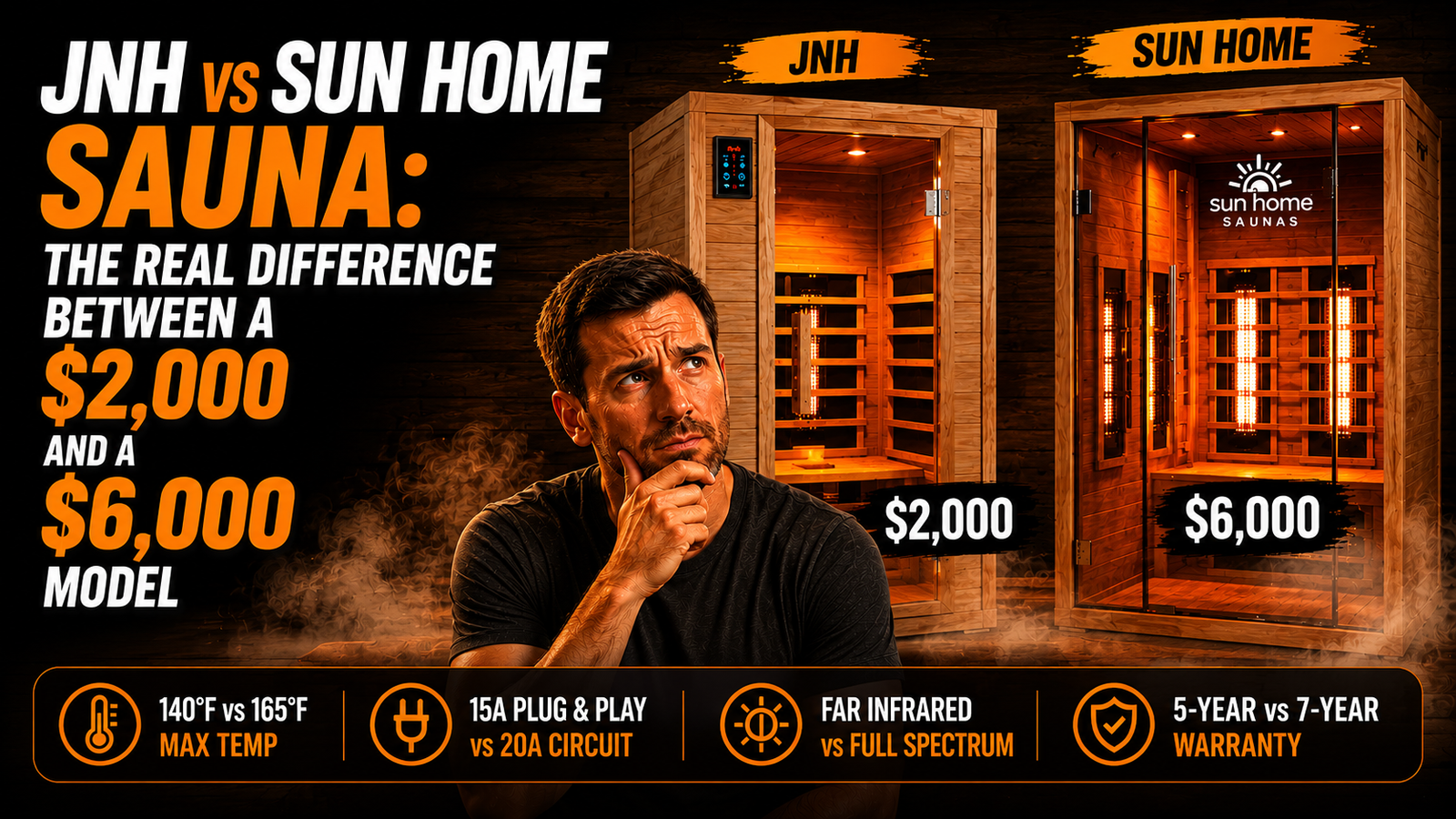
Most people who land on this comparison have already spent two hours on Reddit and still aren’t sure. They’ve seen the Sun Home ads, they’ve read that JNH is “good enough,” and now they’re staring at a $3,950 gap wondering if they’ll regret the cheaper one in six months.
Here’s the honest answer: both saunas work. The real differences are more specific — and more practical — than most comparison articles admit. This one breaks them down with actual specs.
Spec Comparison at a Glance
| Spec | JNH Joyous 2-Person | Sun Home Equinox 2-Person |
|---|---|---|
| Price | $2,049 (Amazon) | $5,999 (direct) |
| Infrared Type | Far infrared only | Full-spectrum (near + mid + far) |
| Heaters | 7 carbon fiber FAR heaters | 6 full-spectrum heaters, 1,880W total |
| Max Temperature | 140°F / 60°C (ETL safety cap) | 165°F / 74°C |
| Wattage | 1,540W | 1,880W |
| EMF Level | 0.32 mG average (third-party tested) | 0.3–0.5 mG (Vitatech, Jan 2025) |
| Electrical | 110–120V / 15A standard outlet | 120V / dedicated 20A circuit required |
| Wood | Canadian Hemlock (untreated) | Kiln-dried Eucalyptus (eco-certified) |
| Dimensions | 47.3″W × 39.5″D × 75″H | 50.9″W × 45.9″D × 77.7″H |
| Warranty | 5 years | 7 years (cabinetry + heaters), 3 years (controls) |
| Assembly | Standard tool assembly | Magne-Seal — no tools required |
| Audio | Bluetooth speakers (2) | Blaupunkt Bluetooth surround sound |
| Certification | ETL listed | ETL, ETL-C, RoHS, Intertek |
| VOC Testing | Not published | 27 µg/m³ TVOC (VERT Environmental, AIHA-accredited, April 2026) |
Price note: JNH Amazon pricing fluctuates. Sun Home pricing is from their official site as of May 2026.
Affiliate links — we may earn a commission. Prices verified May 2026.
Where They Actually Differ (Beyond the Price Tag)
1. Temperature ceiling: 140°F vs 165°F
JNH’s 140°F / 60°C cap isn’t a design flaw — it’s an ETL safety standard built into the control panel. For most far-infrared sessions (20–40 min at 120–135°F / 49–57°C), you’ll never hit the ceiling. But if you want the intense heat of a traditional sauna feel, JNH can’t deliver that.
Sun Home’s 165°F / 74°C is independently verified and the highest of any infrared sauna currently on the market. Whether you’ll ever use that ceiling is a personal question — but it does mean the sauna heats faster and holds temperature more easily in cold rooms.
2. Infrared spectrum: far-only vs full-spectrum
JNH uses far infrared only — the most common type, well-researched, and effective for heat therapy and relaxation. Sun Home delivers near, mid, and far simultaneously. Near infrared penetrates shallower tissue (skin surface, wound healing support). Far infrared goes deeper (circulation, muscle recovery).
Sun Home claims “60% deeper sweat” from full-spectrum — this is brand marketing language, not an independently published figure. The clinical research comparing full-spectrum vs far-only outcomes is still thin. For most users, far infrared is more than sufficient.
Why Sun Home Requires a 20A Circuit — And JNH Doesn’t
This is the most underrated practical difference between these two saunas, and the one most buyers don’t find out about until after they’ve ordered.
JNH runs on any standard 110–120V / 15A household outlet. Plug it in like a vacuum cleaner — bedroom, living room, insulated garage, wherever. No electrician, no permit, no additional cost.
Sun Home requires a dedicated 20A circuit. That means a circuit that serves only the sauna — nothing else on the same line. If your installation spot doesn’t already have one, you’re looking at $150–$500+ for an electrician before you even turn the sauna on. In older homes, it can run higher.
Why the difference? Sun Home’s heaters draw 1,880W continuously at full output. Running that on a shared 15A circuit would exceed the 80% continuous-load safety threshold and risk tripping breakers. JNH’s 1,540W at 15A stays just under that threshold — which is why it works on a standard outlet.
Sun Home’s marketing leads with temperature and full-spectrum wavelengths. The circuit requirement is buried in the specs. That’s worth knowing before you fall in love with the product page.
4. EMF: both are low, but Sun Home has more data
Both saunas are legitimately low-EMF. JNH tests at 0.32 mG average (third-party tested). Sun Home sits at 0.3–0.5 mG at seated distance (Vitatech Electromagnetics, January 2025).
The numbers are essentially equivalent. The real difference is documentation depth: Sun Home also publishes independent VOC testing (27 µg/m³ TVOC, AIHA-accredited lab, April 2026). JNH doesn’t publish VOC data. For most buyers this won’t matter — but if you’re EMF-sensitive or chemically sensitive, Sun Home’s verification paper trail is genuinely more thorough.
5. Warranty and what happens when something breaks
JNH’s 5-year warranty is solid for the price range. Sun Home offers 7 years on cabinetry and heaters, 3 years on controls — and includes in-home technician service as standard. If a heater panel fails, Sun Home sends someone to your house. JNH’s support is more traditional: file a claim, ship parts, fix it yourself.
For a $2,049 purchase, that’s acceptable. For a $5,999 purchase, in-home service is what you’d expect — and Sun Home delivers it.
What Real Users Say
Who Should Choose JNH
If you’re not sure how often you’ll actually use a sauna, JNH is the honest starting point. Most people overestimate their usage when buying new wellness equipment — that’s not a criticism, it’s just what tends to happen. Starting at $2,049 leaves room to find out.
JNH Joyous makes sense if:
- Your all-in budget is under $2,500 (sauna + any accessories)
- You want plug-and-play installation — no electrician, no circuit upgrades
- You’re buying your first infrared sauna and aren’t certain how often you’ll use it
- You plan to use it 2–4x per week for standard 20–35 minute sessions
- Far infrared heat therapy is what you’re after — no need for full-spectrum
As an Amazon Associate, we earn from qualifying purchases.
Who Should Choose Sun Home Equinox
Sun Home Equinox makes sense if:
- You plan to use it daily or near-daily and want it built for the long run
- You already have (or can budget for) a dedicated 20A circuit at the install location
- You want the highest independently verified temperature and the most EMF documentation
- Full-spectrum infrared wavelengths matter to your specific wellness goals
- You want in-home warranty service — not DIY part replacement
- Your total budget is $6,500+ including potential electrical work
Affiliate link — we may earn a commission. Price verified May 2026.
The Honest Take on the $3,950 Gap
Most buyers aren’t paying for better EMF — the numbers between these two saunas are nearly identical. What they’re actually paying for is hotter performance, in-home service, and the confidence that comes with owning the most documented sauna on the market.
Whether that confidence is worth $3,950 comes down to usage math. If you use it every day, the gap works out to about $2.16 per session over five years — for a sauna that runs hotter, holds temperature better, and comes with a technician if something goes wrong. That’s defensible.
If you use it twice a week, the same gap is $7.59 per session. At that point, JNH does the job for a fraction of the cost.
Related Reading
- JNH Lifestyles Full Review — all Joyous models compared, with specs and user feedback
- Sun Home Equinox Full Review — real costs, assembly, and who it’s actually built for
- Best Infrared Saunas Under $3,000 — how JNH compares to other options in the budget range
- Infrared Sauna EMF Guide — how to read EMF ratings and what the numbers actually mean
- Infrared Sauna Electricity Cost — what either sauna will add to your monthly bill
FAQ
Is JNH Lifestyles a good sauna brand?
Yes, for the price. The Joyous collection is one of the most consistently rated budget infrared saunas on the market — ETL certified, third-party EMF tested at 0.32 mG, and 4.7 stars across thousands of Amazon reviews. It’s not a premium product, but it’s legitimate and performs as advertised.
Why does Sun Home Equinox require a 20A circuit when JNH doesn’t?
Sun Home’s heaters draw 1,880W continuously, which exceeds the safe 80% continuous-load limit for a standard 15A circuit (1,440W). JNH’s 1,540W stays just under that threshold and runs safely on a standard outlet. If Sun Home ran on a shared 15A circuit, it would trip breakers under sustained use.
Is full-spectrum infrared actually better than far infrared only?
It depends on what you’re using the sauna for. Far infrared — what JNH delivers — is the most researched wavelength for heat therapy, circulation, and relaxation. Near infrared adds shallower penetration benefits like skin and surface tissue recovery. For general wellness and daily relaxation, far infrared alone is effective. Full-spectrum adds breadth, but the clinical evidence comparing real-world outcomes is still limited.
Does Sun Home’s EMF shielding make it meaningfully safer than JNH?
Not meaningfully. Both measure well under 1 mG at seated distance — far below ICNIRP and NIEHS safety guidelines. The difference between JNH’s 0.32 mG and Sun Home’s 0.3–0.5 mG is negligible from any established health standpoint. Sun Home’s advantage is verification depth and data transparency, not a fundamentally different exposure level.
Can I use JNH in an insulated garage?
Yes — JNH is rated for indoor use including insulated garages and runs on a standard 15A outlet. Note that in cold ambient temperatures, heat-up time increases and the 140°F / 60°C ceiling becomes harder to reach. Sun Home’s higher wattage helps compensate in colder spaces, though it requires that dedicated 20A circuit regardless of location.
Transparency: This article contains affiliate links to Amazon (JNH) and Sun Home Impact (Sun Home). If you purchase through these links, we may earn a commission at no extra cost to you. This does not affect our analysis or recommendations.