
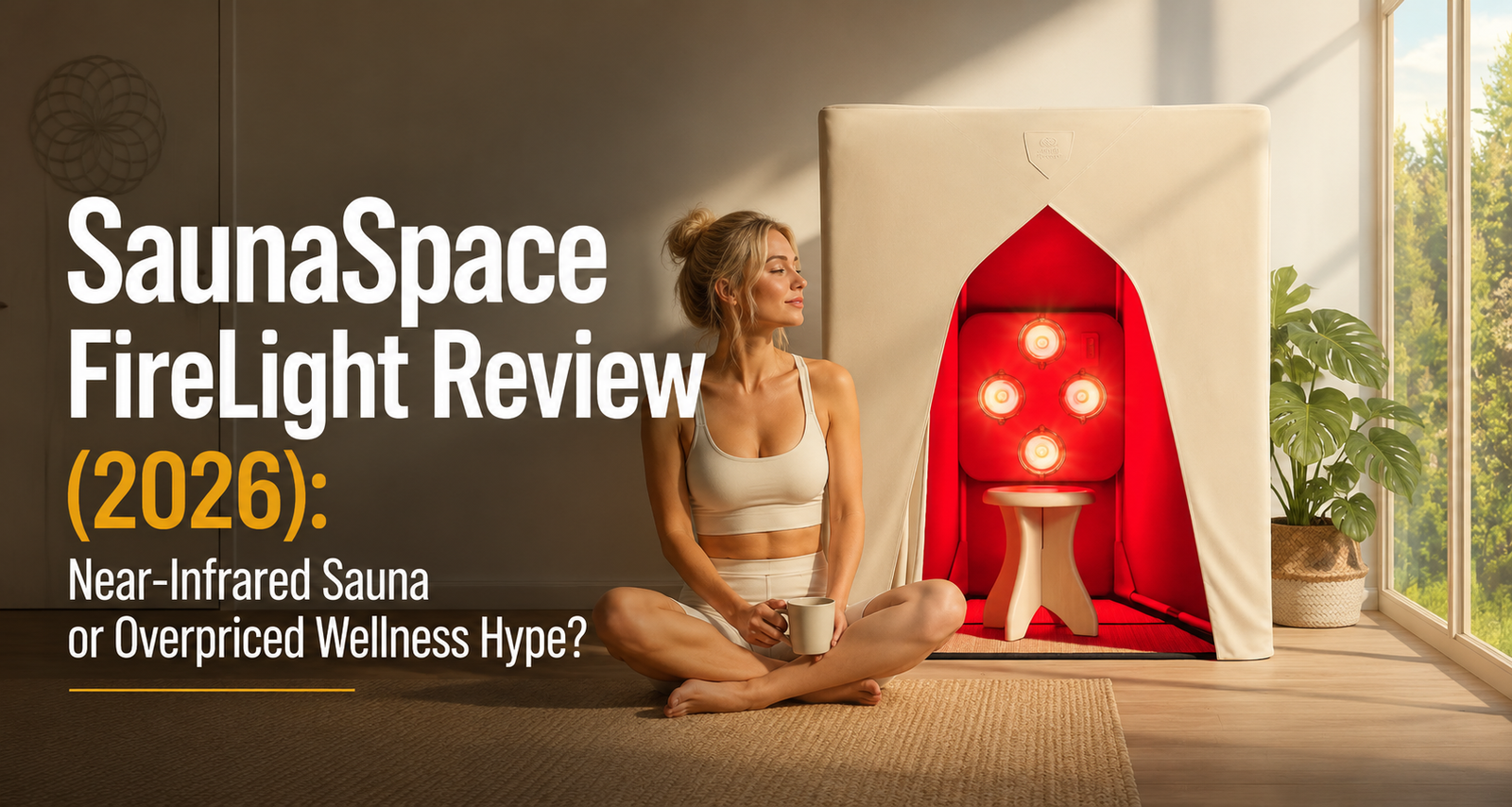
Let’s get this out of the way first: SaunaSpace is not a sauna in the way most people imagine a sauna.
It’s not competing with JNH or Clearlight on price or features. It’s a near-infrared light therapy device that happens to make you sweat — built from organic materials, shaped like a canvas tent, and priced like a piece of medical equipment. If that sounds weird, it’s because it kind of is. In a good way, if it’s what you actually need.
This review uses verified specs from SaunaSpace’s official Use Guide (March 2026) and documented owner experience. We haven’t personally used one — we won’t pretend otherwise.
SaunaSpace FireLight is a near-infrared light therapy sauna — not a far-infrared cabin. Air inside stays 100–130°F / 38–54°C, but the bulbs hit 370°F+, heating your body directly. Zero preheat. EMF-free when plugged into a grounded outlet. Plug-and-play 120V. Classic (4 bulbs) starts at $4,995. 5-year warranty, 100-day trial. Right for biohackers, apartment dwellers, EMF-sensitive buyers. Wrong for anyone wanting hot-air sauna feel or 2+ person use.
What It Actually Feels Like Inside
Most infrared saunas heat the air to 130–170°F / 54–77°C. You sit in that hot air, your body absorbs the heat, you sweat. Simple.
SaunaSpace flips this. The tungsten bulbs fire near-infrared light directly at your body. The air inside stays relatively cool — 100–130°F / 38–54°C. But the surface temperature near the bulbs exceeds 370°F / 188°C. The side of your body facing the panel gets intensely hot; the air around you doesn’t.
One owner described it as “sunbathing, not gasping in hot air.” Another said the skin on the side facing the bulbs starts tingling from intense heat while the rest of the body stays hot but relaxed. You still sweat — often faster than expected — but the experience is nothing like a wood cabin sauna.
The canvas tent isn’t trapping heat the way wood does. The light is the heater. The enclosure just keeps the light in.
How It Compares to a Normal Infrared Sauna
| Factor | SaunaSpace FireLight | Clearlight Sanctuary | JNH / Dynamic |
|---|---|---|---|
| Infrared type | Near-infrared (NIR) | Far-infrared (FIR) | Far-infrared (FIR) |
| Light therapy | Real photobiomodulation | None | None |
| Ambient air temp | 100-130F / 38-54C | 130-160F / 54-71C | 120-150F / 49-66C |
| Preheat | Zero | 15-30 min | 15-30 min |
| EMF | Zero (grounded outlet) | Low-EMF | Low-EMF (varies) |
| Structure | Canvas tent, foldable | Wood cabin, permanent | Wood cabin, permanent |
| Capacity | 1 person | 1-5 person | 1-3 person |
| Electrical | 120V standard plug | 240V dedicated circuit | 120V standard plug |
| Price | $4,995-$8,945+ | $4,000-$10,000+ | $1,500-$3,500 |
| Warranty | 5 years | Lifetime (some) | 1-3 years |
| Trial period | 100 days | Varies | 30 days |
Product Line (Prices Verified May 2026)
| Product | Bulbs | Price | Session |
|---|---|---|---|
| FireLight Classic | 4 x 250W | $4,995 | 20-40 min |
| Classic + SilverLining | 4 x 250W | $6,445 | 20-40 min |
| SuperSauna | 7 x 250W | Confirm at sauna.space | 10-20 min |
| SuperSauna + SilverLining | 7 x 250W | Up to ~$8,945 | 10-20 min |
| Hearth Panel only | 4 x 250W | $1,495 | No enclosure |
| Glow Therapy Light | 1 x 250W | $695 | Spot treatment |
The SuperSauna has two panels (Hearth Quartet + Hearth Trio), each needing its own 120V/15A outlet — two standard outlets total. The Classic only needs one.
Full Specs
| Spec | Classic (4 Bulb) | SuperSauna (7 Bulb) |
|---|---|---|
| Wattage | 1,000W | 1,750W |
| US voltage | 120V / 8.3A | 120V / 14.58A |
| Outlets needed | 1 x 120V/15A grounded | 2 x 120V/15A grounded |
| Also works on | 240V / 4.2A | 240V / 7.29A |
| Ambient air temp | 100-130F / 38-54C | 100-130F / 38-54C |
| Near-bulb temp | 370F+ / 188C+ | 370F+ / 188C+ |
| Session length | 20-40 min (max 60) | 10-20 min (max 30) |
| Body rotation | 90 degrees every 5 min | 90 degrees every 2-3 min |
| EMF | Zero when plugged into grounded outlet | |
| Assembled size | 52″W x 52″D x 63″H | |
| Total weight | 52.7 lb / 23.9 kg | More (add Trio panel) |
| Wood | Untreated basswood, zero-VOC | |
| Cover | Organic cotton, machine washable | |
| Bulb lifespan | 5,000 hours, $95 to replace | |
| Warranty | 5 years (all components) | |
| Trial | 100 days | |
| Certifications | UL-listed, CE-certified | |
| Made in | Columbia, Missouri USA | |
The EMF Claim Is More Nuanced Than It Looks
SaunaSpace markets every model as EMF-free. That’s mostly accurate — incandescent bulbs produce near-zero electromagnetic fields by nature, and every component is shielded and grounded.
But there’s a condition buried in the official Use Guide that most reviews skip:
“The product can still be used if the outlet is not grounded, but it will emit EMFs.” SaunaSpace includes a GFCI Outlet Tester in the box for exactly this reason. Test before your first session — not after.
The SilverLining upgrade ($1,450) is a separate layer — organic cotton woven with 35% pure silver that blocks ambient WiFi, 5G, and Bluetooth from your home environment. The sauna is already near-zero EMF. SilverLining is for people who want to block the room around them, not just the sauna’s own emissions. Worth it if you’re EHS-sensitive. Probably overkill for most buyers.
The Science Behind the Light
Near-infrared photobiomodulation is real research, not just biohacker marketing. NIR wavelengths in the 700–1000nm range have been shown in peer-reviewed studies to stimulate mitochondrial function, reduce inflammation, and support cellular repair.
What makes SaunaSpace different from LED red light panels is the source itself. The FireLight Bulb produces continuous full-spectrum incandescent output — roughly 90% heat, 10% light, no flicker. Closer to natural sunlight than anything a carbon-panel sauna puts out.
“Cellular healing,” “nervous system reset,” “detox at a cellular level” — common in wellness marketing but not specifically proven for near-infrared in controlled trials. SaunaSpace’s own FDA disclaimer says their products aren’t intended to diagnose or treat any disease. The photobiomodulation research is solid. The broader healing language is brand philosophy. Worth keeping that distinction in mind when you’re staring at a $5,000 price tag.
The Rotation Thing
Every review mentions it eventually, so let’s just address it upfront.
Because the light panel is on one side only, you rotate your body 90 degrees every 5 minutes (Classic) or every 2–3 minutes (SuperSauna) to expose all four sides. The internet calls this the “rotisserie chicken” effect. It’s not exactly wrong.
One long-term owner sets a timer every 2 minutes. Another says it becomes second nature within a week. It’s not a dealbreaker — but if actively managing your position throughout a session sounds annoying, that’s worth knowing before you spend $5,000.
Classic vs. SuperSauna
The SuperSauna adds a Hearth Trio (3 bulbs) below the Quartet (4 bulbs) — more coverage, more intensity, shorter sessions. Sounds better. But SaunaSpace explicitly says SuperSauna is only for people who are completely healthy with no underlying conditions.
- Classic — start here. One outlet, 20–40 min sessions, works for everyone.
- SuperSauna — only if you’re healthy and heat-acclimated. Two outlets required. You can retrofit from Classic later if you want to upgrade.
A Few Things Worth Knowing Before You Buy
The organic cotton cover is machine washable — delicate cycle, hang dry. Good news for something you’re going to sweat in every day.
The SilverLining cover is hand-wash only. Cold water, gentle soap, hang dry. If you’re the type who throws everything in the machine without reading labels, factor that in.
Always put a towel on the stool and bamboo mat during sessions. Sweat on untreated wood can void the warranty — it’s in the Use Guide in bold.
And this one surprises people: SaunaSpace is strictly indoor-only. Wet, humid, or outdoor environments void the warranty. Don’t set it up on a covered porch and assume you’re fine.
Why SaunaSpace Costs So Much
This is the question everyone has and nobody fully answers. You’re looking at a canvas tent with light bulbs, and the price starts at $4,995. So what exactly are you paying for?
A few things that genuinely add cost: everything is handmade in Columbia, Missouri — not assembled overseas. The wood is untreated North American basswood with zero-VOC certification. The covers are GOTS-certified organic cotton. The bulbs are custom-engineered tungsten, hand-blown, designed specifically for NIR output — not repurposed incandescent hardware. Every electrical component is individually shielded. The grounding mat is bamboo. There are no plastics anywhere in the product.
That’s a genuinely different supply chain from a $1,500 JNH that ships in a box from a warehouse. Whether the difference justifies $3,500+ extra depends entirely on how much you care about material purity and NIR light therapy specifically — versus just wanting to sweat.
The 100-day trial helps. If you try it and it’s not what you expected, you’re not stuck. That’s a real safety net at this price point.
Is SaunaSpace Actually Worth $5,000?
For most infrared sauna buyers — no. Most people searching “infrared sauna” want heat, relaxation, and sweating. A JNH or Dynamic delivers all of that for $1,500–$2,500. Paying an extra $2,500–$3,500 for NIR photobiomodulation, zero-VOC materials, and a foldable canvas format doesn’t make sense unless those things specifically matter to you.
For a specific type of buyer — yes. If you’ve already tried far-infrared and want more from your sessions. If you’re managing a health condition and have a practitioner guiding you toward NIR therapy. If EMF exposure is a documented concern rather than a vague worry. If you live in an apartment and a permanent wood cabin isn’t an option. For those buyers, there’s genuinely nothing else on the market that does what SaunaSpace does.
The honest answer: it’s worth it if you know exactly why you’re buying it. It’s not worth it if you’re buying it because it seems premium.
Is This For You?
Buy it if you’re a biohacker or functional medicine user who specifically wants NIR photobiomodulation — not just heat. If you live in an apartment and need something portable that folds away. If EMF exposure is a genuine concern and you want the most controlled environment available. If material purity matters — zero-VOC wood, organic cotton, no plastics, nothing off-gassing.
Skip it if you want the classic sauna feel — enveloping 160°F hot air, the sensation of a proper Finnish sauna. SaunaSpace won’t give you that. Skip it if you need 2+ person capacity. Skip it if $5,000 for a canvas light therapy tent feels like too much of a leap — because JNH and Dynamic give you solid far-infrared heat for $1,500–$2,500, and that’s a perfectly reasonable choice for most buyers.
Bottom Line
SaunaSpace FireLight is genuinely unlike anything else on the market. If you know you want near-infrared light therapy, zero EMF, organic materials, and zero preheat in a portable setup — nothing else comes close. If you want a hot sauna that feels like a sauna, buy a far-infrared cabin and keep $2,000–$3,000 in your pocket. The mistake is buying this expecting one and getting the other.
FAQ
Is SaunaSpace worth the price?
Depends entirely on what you’re buying it for. For NIR photobiomodulation, zero-VOC materials, and EMF-free design — yes, nothing competes at this level. For heat therapy and sweating alone, far-infrared cabins do that for $1,500–$3,000 less.
What happened to the Faraday and Luminati?
Rebranded. The Luminati is now the FireLight Classic. The Faraday is now the FireLight with SilverLining. Same technology, new names as of 2024–2025.
Does it get as hot as a regular infrared sauna?
The air inside doesn’t — it stays 100–130°F / 38–54°C. But the bulbs themselves hit 370°F+ / 188°C+, heating your body directly via radiant NIR light. Most people sweat faster than they expect despite the cooler air.
Is it actually EMF-free?
Yes — if your outlet is properly grounded. The Use Guide is explicit: ungrounded outlet means EMF emissions. SaunaSpace includes a GFCI tester in the box. Test before your first session.
What outlet does it need?
Classic: one grounded 120V/15A outlet. SuperSauna: two grounded 120V/15A outlets — one per panel. Both plug-and-play, no electrician needed as long as outlets are grounded.
Classic or SuperSauna?
Classic first, always — especially if you have any health conditions or are new to NIR therapy. SuperSauna (10–20 min sessions) is only for completely healthy, heat-acclimated users. You can retrofit from Classic to SuperSauna later if you want to upgrade.
Why do you have to rotate?
One light panel, one direction. To expose all sides of your body, you rotate 90 degrees every 5 minutes in the Classic, every 2–3 minutes in the SuperSauna. Four positions, full coverage. Most users find a rhythm within a week.
Can I use it in an apartment?
Yes — actually one of the best use cases. Assembles in an hour, works on any flooring, no permanent installation, folds down to store. Footprint when assembled is 52″ x 52″ — about the size of a large armchair.
Can it go outdoors?
No. The Use Guide is explicit — wet, humid, or outdoor environments void the warranty. Indoor only.
Related Reading
- Infrared Sauna EMF Levels: What the Numbers Actually Mean — for evaluating EMF claims across all brands
- Best Low-EMF Infrared Saunas — how SaunaSpace compares to far-infrared low-EMF options
- Best Infrared Saunas Under $3,000 — if price or format does not fit
- Infrared Sauna Benefits: What the Research Actually Shows — evidence behind heat and light therapy
- Infrared Sauna Installation Cost — electrical requirements across sauna types