

Heavenly Heat sauna heat-up time is advertised at 10–15 minutes, but independent testing found 25–30 minutes on the 2-Person model — roughly double, like a “15-minute recipe” that’s still not done at the 30-minute mark. The compact ECO model fares better, reaching temperature in 22–24 minutes. Both numbers are real; they’re just measuring different things than the marketing copy implies.
Best Value: Red Light + Infrared in One
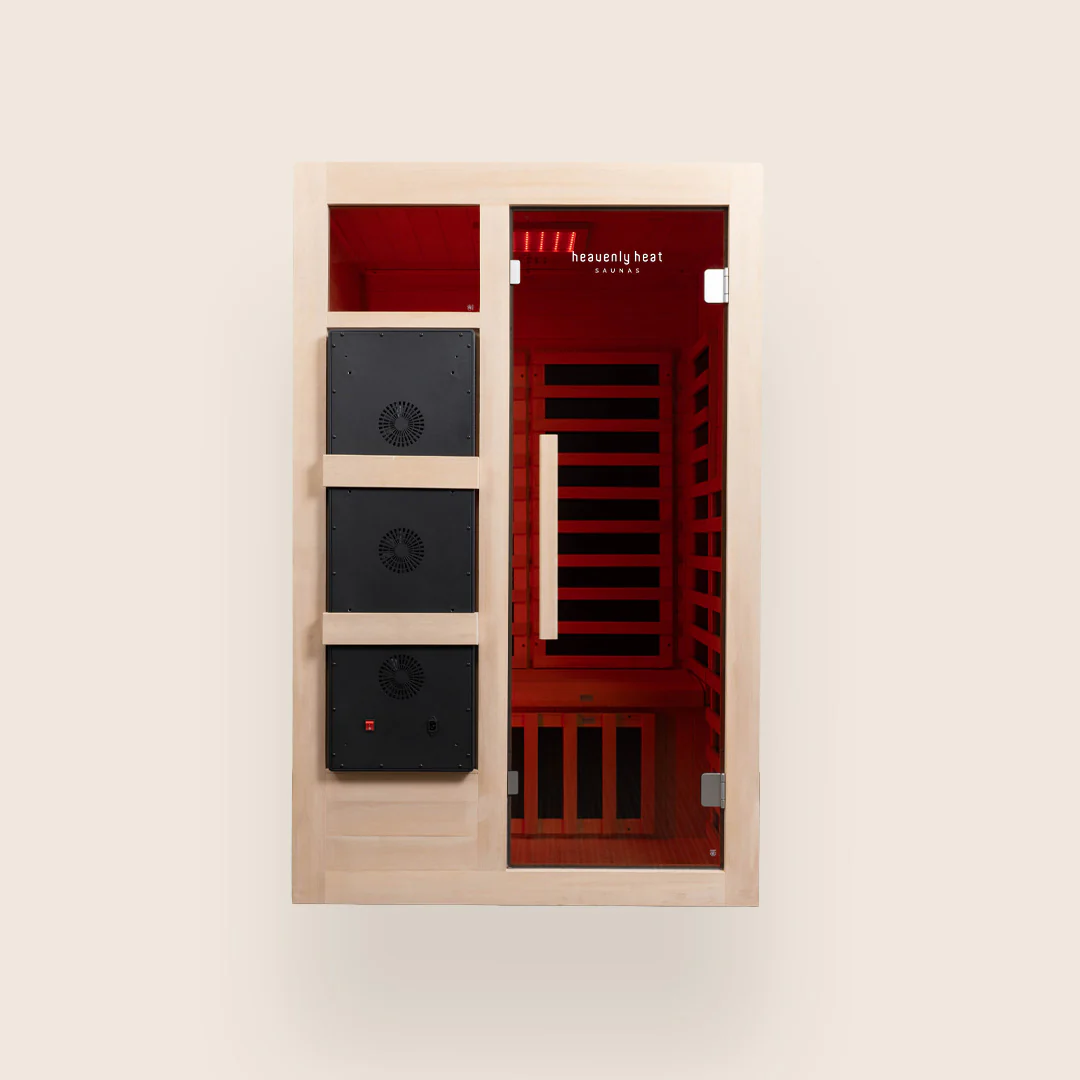
We don’t currently have an affiliate relationship with Heavenly Heat — this link earns us nothing.
What Heavenly Heat Advertises
Heavenly Heat’s marketing states a 10–15 minute warm-up. The company’s own product pages also note that ambient room temperature and available power draw affect real-world heat-up time — a disclaimer that turns out to matter more than it sounds.
Why This Number Makes People Feel Misled
Heavenly Heat sauna heat-up time is one of the things buyers care about most before purchase — and one of the first things they check after delivery. Picture it: box says 10–15 minutes, so you set a timer on your phone, sit down in your towel, and watch the display. Fifteen minutes pass. It’s warm, but not there yet. Twenty minutes. Still climbing. By the time it actually hits temperature, you’ve had time to check your phone twice and start wondering if something’s broken. That’s the moment most people go looking for reviews — and find out they’re not the only one.
Our neutral take: heat-up time genuinely varies a lot, and it’s driven by three real factors — ambient room temperature, how well-insulated the cabin is, and the sauna’s actual wattage. A sauna in a cold garage in January and the same sauna in a heated basement in July will post very different numbers, and that’s physics, not deception. Where we’d actually get suspicious is different: if your room is already reasonably warm and heat-up is still dramatically slow, that’s worth contacting the manufacturer about — at that point it’s less likely to be ambient conditions and more likely something’s actually wrong with the unit.
What Independent Testing Actually Found
Garage Gym Reviews (GGR) tested the Far Infrared 2 Person model over multiple sessions. Their result: 25–30 minutes to reach 165°F — not 10–15. The ceiling itself checked out; the timeline to get there didn’t.
A separate independent test tells a different story for a different model. homeindepth.com tested the compact ECO model and measured 22–24 minutes to reach its temperature ceiling — notably faster than GGR’s number for the 2-Person. Makes sense when you think about it like heating a room: a studio apartment warms up faster than a two-bedroom with the same space heater running. Smaller box, less air to heat, quicker climb.
Why the Gap Might Exist
We can point to one contributing factor with real numbers: Heavenly Heat’s 2-Person model runs at 1,700W, while the Sun Home Equinox — which independently tests at roughly 15 minutes to its own 165°F ceiling — runs at 1,880W. That’s only about a 10% difference in power, which doesn’t fully explain a heat-up time that’s roughly double.
Beyond wattage, think of it the way you’d think about an oven: two ovens set to the same 350°F can bake at noticeably different speeds depending on how well the door seals, how much air space is inside, and how the heating element is arranged. Cabin volume, insulation quality, and heater design likely all play a role here the same way. We don’t have the data to say exactly how much each factor contributes, and we’re not going to pretend otherwise — this is a case where the honest answer is “probably several things combined,” not a single clean explanation.
Does a 20A Circuit Heat It Up Faster?
Heavenly Heat’s 2-Person model works on either a 120V/15A or 120V/20A circuit. In our full review, we recommended running the 20A option when available — more available power should mean a faster climb, the same logic as a wider hose filling a pool quicker than a garden hose. That’s a reasonable inference. But we don’t actually know which circuit GGR used for their 25–30 minute result, so we can’t tell you exactly how many minutes 20A buys you over 15A. Nobody’s published that side-by-side test yet.
How This Compares
| Sauna | Advertised Heat-Up | Independently Measured |
|---|---|---|
| Heavenly Heat (2-Person) | 10–15 min | 25–30 min (GGR) |
| Heavenly Heat (ECO) | 10–15 min | 22–24 min (homeindepth) |
| Sun Home Equinox | ~15 min | ~15 min (GGR, roughly matches) |
Sun Home’s advertised number and its independently tested number are close together. Heavenly Heat’s are not — on the 2-Person model, at least. That gap is the single most useful data point in this whole article.
Who Should Care About This — and Who Shouldn’t
| Care About This If You’re… | Don’t Prioritize This If You’re… |
|---|---|
| Planning sauna sessions around a tight daily schedule | Someone who preheats before doing other things and isn’t watching the clock |
| Choosing between brands and want the one with accurate advertised timing | More focused on materials, EMF, or price than speed |
| Considering the compact ECO model, which heats up meaningfully faster | Set on the 2-Person or larger models regardless of heat-up time |
PRL Take
The advertised 10–15 minutes is optimistic marketing, not an outright lie — but on the 2-Person model, the gap to reality is large enough that we understand why buyers feel misled when they time it themselves. The fix isn’t complicated: budget 25–30 minutes for the 2-Person, not 10–15. Plan it like you’d plan for traffic on a commute you’ve driven a hundred times — the “quick” version is the exception, not the rule. If you specifically want the faster warm-up, the ECO’s smaller cabin is the more honest match for that expectation.
FAQ
Quick answers on Heavenly Heat sauna heat-up time:
How long does a Heavenly Heat sauna actually take to heat up?
25–30 minutes for the 2-Person model, per GGR’s independent testing — not the 10–15 minutes advertised. The compact ECO model heats up faster, in 22–24 minutes.
Why is the real heat-up time so different from what’s advertised?
Ambient room temperature, cabin insulation, and available power all affect the real number. If your room is already warm and it’s still taking far longer than expected, that’s worth raising with Heavenly Heat directly.
Does a 20A circuit heat it up faster than 15A?
Likely, based on the higher available power draw — but no one has published a direct side-by-side test of the two circuits on this model, so we can’t give you an exact time difference.
Which Heavenly Heat model heats up fastest?
The ECO, based on independent testing — its smaller cabin reaches temperature in 22–24 minutes versus 25–30 for the 2-Person model.
Sources
| Source | Supports | Last Checked |
|---|---|---|
| Heavenly Heat official FAQ | 10–15 min advertised heat-up claim; ambient/power disclaimer | July 2026 |
| Garage Gym Reviews independent test | 25–30 min measured heat-up, 2-Person model; 165°F ceiling confirmed | July 2026 |
| homeindepth.com independent test | 22–24 min measured heat-up, ECO model | July 2026 |
| PRL Heavenly Heat Sauna Review | Circuit recommendation context, brand background | July 2026 |