The irony is hard to miss.
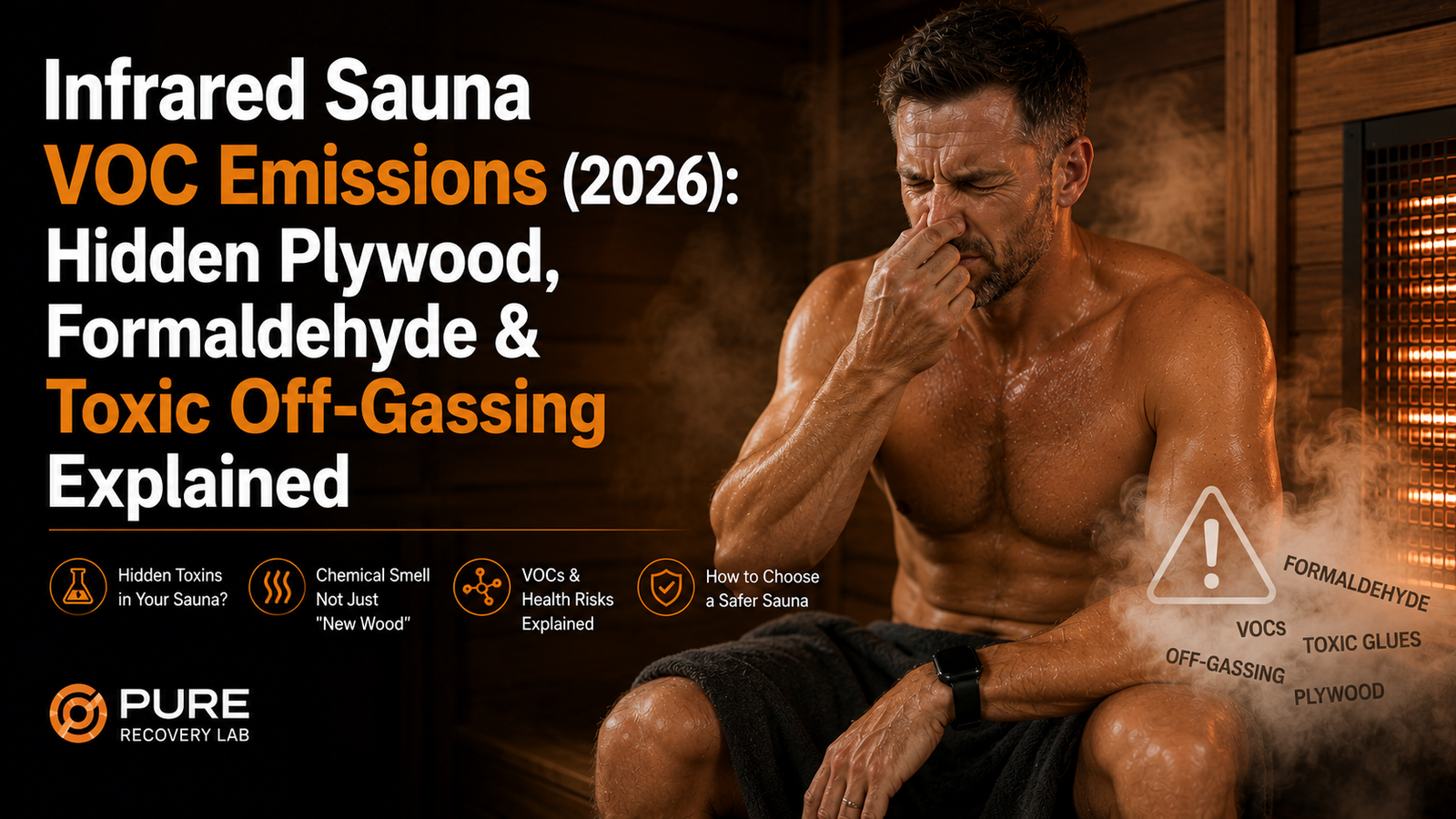
You buy an infrared sauna to detox — and the first thing you notice when you turn it on is a chemical smell.
That smell has a name: VOC off-gassing. Depending on what your sauna is made of, it can range from a harmless first-use odor that disappears in a week, to a genuine air quality problem that doesn’t go away.
This article explains what’s actually happening, what materials to watch for, and how to evaluate a brand’s VOC claims before you buy.
VOCs (volatile organic compounds) off-gas from sauna materials when heated. The main sources are hidden adhesives, plywood or particle board in the frame, and wood finishes — not the solid wood panels you can see. Heat accelerates off-gassing significantly. The fix is simple: solid untreated wood, no formaldehyde-based adhesives, no manufactured board. Harder to verify than it sounds, because brands control what they disclose.
Why Saunas Are a Special VOC Case
VOCs are everywhere — paint, furniture, flooring. Most of the time, exposure is low enough not to matter.
Saunas are different for two reasons.
First, heat dramatically accelerates off-gassing. Research shows VOC emissions increase roughly 60% when temperature rises from 120°C to 140°C. Your infrared sauna runs at 110–170°F / 43–77°C — well within the range where this effect is real.
Second, you’re sitting inside a small enclosed space for 20–45 minutes, breathing whatever the materials are releasing. That’s meaningfully different from walking past a piece of furniture.
The EPA classifies formaldehyde — one of the most common VOCs in wood products — as a probable human carcinogen. That’s the one that matters most in this context.
Where the VOCs Actually Come From
This is where most buyer guides get it wrong. They focus on wood species — cedar vs. hemlock vs. basswood.
Wood species matters, but it’s probably the least important variable.
One independent tester who ran VOC measurements on multiple sauna brands found that a poplar sauna (marketed as a low-VOC choice) measured higher VOCs than a hemlock sauna. His conclusion: wood type might be the least important factor on the list.
The real sources of VOC concern, in order of importance:
- Hidden manufactured board. Many saunas use plywood or particle board in the frame or floor — invisible once assembled. Particle board uses formaldehyde-based adhesives that off-gas significantly when heated. This is the biggest risk in budget saunas. You cannot see it from the outside.
- Adhesives. Cheap spray adhesives near heaters release VOCs under heat. High-quality water-based wood glues show minimal off-gassing at infrared temperatures. The question is which adhesive and where it’s placed.
- Wood finishes and treatments. Any varnish, lacquer, or stain on interior wood surfaces will off-gas when heated. Interior panels should be raw, untreated wood.
- The wood itself. Cedar produces aromatic terpenes and phenols — pleasant to most, problematic for those with sensitivities. Basswood and hemlock have minimal natural VOC output. Eucalyptus is dense with low off-gassing. Poplar is marketed as clean but real-world testing shows variability.
Some saunas advertise “cedar” or “basswood” panels while using cheaper manufactured board behind the walls in framing or floor systems. In a heated cabin, those hidden materials become part of your daily exposure. You won’t smell the difference between good cedar and good cedar over cheap particleboard framing — until you’re breathing it for 30 minutes a day.
Wood Species VOC Profiles
| Wood Species | Natural VOC Profile | Scent | Best For | Used By |
|---|---|---|---|---|
| Western Red Cedar | Moderate — terpenes, phenols | Aromatic (strong) | Traditional sauna feel | Sun Home Eclipse, many brands |
| Canadian Hemlock | Low — minimal natural compounds | Near-odorless | Scent-sensitive users | JNH Lifestyles, Dynamic Saunas |
| Basswood | Low — minimal resins/tannins | Mild | Allergy-sensitive users | SaunaSpace FireLight |
| Eucalyptus | Low — naturally antimicrobial | Subtle, clean | Durability + low scent | Sun Home Equinox/Solstice |
| Poplar/Abachi | Variable — marketed as low-VOC but real-world testing shows inconsistency | Minimal | Chemical sensitivity | High Tech Health |
Real-world VOC output depends more on construction methods and hidden materials than wood species alone.
Sauna VOC Testing Explained: Gold Standard vs. Marketing Claims
There is no standardized mandatory VOC testing protocol for infrared saunas in the US.
Brands can claim “zero VOC” or “non-toxic” without any independent verification. Some conduct genuine third-party testing. Many don’t.
When testing does happen, the methodology matters enormously:
- Whole-unit chamber testing is the gold standard. The entire assembled sauna is tested in an environmental chamber at operating temperature. This catches VOCs from hidden components, adhesives, and wiring — not just the panels. Radiant Health conducts this type of testing.
- Component-level testing tests individual materials (a panel sample, a heater) but misses how the full assembled unit performs. A brand can show you clean wood panel results while particleboard framing off-gasses freely.
- No testing at all — claims based on material selection only (“we use zero-VOC wood”) without any emissions measurement.
We’ve compared the construction transparency of the top premium saunas so you don’t have to guess.
Why New Saunas Smell Chemical — And When to Worry
Almost every new infrared sauna has some smell on first use. This is normal.
The question is: what kind of smell, and how long does it last?
Normal: Mild wood scent, fades significantly within 3–5 sessions. Cedar saunas will smell like cedar — that’s the wood, not a problem.
Red flag: Sharp chemical or formaldehyde-like odor. Makes your eyes water. Persists beyond 5–10 sessions. That’s not new-wood smell. That’s manufactured board or low-grade adhesive — and it won’t go away on its own.
One Reddit user described buying a cheap Amazon infrared sauna that “arrived smelling like formaldehyde.” That’s not a break-in issue. That’s a construction quality issue.
The standard advice: run your sauna empty for 3–5 sessions before using it, with ventilation. This burns off residual surface compounds. If the smell is still strong after 10 sessions, that’s a material quality issue that warrants a return under warranty.
Brand-by-Brand VOC Transparency
| Brand | Wood | No Plywood / Particle Board | VOC Testing | Notes | Action |
|---|---|---|---|---|---|
| SaunaSpace | Basswood (zero-VOC, untreated) | ✅ Confirmed | Material-based, no chamber test cited | Organic cotton, no adhesives, no finishes | Read Review → |
| Sun Home Equinox | Eucalyptus (kiln-dried) | ✅ No plywood disclosed | Chamber test Feb 2026, 27 µg/m³ | ETL/RoHS/Intertek certified | Read Review → |
| Clearlight | Western red cedar or basswood | Not confirmed publicly | No chamber test cited | Claims eco-certified wood | Read Review → |
| Sunlighten | Basswood or cedar | Not confirmed publicly | No chamber test cited | Claims non-toxic construction | Read Review → |
| JNH Lifestyles | Canadian hemlock | Not confirmed publicly | No VOC testing cited | Budget tier, less transparency | Read Review → |
| Dynamic Saunas | Canadian hemlock | Not confirmed publicly | No VOC testing cited | Budget tier, less transparency | Read Review → |
| Radiant Health | Poplar | ✅ Confirmed | ✅ Whole-unit chamber testing, zero detectable VOCs | Most rigorous testing we found | — |
Table reflects publicly available information as of May 2026. “Not confirmed publicly” means the brand has not published documentation — it does not mean they use these materials.
Several brands use “zero VOC” or “non-toxic” language without publishing test data. These claims are often based on material selection alone — not actual emissions measurement. Without whole-unit chamber testing at operating temperature, “zero VOC” is a material philosophy, not a verified measurement. The distinction matters if VOC exposure is a genuine health priority for you.
What to Actually Check Before You Buy
In order of reliability:
- Ask: is any plywood or particle board used anywhere in the construction? This includes the floor, framing behind panels, and structural components. “Solid wood panels” does not mean solid wood construction throughout.
- Ask what adhesives are used and where. Water-based glues fully cured before assembly are low-risk. Spray adhesives or urea-formaldehyde adhesives near the interior are not.
- Look for whole-unit VOC chamber testing — not just material certifications. ETL and UL marks cover electrical safety, not VOC emissions.
- Check whether interior surfaces are finished. Any varnish or coating on interior panels is a VOC source when heated. Interior surfaces should be unfinished raw wood.
Practical Steps for New Sauna Owners
- Run 3–5 empty burn-in sessions before your first use, with ventilation nearby.
- Never use chemical cleaners on interior surfaces. They absorb into untreated wood and re-release when heated.
- Don’t diffuse essential oils directly on wood surfaces. Oil near heaters releases compounds into enclosed air.
- Ventilate after every session. Leave the door open 10–15 minutes to clear residual off-gassing.
- If the smell persists beyond 10 sessions, contact the manufacturer. You may have a materials quality issue that warrants a return.
Bottom Line
VOC risk in infrared saunas is almost entirely about hidden manufactured board and cheap adhesives — not the wood species on the spec sheet. If a brand can’t tell you whether plywood or particle board is used anywhere in the construction, that’s your answer. Whole-unit chamber testing is the only way to verify VOC claims. Most brands don’t do it. Radiant Health does. SaunaSpace’s material design eliminates the main risk sources by default. For JNH and Dynamic buyers: run your burn-in sessions, ventilate properly, and don’t introduce chemicals into the cabin.
FAQ
Are infrared saunas toxic?
Not inherently. High-quality saunas built with solid untreated wood, water-based adhesives, and no manufactured board have minimal VOC emissions. Budget saunas using particle board framing or cheap adhesives can have meaningful formaldehyde off-gassing at operating temperatures. The risk is in construction quality, not infrared technology itself.
Why does my new infrared sauna smell chemical?
A mild wood smell on first use is normal and clears within a few sessions. A sharp chemical or formaldehyde-like smell that persists beyond 5–10 sessions indicates low-grade adhesives or manufactured board — not a break-in issue. Run 3–5 empty sessions with ventilation. If the chemical smell continues, contact the manufacturer about a return.
What does “zero VOC” mean for an infrared sauna?
It depends on how the brand defines it. Some use “zero VOC” to mean they use untreated wood — a material philosophy, not a measured result. Others have actual chamber test data. Ask which definition applies and whether testing data is available.
Does cedar off-gas in a sauna?
Yes — cedar produces terpenes and phenols when heated, which create its aromatic scent. These compounds are not considered harmful to most people. However, people with terpene allergies or respiratory sensitivities may react to them. Hemlock or basswood are lower-aromatic alternatives.
Related Reading
- Infrared Sauna EMF Levels: What the Numbers Actually Mean — the parallel concern to VOCs for material-safety-focused buyers
- Best Low-EMF Infrared Saunas — brands with verified EMF and generally better materials transparency
- SaunaSpace FireLight Review — the brand with the most transparent materials approach in this comparison
- Sun Home Equinox Review — full-spectrum sauna with published VOC chamber test data
- Infrared Sauna Benefits: What the Research Actually Shows — context for why material quality matters