
If you’re researching Sunlighten sauna heat-up time, you’ve probably already noticed a confusing gap: some sources say 15–20 minutes, others say 45 minutes, and Sunlighten’s own official guidance says to preheat for approximately 45 minutes before entering.
All of these numbers are technically correct — and understanding why they differ tells you everything you need to know about how to actually use a Sunlighten sauna effectively.
This guide breaks down real warm-up times by model, explains the 15-minute vs. 45-minute confusion, and gives you an honest picture of where Sunlighten’s heating performance is strong — and where it has real limitations compared to competing brands.
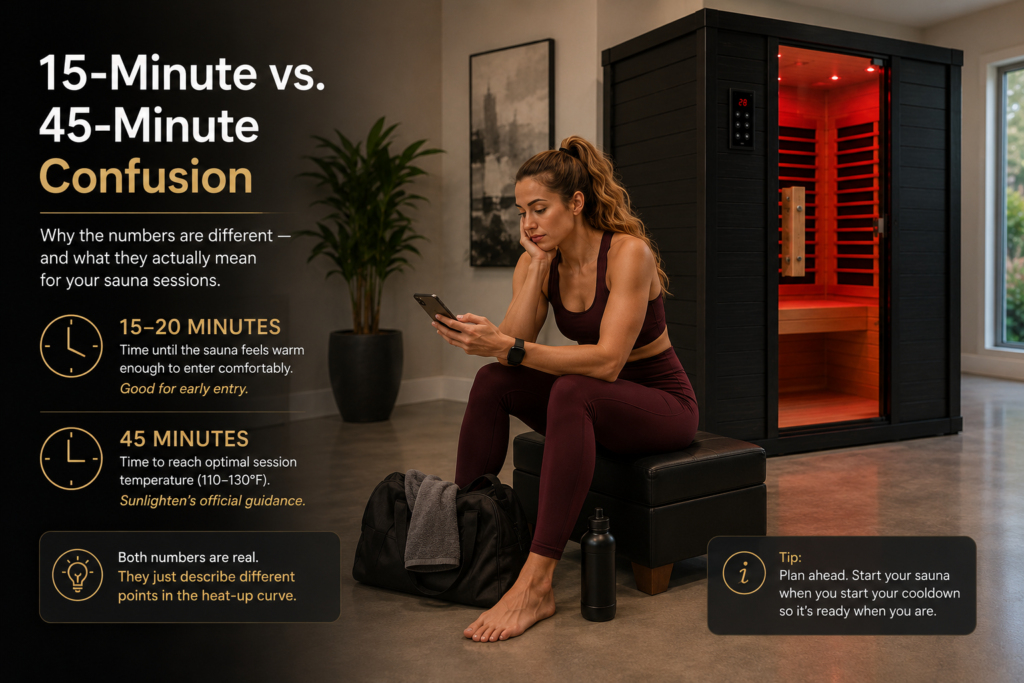
The key distinction upfront: Sunlighten’s 45-minute preheat recommendation is the time to reach optimal session temperature. The 15–20 minute figure is the time until the cabin is warm enough to enter comfortably. Both are real — they describe different points in the heat-up curve. Most buyers don’t realize this until after purchase.
The 15-Minute vs. 45-Minute Confusion — Explained
This is the most important thing to understand about Sunlighten sauna heat-up performance, and most sources gloss over it entirely.
Sunlighten’s official user manuals — including the mPulse manual and the Signature series guidance — specify a preheat time of approximately 45 minutes. The Signature I documentation states the sauna heats up at approximately one degree per minute, depending on room temperature. Starting from a cold room at around 65–70°F, that means the cabin reaches 100°F in about 35 minutes and optimal session range (110–130°F) in 40–50 minutes.
So where does the “15–20 minutes” figure come from? That’s the point at which many owners — including a number of long-term Sunlighten users — choose to enter the sauna and warm up with it, rather than waiting for full preheat. This is a valid usage pattern for infrared saunas: since the panels are delivering infrared energy from the moment they’re on, you can receive benefit before the cabin air reaches peak temperature.
The two numbers describe different things, and neither is wrong. But Sunlighten’s official guidance is 45 minutes — and buyers comparing to brands that advertise “10-minute preheat times” need to factor that in honestly.
What this means practically: If you’re planning spontaneous sessions, Sunlighten saunas require more advance planning than some competitors. If you build the preheat into your routine — starting the sauna when you begin your post-workout cooldown, for example — the 45 minutes rarely feels like a limitation. But it’s a real difference worth knowing before you buy.
Heat-Up Time by Sunlighten Model
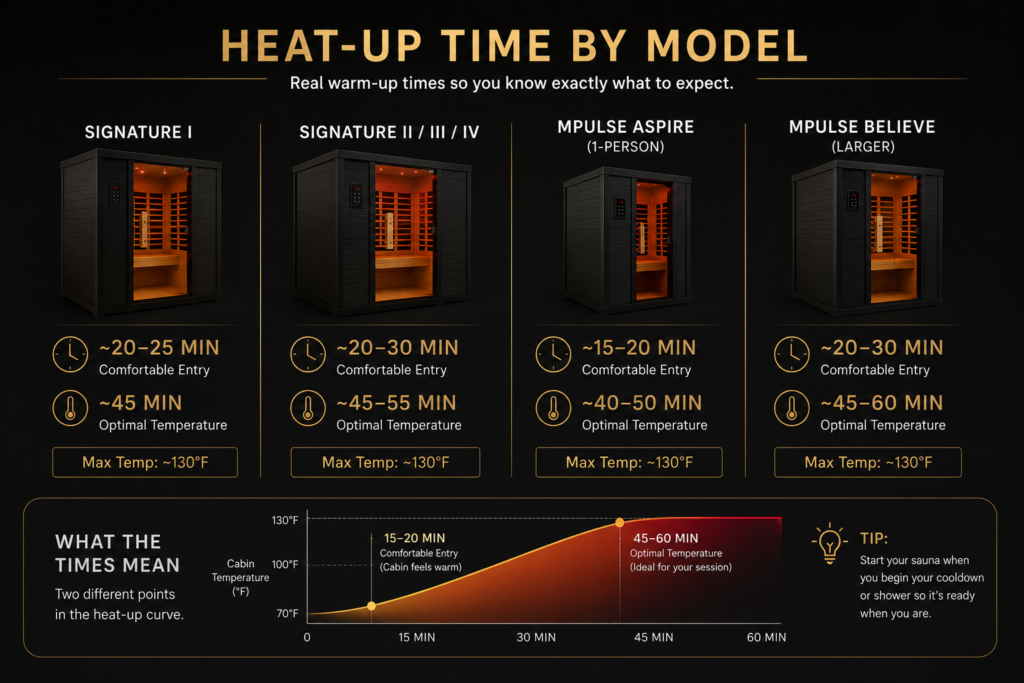
Sunlighten’s current lineup has four main product lines with meaningfully different heating characteristics. Understanding those differences matters for both purchase decisions and daily use.
| Model line | Heater type | Wattage | Comfortable entry | Optimal temp | Max temp |
|---|---|---|---|---|---|
| Signature I | SoloCarbon far infrared | 1,350W | ~20–25 min | ~45 min | ~130°F |
| Signature II / III / IV | SoloCarbon far infrared | 1,400–2,000W+ | ~20–30 min | ~45–55 min | ~130°F |
| mPulse Aspire (1-person) | SoloCarbon full spectrum (FIR/MIR/NIR + red light) | ~1,750W | ~15–20 min | ~40–50 min | ~130°F |
| mPulse Believe / larger | SoloCarbon full spectrum | ~2,000W+ (20A dedicated) | ~20–30 min | ~45–60 min | ~130°F |
| Amplify II / III | SoloCarbon + additional halogen heaters | ~2,000W+ (20A dedicated) | ~15–20 min | ~30–40 min | 165°F |
| Solo (portable) | SoloCarbon far infrared (9 heaters) | Standard 120V outlet | ~10–15 min | ~20–25 min | 150°F |
All figures assume indoor ambient temperature of 65–75°F. Colder environments — garages, basements, outdoor installations — extend heat-up times significantly. Sunlighten’s own documentation notes that warm-up can be impacted if the sauna is placed near or on cool surfaces like concrete and basement walls.
Why the Amplify Is Sunlighten’s Fastest-Heating Model
The Amplify line stands out because it is the only Sunlighten sauna that adds halogen heaters on top of the standard SoloCarbon panels. This hybrid approach is specifically designed to reach higher temperatures faster — and it works.
Where the Signature and mPulse lines cap out around 120–130°F of cabin air temperature, the Amplify can reach 165°F — the hottest of any Sunlighten model. That higher ceiling means it also crosses the comfortable-entry threshold faster, typically in 15–20 minutes rather than 25–30. For buyers who want the closest infrared-sauna approximation to a traditional Finnish sauna experience, the Amplify is Sunlighten’s answer.
The trade-off is that the Amplify doesn’t offer the smart features and programmable wellness sessions of the mPulse. It also has no floor heaters — a design limitation that means your feet and lower legs receive less direct infrared coverage than in the mPulse or Signature models. For buyers focused purely on heating performance and warm-up speed, the Amplify wins within the Sunlighten lineup. For buyers who want full-body coverage and guided programs, the mPulse is the stronger choice despite its slower warm-up.
The Amplify prioritizes heat intensity. The mPulse prioritizes infrared precision and personalization. They are genuinely different products that serve different users — not just different price points of the same thing.
The mPulse: Smart Features vs. Heating Performance
The mPulse is Sunlighten’s flagship and most recognized product. It’s also the model most likely to create unrealistic heating expectations — because the marketing emphasizes the technology story while the heating performance is actually more modest than the price implies.
The mPulse’s SoloCarbon panels have high emissivity — clinically tested at 96–99% in the far-infrared range, meaning they efficiently convert power into usable infrared energy. The 3-in-1 heater design adds near and mid infrared alongside far infrared. But the power density — watts per square inch of heater surface — is relatively low by design. Sunlighten’s engineering philosophy prioritizes even, comfortable warmth over aggressive heat output.
In simple terms: the mPulse is designed to feel comfortable and consistent — not aggressively hot. Sunlighten doesn’t feel weak because it lacks infrared power — it feels gentler because the system is engineered around slower, more even heat delivery. That’s the product philosophy, not a defect.
The result is a sauna that heats your body effectively over a 30–45 minute session, but doesn’t create the intense immediate heat some buyers expect from a $7,000–$12,000 product. The cabin air temperature stays in the 120–130°F range regardless of what temperature you set the dial to — setting it to 150°F keeps the heaters running at full output but doesn’t mean the cabin will reach that air temperature.
An honest assessment of mPulse heating: The mPulse is not built for maximum heat. It is built for maximum infrared delivery precision. If you want a wellness-focused sauna with programmable sessions, clinical study-backed presets, and red light integration, the mPulse delivers. If you want a sauna that gets intensely hot quickly, the Amplify — or competing brands with higher power density — will serve you better.
What Actually Affects Your Sunlighten’s Warm-Up Speed
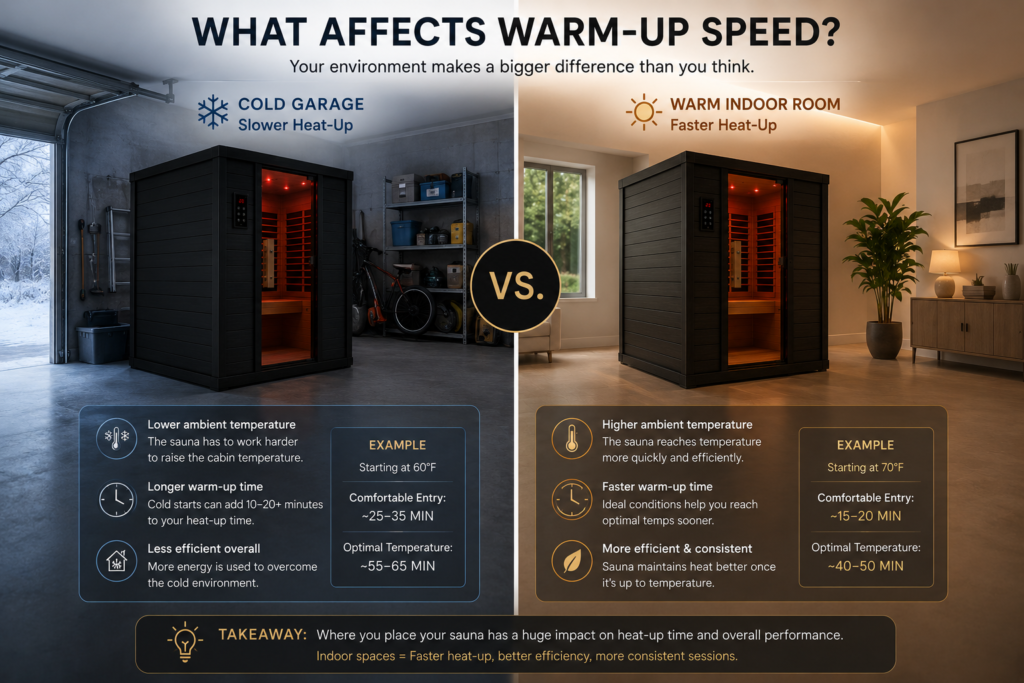
If your Sunlighten is consistently taking longer to heat up than expected, or never seems to reach a satisfying temperature, the cause is almost always one of these four factors.
1. Ambient room temperature
This is the dominant variable for all Sunlighten models. The Signature I documentation explicitly states that heat-up rate depends on room temperature — approximately one degree per minute under normal conditions. In a cold garage in winter, that rate slows significantly. Sunlighten’s own manual warns that warm-up can be impacted by placement near concrete floors or basement walls, which act as heat sinks.
If you’re installing a Sunlighten sauna in an unheated space, budget extra preheat time — and understand that in genuinely cold environments (below 50°F), the mPulse and Signature lines may struggle to reach their optimal temperature range at all.
Rule of thumb: For every 10°F drop in ambient room temperature below 70°F, add roughly 5–8 minutes to your expected preheat time. A garage at 45°F in winter can push a Signature I from a 45-minute preheat to 60–75 minutes — or mean it never fully reaches optimal temperature on the coldest days.
2. Circuit and electrical supply
The Signature I runs on a standard 120V/15A circuit at 1,350W. All other full-size Sunlighten models — Signature II and larger, mPulse Believe and larger, all Amplify models — require a dedicated 120V/20A circuit. Running a 20A-rated sauna on a shared 15A circuit directly reduces wattage delivered to the heaters, extending warm-up time and reducing peak temperature.
One long-term mPulse owner’s experience is instructive here: the mPulse Believe requires a dedicated 120V 20A NEMA 5-20R outlet, and having this installed by an electrician before setup is the correct approach. If you’re experiencing slow heating and haven’t confirmed your dedicated circuit, that’s the first thing to check.
3. Heater panel condition
Over time, individual SoloCarbon panels can degrade or develop connection issues. If your sauna heats unevenly — warm on one side and noticeably cooler on another — that points to a specific heater panel rather than a general performance issue. Sunlighten’s warranty covers heater panels for 7 years on most models, so an uneven-heating issue is worth reporting to their support team rather than accepting as normal performance.
4. mPulse tablet and timer settings
The mPulse’s Android control tablet adds a layer of complexity that can affect heating. Timer settings, session programs, and connectivity issues can all cause the sauna to behave unexpectedly. If your mPulse seems to shut off before reaching temperature, verify the session timer hasn’t expired. The tablet is also known to have reliability issues after extended use in heat — many owners end up using the physical external control panel instead, which is a more reliable fallback.
Quick diagnosis: Slow in winter but normal in summer → ambient temperature. Always slow regardless of season → check circuit and dedicated outlet. Heats unevenly → heater panel issue, contact Sunlighten support. Shuts off unexpectedly → check mPulse timer settings or use external control panel.
How Sunlighten Compares to Other Brands on Heat-Up Time
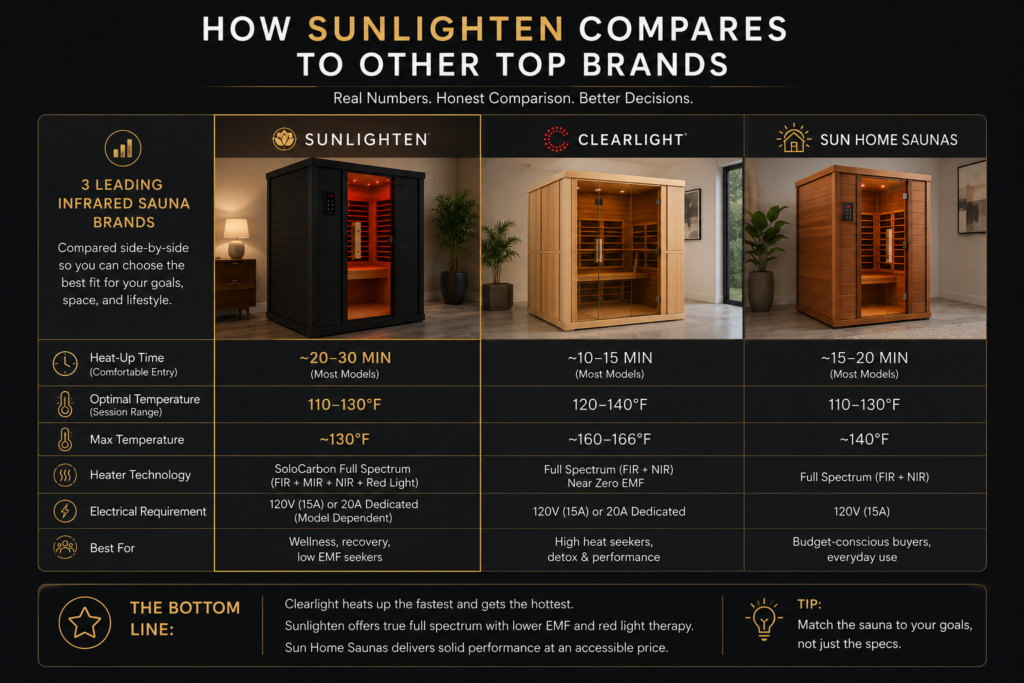
Sunlighten occupies a specific position in the heat-up speed comparison: not the fastest, but more consistent than budget brands, and with a clear internal hierarchy depending on which model line you choose.
Compared to Clearlight, Sunlighten’s Signature and mPulse lines have similar warm-up profiles for comparable cabin sizes — both in the 15–30 minute comfortable-entry range, with optimal temperature reached in 40–50 minutes. Clearlight’s True Wave heaters run at lower surface temperatures but achieve competitive heat-up times due to efficient far infrared output in the 9.4-micron range. Neither brand is dramatically faster than the other at similar power levels.
Where Sunlighten diverges is at the extremes of its lineup. The Amplify, with its halogen heaters, is genuinely faster and hotter than anything Clearlight offers. The Signature I, at 1,350W, is one of the lower-powered single-person saunas in the premium category, and its slower heat-up reflects that power level honestly.
Compared to Sun Home saunas, which are designed around higher power density and faster core temperature rise, Sunlighten’s mPulse and Signature lines produce a noticeably more gradual heating curve. Sun Home’s engineering prioritizes aggressive heat output; Sunlighten’s prioritizes infrared quality and even distribution. These are different engineering philosophies, not simply different price points — and buyers should choose based on which outcome they actually want.
Put simply: Sun Home is built to make you sweat faster. Sunlighten is built to deliver infrared more precisely. Neither is wrong — they solve different problems.
If your primary goal is to heat up fast and sweat hard, Sunlighten is not the strongest option in its price range. If your goal is a guided, comfortable wellness session with clinically tested infrared delivery, Sunlighten is genuinely difficult to beat.
Before you buy — check this first
If you’re deciding between Sunlighten, Clearlight, and Sun Home specifically on heating performance, warm-up speed, and real-world EMF levels, our side-by-side analysis breaks down exactly where each brand wins — and where the marketing doesn’t match the engineering.
→ See our full infrared sauna rankings for 2026 · Sun Home vs Sunlighten: power vs smart systems
Who This Matters Most For
Heat-up time and heating profile aren’t equal concerns for every buyer. Here’s an honest breakdown of where Sunlighten’s performance fits — and where it doesn’t.
Sunlighten is a strong fit if:
- You want a guided wellness system, not just heat. The mPulse’s six preset programs — built from 37 third-party clinical studies — are the most sophisticated in the consumer infrared sauna category. If you want structured sessions for specific goals (cardiac, detox, recovery), no competitor matches this.
- You prioritize infrared quality over cabin air temperature. Sunlighten’s SoloCarbon heaters have independently verified 96–99% emissivity — among the highest in the industry. If what you care about is high-quality infrared reaching your body rather than how hot the air feels, Sunlighten delivers.
- You’re installing indoors in a climate-controlled room. In these conditions, Sunlighten’s 45-minute preheat becomes manageable by simply scheduling sessions in advance. The heating consistency is reliable when ambient conditions are favorable.
- Long-term warranty coverage matters to you. Sunlighten offers a 7-year warranty on heaters and wood cabinetry — stronger than most competitors at comparable price points.
Think carefully about Sunlighten if:
- You want fast, intense heat on demand. If you’re the type to decide spontaneously “I’m going to sauna now,” a 45-minute optimal preheat requires adjustment. The Amplify partially addresses this, but even it isn’t a “quick heat” product compared to brands designed for high power density.
- Your installation space is a cold garage or basement. This is where Sunlighten’s heating limitations become most noticeable. The Signature and mPulse lines may struggle to reach peak temperature in cold environments, and the mPulse’s tablet adds a reliability variable in temperature-stressed conditions.
- You’re comparing on price-to-heat-performance ratio. At $7,000–$12,000 for the mPulse, you’re paying substantially for the smart features, brand heritage, and clinical research backing. If heating performance per dollar is the priority, there are capable alternatives at lower price points that heat faster and don’t require the same electrical planning.
- You want the smartest features without the reliability risk. The mPulse tablet has a documented track record of heat-related failure after extended use. For a premium product at this price, that’s a genuine concern worth researching before committing.
For a deeper look at how Sunlighten’s heating profile compares specifically to Sun Home — the brand most commonly positioned as the performance alternative — see our Sun Home vs Sunlighten comparison.
The Right Way to Use Sunlighten’s Heat-Up Time
Sunlighten’s official protocol, consistent across all model lines, is to preheat for approximately 45 minutes and begin your session when the cabin reaches 100°F. The optimal experience occurs between 100°F and 130°F.
For new users, Sunlighten recommends beginning with 10–15 minute sessions at 100°F every other day, extending as acclimatization develops. The don’t-be-surprised-if-you-don’t-sweat-in-the-first-few-sessions note in the user manual is worth taking seriously — Sunlighten saunas have a learning curve that reflects the gradual nature of infrared heating rather than the immediate intensity of traditional saunas.
For experienced users, the most effective approach is to set the temperature to maximum regardless of your comfort preference. This keeps the heaters running at full output throughout the session. The air temperature will stabilize in the 120–130°F range — the thermostat setting doesn’t determine the cabin air temperature, it determines when the heaters cycle off.
| Session stage | Recommended action | Why |
|---|---|---|
| 0–45 min | Preheat outside the sauna (official guidance) | Panels reach stable output; cabin approaches optimal temperature range |
| 15–20 min (alternative) | Enter early and warm up with the sauna | Valid approach for infrared saunas; you receive infrared energy from the start |
| Session (30–45 min) | Set temp to maximum; stay seated | Keeps heaters at full output; core temperature rises gradually |
| Post-session | Cool down naturally; rehydrate with 24+ oz water | Sunlighten’s specific post-session protocol from the user manual |
Frequently Asked Questions
Why does my Sunlighten take so long to heat up compared to what I expected?
The most likely explanation is that you were comparing Sunlighten’s comfortable-entry time (15–20 minutes) to its optimal session temperature time (45 minutes), or comparing to a brand that uses different measurement standards. Sunlighten’s official 45-minute guidance is honest and reflects the Signature I’s 1,350W output heating at approximately one degree per minute from a standard room temperature. It’s slower than some competitors and that’s a factual characteristic of the product, not a defect.
Does the mPulse heat up faster than the Signature?
Not meaningfully for comparable cabin sizes. The mPulse’s full-spectrum heaters add near and mid infrared to the far infrared output, but the power density and warm-up profile are similar to the Signature at equivalent wattage. The Amplify heats faster than either, specifically because of its additional halogen heaters — not because of the infrared spectrum differences.
Why does my Sunlighten feel less intense than I expected at maximum temperature?
This is one of the most common first-impression issues with Sunlighten — and it’s by design, not a malfunction. Sunlighten’s philosophy is optimal infrared delivery at moderate cabin temperatures, not aggressive air heat. The cabin will stabilize at 120–130°F regardless of the thermostat setting. If you’re 20–25 minutes in and not sweating, extend the session rather than increasing the dial — the sweating response is threshold-driven, and most users cross it between 25–40 minutes. The mPulse in particular is built for gradual, sustained sessions rather than intense immediate heat.
Is the Amplify worth it specifically for faster heat-up?
If faster warm-up and higher peak temperature are your primary goals within the Sunlighten lineup, yes — the Amplify is the honest answer. The halogen heaters make a genuine difference in both speed and ceiling temperature. The trade-off is that you lose the mPulse’s smart features and the full floor heater coverage. Whether that trade-off makes sense depends on whether you actually use the programmatic features or primarily just want to sweat.
My Sunlighten heats unevenly — one side feels much hotter. Is this normal?
No, this is not normal and should be reported to Sunlighten support. Uneven heating across the cabin typically indicates a specific heater panel that has failed or lost connection. Sunlighten’s warranty covers heater panels for 7 years — document the issue, note which area feels cooler, and contact their customer care team. This is a fixable problem, not an inherent design characteristic.
Bottom line
Sunlighten saunas heat up in 15–20 minutes to a comfortable entry point and 40–50 minutes to optimal session temperature under normal indoor conditions. The 45-minute official guidance is honest — and buyers comparing to brands advertising shorter preheat times should verify whether those comparisons are measuring the same thing.
Within the lineup, the Amplify is the fastest and hottest. The Signature is the slowest at the 1-person level due to its lower wattage. The mPulse sits in between, prioritizing infrared precision over heat speed. None of these are defects — they are the predictable result of each line’s engineering priorities.
If warm-up speed and heat intensity are your primary purchase criteria, Sunlighten’s Amplify is the right choice within the brand, or a higher-power-density competitor may be a better fit entirely. If infrared quality, clinical research backing, and long-term reliability matter more, Sunlighten remains one of the most credible options in the category.
→ See our full infrared sauna rankings for 2026 · Sun Home vs Sunlighten: which delivers more heat per dollar?
About Pure Recovery Lab
Pure Recovery Lab focuses on breaking down real performance factors behind recovery equipment — especially what most brands don’t explain clearly.
Transparency
This article may contain affiliate links. We may earn a commission at no extra cost to you.