Quick Answer — if you want the short version:
- Sunlighten’s official low-EMF claims are real and independently verified
- Independent seated-position measurements are consistently higher than the marketed figures — especially for the mPulse
- Even the higher readings remain well below every international safety threshold
- The Signature series performs better than the mPulse for EMF-conscious buyers
- Sunlighten does not publish ELF data — a gap worth asking about before purchasing
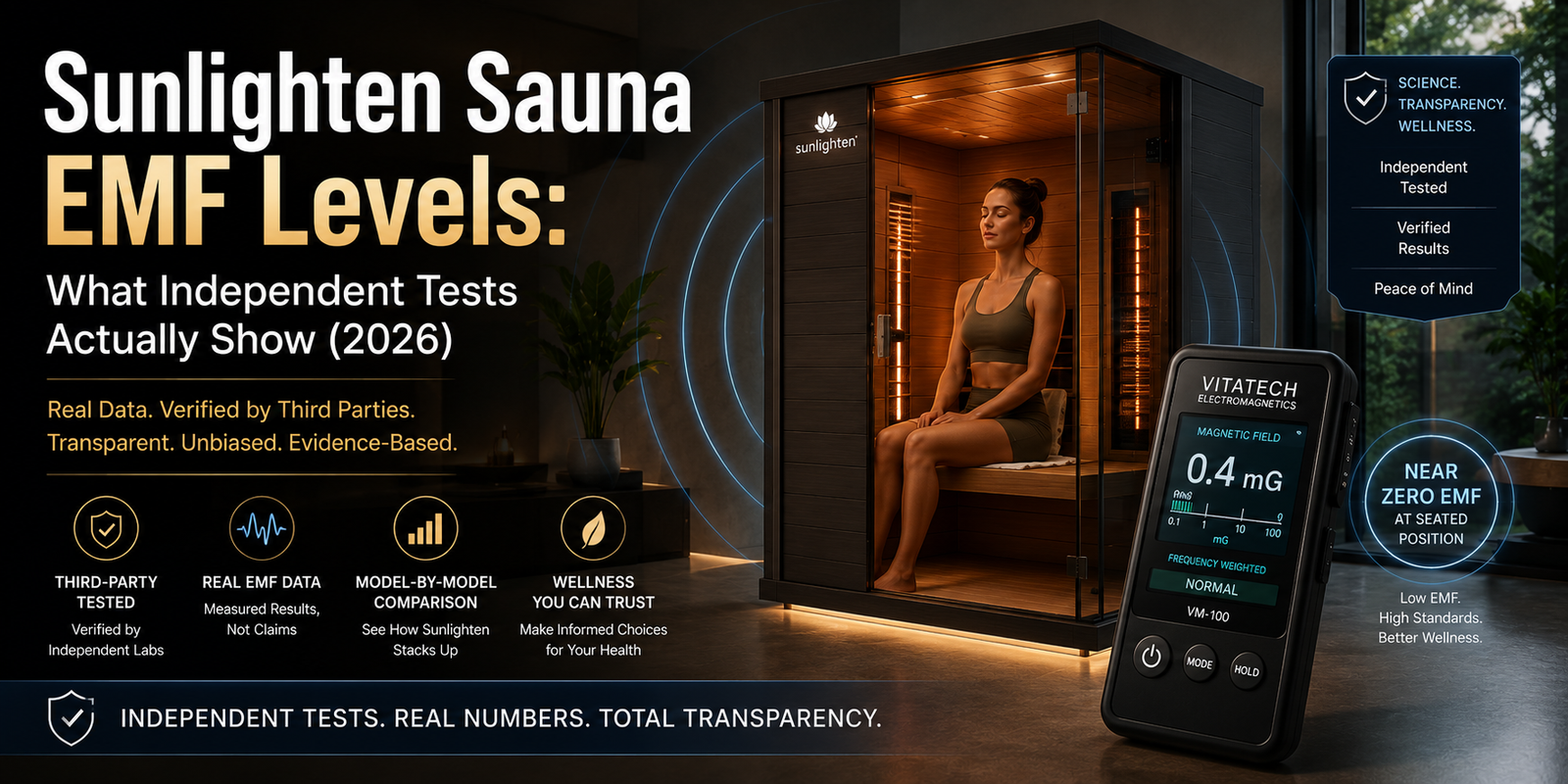
Sunlighten markets their saunas as low-EMF, and they have third-party testing to back that claim. But if you look closely at their documentation — and at independent tests conducted outside of Sunlighten’s own facilities — a more nuanced picture emerges.
The official VitaTech figure is 0.5 mG or less. Independent real-world measurements on the mPulse range from 3.5 mG to 5.0 mG at the seating position. Sunlighten’s own Australian site acknowledges saunas have been measured between 0 and 10 mG across the full lineup. Sunlighten’s primary testing was conducted at the heater panel surface, not at the seated user position.
None of these numbers are necessarily dangerous — all fall well below ICNIRP’s general public reference level of 1,000 mG. But the gap between Sunlighten’s marketed figure and real-world measurements is large enough to deserve honest explanation.
This guide breaks down what the VitaTech test actually measures, how different Sunlighten models compare, and what the independent evidence says — clearly distinguishing verified data from unverified claims.
Key distinction upfront: Sunlighten’s published VitaTech figure (0.5 mG or less) is measured at the heater panel surface. This is the standard methodology for comparing heater design. Your actual EMF exposure during a session depends on your distance from the panels — and at typical seating positions, independent measurements consistently show higher readings than the heater-surface figure.
The VitaTech Test: What Document VTE-3200 Actually Covers
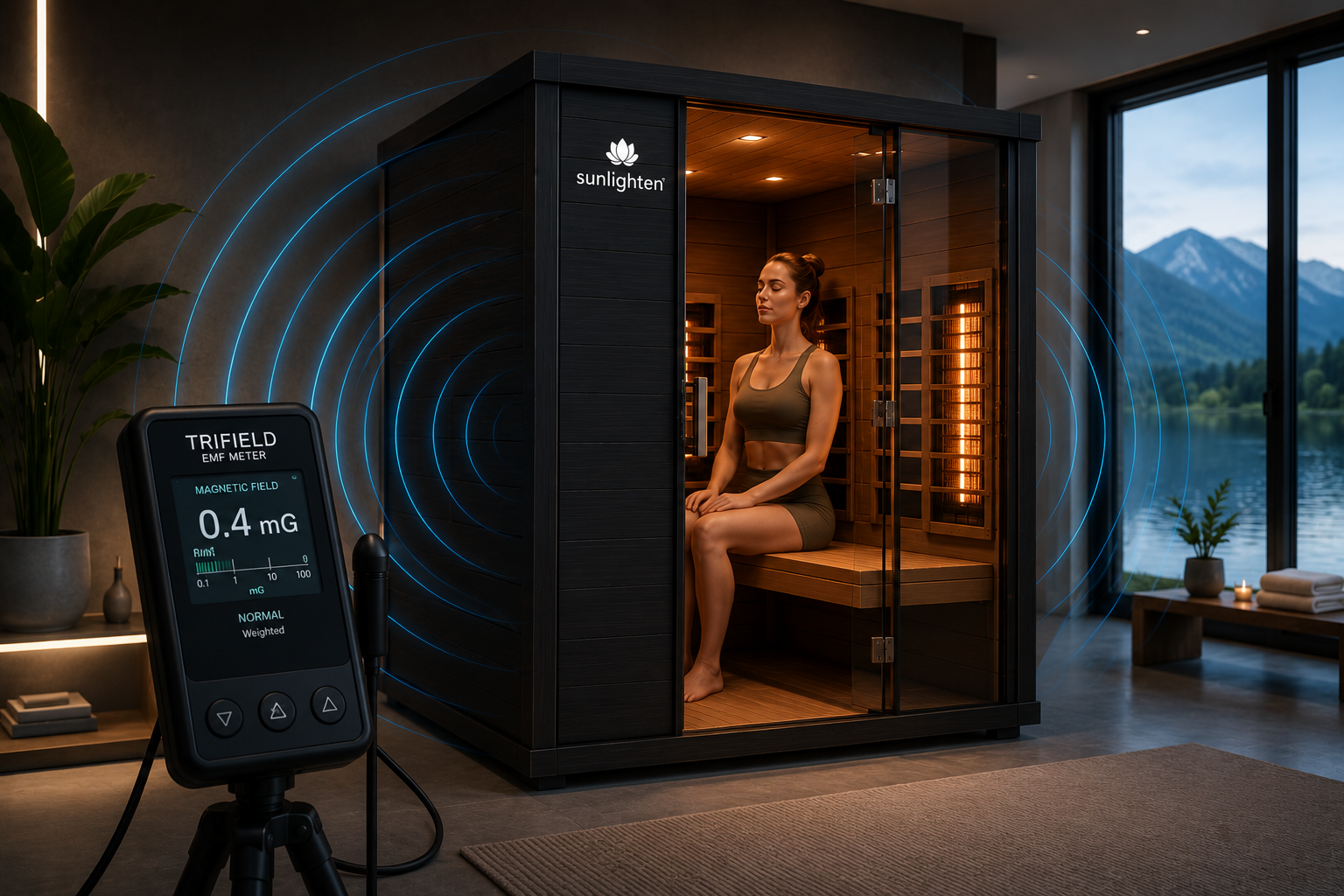
Sunlighten is one of the few infrared sauna brands that makes its VitaTech Electromagnetics test report publicly accessible. The document number is VTE-3200 (publicly accessible PDF), and it represents a meaningful level of transparency that most competitors don’t offer.
VitaTech Electromagnetics has been the industry standard for sauna EMF testing for over 25 years. Their methodology involves measuring EMF at the heater element surface under controlled conditions. The VTE-3200 report was conducted at Sunlighten’s warehouse in Lenexa, Kansas, with the stated objective of determining the maximum EMI that a user would be exposed to during typical use.
The results Sunlighten publishes from this report:
- Heater panels measure 0.5 mG or less — lower than 95% of common household devices
- Some panels measure as low as 0.1 mG
- All readings below VitaTech’s industry standard threshold of 10 mG for “ultra-low” classification
These are real figures from a named, credible independent lab. The question is not whether the testing is legitimate — it is. The question is what the heater-surface measurement tells you about your actual exposure during a 30–45 minute session.
The measurement gap: EMF drops significantly with distance. A heater measuring 0.5 mG at the surface will measure less at 6 inches, less again at 12 inches. But a full-spectrum sauna with multiple heater types — near, mid, and far infrared elements, plus control electronics — has multiple EMF sources. The seated user position reading integrates all of these sources at your actual distance, and that figure is not what VTE-3200 primarily reports.
EMF Levels by Sunlighten Model: What the Evidence Shows
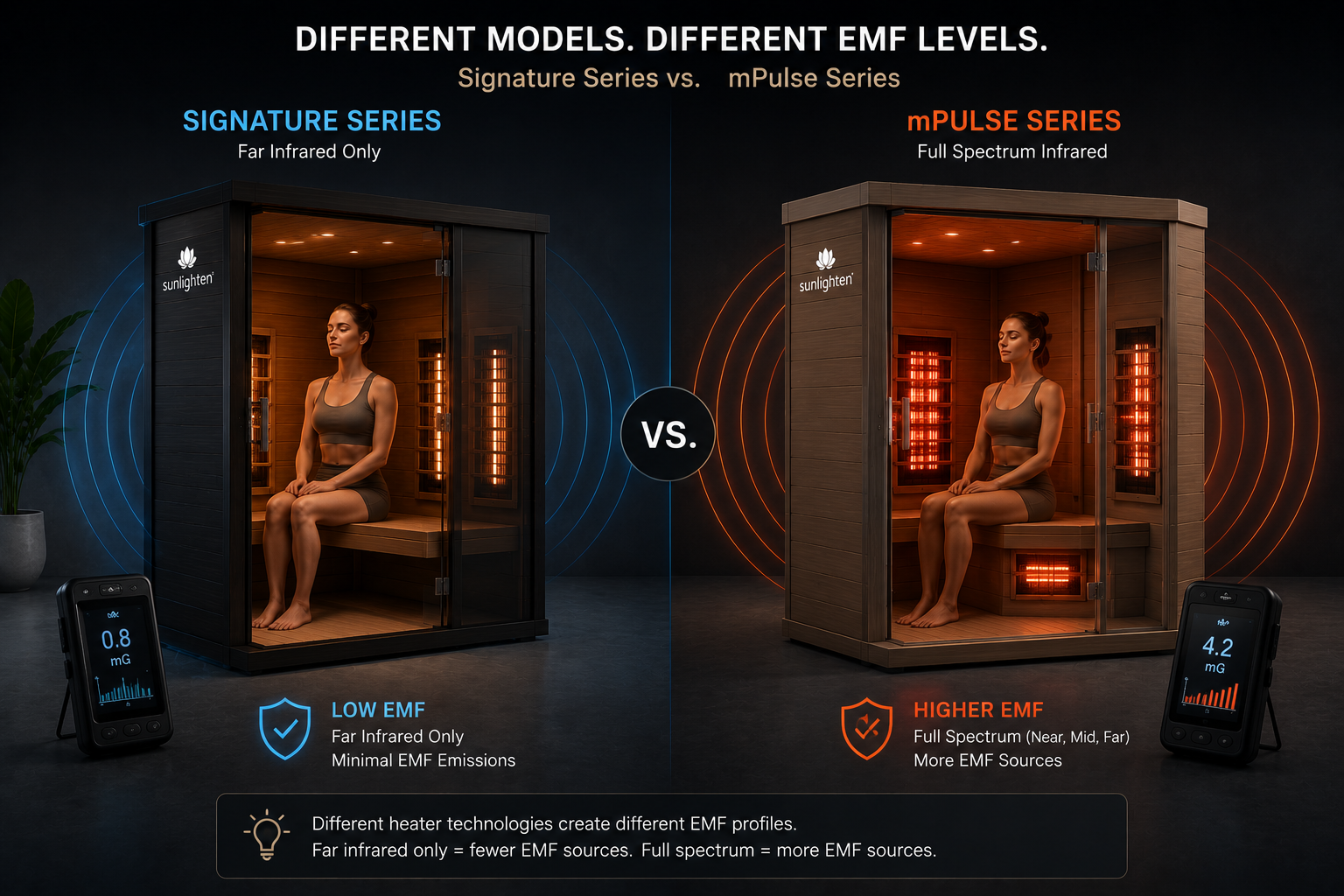
Sunlighten’s lineup spans four product lines with meaningfully different EMF profiles. Understanding the differences between them matters for purchase decisions.
| Model line | Heater type | Official figure (VitaTech) | Independent measurements | ELF data |
|---|---|---|---|---|
| Signature series | SoloCarbon far infrared only | Below 1 mG at panel surface | Below 3.0 mG (multiple sources) | Limited published data |
| mPulse series | SoloCarbon full spectrum (NIR + MIR + FIR) + control tablet | 0.5 mG or less at panel surface | 3.5–5.0 mG at seating position (independent); some reports up to 10+ mG | Not separately published |
| Amplify series | SoloCarbon + halogen heaters | Not separately published | Limited independent data | Not published |
| Solo (portable) | SoloCarbon far infrared | Below 1 mG at panel surface | Consistent with Signature range | Not published |
The mPulse is the model with the largest gap between official and independent measurements. This is not surprising: the mPulse includes near and mid infrared heaters alongside far infrared, a control tablet with its own electronics, and more complex wiring than the far-infrared-only Signature. More components means more potential EMF sources — and the seated-position reading integrates all of them.
What Independent Testing Shows (And Why It Differs from Official Figures)
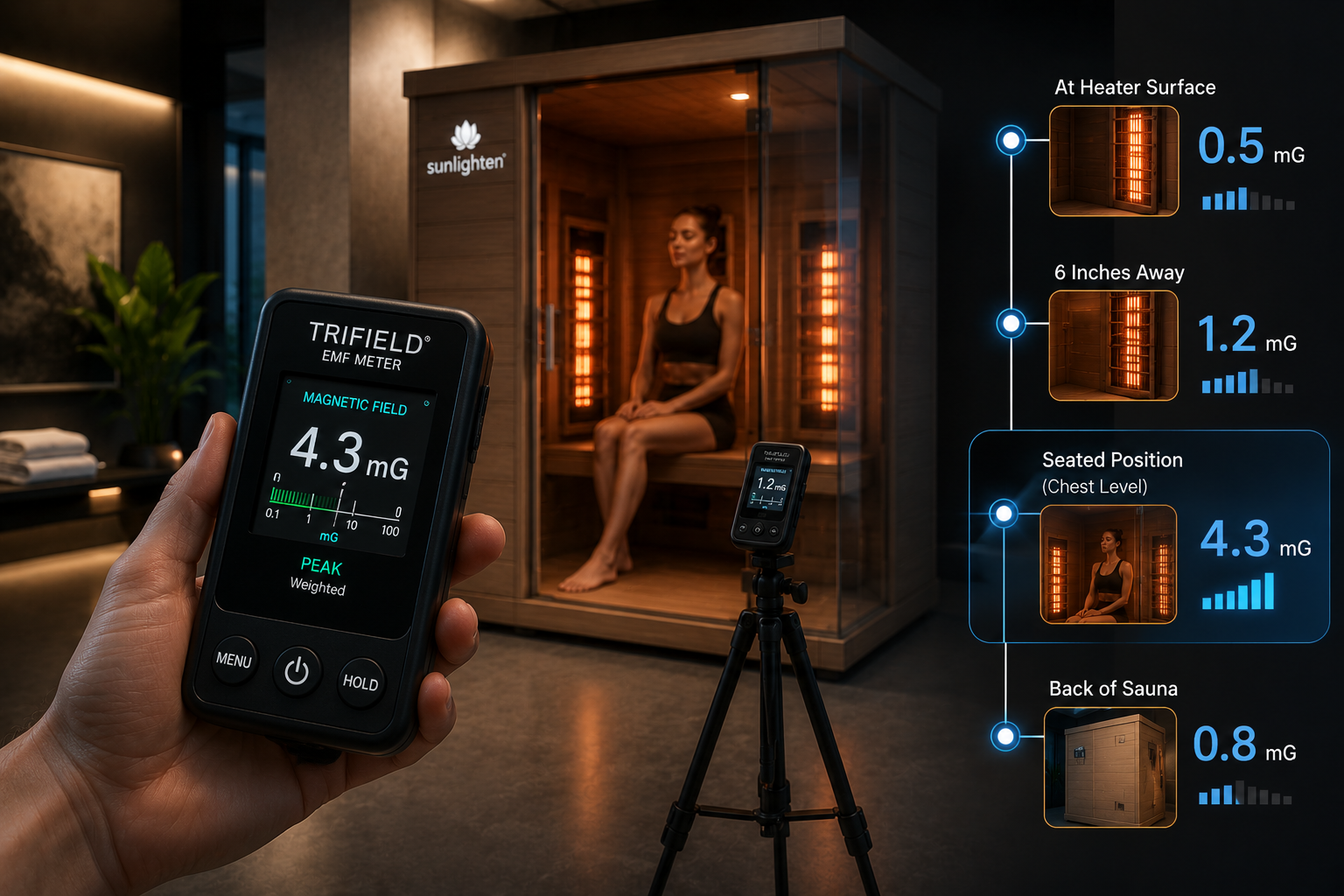
Three categories of independent evidence exist for Sunlighten’s EMF performance, and they tell a more variable story than the official marketing.
Consumer reviewer measurements (Trifield TF2 meter)
At least one long-term mPulse owner published independent Trifield TF2 measurements taken directly next to the control board of one of the heaters. The results showed that with the exception of electric emissions from the heater control board, the mPulse adds very little to overall EMF exposure — a result that aligns broadly with Sunlighten’s claims for the far infrared panels specifically.
However, this testing was conducted at the reviewer’s outdoor patio, which introduces ambient EMF from WiFi and other devices. It is not a controlled environment measurement.
Specialist EMF assessors
Healing Heat Therapy, a site focused specifically on EMF-conscious sauna selection, reports independent measurements of 3.5–5.0 mG on the mPulse at the seating position. Their broader assessment: the Signature series measures below 3.0 mG, while older mPulse models reported levels over 10 mG, with their direct readings settling at 3.5–5.0 mG. They note that Sunlighten has substantially reduced EMF over the past decade but remains higher than Clearlight’s far infrared models.
Critical independent review
One critical review site (Sauna-Warnings.com) reports seating-position readings of 5–15 mG and electric field readings of 25–40 V/m, describing the ELF performance as “not unsafe but certainly not industry-leading.” This site has a clear position favoring other brands and should be read with that context in mind — but the directional finding (mPulse measures higher at the seating position than official figures suggest) is consistent with other independent sources.
What the independent evidence consistently shows: Sunlighten’s Signature series performs closer to their official 0.5 mG figure at the seating position. The mPulse, with its additional heater types and electronics, measures higher — consistently in the 3–5 mG range at seated distance in independent testing, not the sub-1 mG figure the official marketing implies. All of these figures are well within international safety limits. The question is whether the official claims are complete.
The ELF Question: What Sunlighten Doesn’t Publish
ELF — extremely low frequency electric fields — is a separate source of electromagnetic exposure that comes from wiring, not heater panels. It is measured in volts per meter (V/m).
Three things to understand about ELF in saunas:
- ELF originates primarily from electrical wiring running through the cabin, not the heater elements themselves
- A sauna can have low heater-panel EMF and still expose users to significant ELF from standard wiring
- Brands like Clearlight specifically address wiring ELF through metal conduit and twisted-pair construction — and publish the results
Sunlighten does not publish separate ELF figures for any of their models. Their VTE-3200 documentation covers magnetic field EMF from heater panels only. Whether their wiring design addresses ELF is not something their published documentation answers.
The one independent estimate available — from a critical review site — puts Sunlighten mPulse electric field readings at 25–40 V/m. For context, Clearlight publishes an ELF figure of 3.4 V/m from their own VitaTech testing. This source has a clear brand preference and should be treated as directional rather than definitive — but the directional finding (Sunlighten does not address ELF as comprehensively as Clearlight) is consistent with what their published documentation shows.
In simple terms: Sunlighten is transparent about heater-panel EMF and less transparent about ELF from wiring. If ELF matters to you specifically, ask Sunlighten directly for this data before purchasing.
How Sunlighten Compares to Other Brands on EMF
| Brand | Official figure | Independent seating-position data | Testing lab | ELF data published |
|---|---|---|---|---|
| Sunlighten Signature | Below 1 mG (panel surface) | Below 3.0 mG | VitaTech (VTE-3200) | No |
| Sunlighten mPulse | 0.5 mG (panel surface) | 3.5–5.0 mG (independent) | VitaTech (VTE-3200) | No |
| Clearlight Premier | Below 1 mG (panel surface) | Consistent with official figure | VitaTech | Yes — 3.4 V/m average |
| Sun Home | 0.5 mG (VitaTech verified) | Consistent with official figure | VitaTech | Yes — dual EMF/ELF shielding |
| Dynamic / budget brands | 5–10 mG (self-reported) | Varies; often higher than stated | No named lab | No |
The honest summary: Sunlighten’s Signature series has a solid EMF profile that independent testing broadly supports. The mPulse is more complex — official figures are from heater surfaces, while independent seated-position measurements are consistently higher. Clearlight and Sun Home publish more complete data including ELF figures, and their far-infrared models show a smaller gap between official and independent measurements.
What International Safety Standards Say
Before evaluating any of these figures, here are the reference points that independent standards bodies actually use:
- ICNIRP (WHO-recognized): general public limit of 1,000 mG for ELF magnetic fields
- VitaTech’s industry standard: 10 mG or less = “ultra-low EMF”
- IRPA/INIRC: 833 mG maximum for general public over 24 hours
At 0.5 mG (official) or 3.5–5.0 mG (independent seated), Sunlighten saunas fall well below every relevant reference level — including VitaTech’s own 10 mG “ultra-low” threshold. The concern is not that their EMF levels are dangerous. The concern is whether their marketing accurately represents what users are actually exposed to during a session.
Bottom line on safety: At any of the measured levels — official or independent — Sunlighten saunas fall well below established safety thresholds. The gap between their marketing figure and real-world measurements is a transparency issue, not a safety issue. For buyers who are not EMF-sensitive, this distinction may not be material. For buyers with specific EMF concerns, it is worth understanding before purchase.
Before you buy — check this firstIf you’re deciding between Sunlighten, Clearlight, and Sun Home specifically on EMF performance, our side-by-side analysis compares verified figures, ELF data, and independent testing across all three brands.
→ See our full infrared sauna rankings for 2026 · How to evaluate any sauna brand’s EMF claims
Who This Matters Most For
Sunlighten’s EMF performance is acceptable if:
- You are not specifically EMF-sensitive. At 3.5–5.0 mG at the seating position — the most credible independent figure for the mPulse — you are well within every published safety threshold. For the majority of buyers, this level of EMF exposure during a 30–45 minute session is not a meaningful health concern.
- You prioritize the mPulse’s clinical features alongside acceptable EMF. The mPulse’s programmatic wellness sessions, SoloCarbon heater quality, and 25+ year brand track record are genuine strengths. If these matter more than minimizing every possible EMF source, the mPulse remains a credible choice.
- You’re choosing the Signature series over mPulse. The Signature’s far-infrared-only design produces a simpler EMF profile — below 3.0 mG in independent testing — that is closer to Clearlight Premier territory. For EMF-conscious buyers who don’t need full-spectrum features, the Signature is the stronger Sunlighten choice on this specific criterion.
Think carefully if:
- You have documented EMF sensitivity. If you are choosing a sauna specifically because of EMF concerns, the gap between Sunlighten’s official 0.5 mG figure and independent mPulse measurements of 3.5–5.0 mG is material. Clearlight’s far infrared models and Sun Home’s full lineup show a smaller gap between marketed and measured figures.
- ELF exposure is a specific concern. Sunlighten does not publish ELF data. Clearlight and Sun Home do. If ELF matters to you specifically, Sunlighten cannot give you the documentation to evaluate this — which means you are accepting their EMF credentials on trust for this dimension of exposure.
- You are comparing the mPulse to Clearlight Premier on EMF as the primary criterion. The evidence consistently shows Clearlight’s far infrared panels have lower seated-position EMF than the mPulse’s full-spectrum system. If EMF minimization is the primary purchase criterion, Clearlight Premier is the stronger choice on the available evidence.
For a direct comparison of how Sunlighten and Clearlight perform across all key criteria — not just EMF — see our Clearlight vs Sunlighten full comparison. For Clearlight’s specific EMF data and how their shielding approach differs, see our Clearlight sauna EMF levels guide.
Frequently Asked Questions
What EMF level does a Sunlighten sauna actually emit?
Sunlighten’s official VitaTech-verified figure is 0.5 mG or less, measured at the heater panel surface. Independent measurements at the seated user position consistently show higher readings: below 3.0 mG for the Signature series, and 3.5–5.0 mG for the mPulse in multiple independent tests. All figures are well below the ICNIRP general public reference level of 1,000 mG and below VitaTech’s own 10 mG “ultra-low” standard.
Why is there a gap between Sunlighten’s official figure and independent measurements?
Sunlighten’s official figure is measured at the heater panel surface under controlled lab conditions. Independent measurements are taken at the seated user position — where you actually sit during a session — which integrates EMF from all sources: all heater types, wiring, and control electronics. EMF drops with distance, but the mPulse’s additional heater components and control tablet add EMF sources that the far-infrared-panel figure doesn’t capture.
Is the Signature or mPulse better for EMF?
The Signature series has a cleaner EMF profile. Its far-infrared-only SoloCarbon design is simpler — fewer heater types, no control tablet in the cabin — and independent measurements consistently place it below 3.0 mG at the seating position. The mPulse’s full-spectrum design and integrated electronics produce a more complex EMF environment, with independent seated-position measurements in the 3.5–5.0 mG range. For buyers prioritizing EMF minimization within the Sunlighten lineup, the Signature is the stronger choice.
Does Sunlighten publish ELF data?
No. Sunlighten’s publicly available documentation covers magnetic field EMF from heater panels. ELF from wiring is not addressed in their published materials. If ELF is a specific concern, request this data directly from Sunlighten before purchasing — and compare their response to brands like Clearlight that publish specific ELF figures from independent testing.
How does Sunlighten compare to Clearlight on EMF?
For far-infrared models: Sunlighten Signature and Clearlight Premier are broadly comparable, with independent measurements in similar ranges (below 3.0 mG for both). For full-spectrum models: Clearlight Sanctuary’s far infrared panels perform similarly, but Clearlight additionally publishes ELF data (3.4 V/m average) that Sunlighten does not provide. On EMF transparency specifically, Clearlight’s documentation is more complete. On verified heater-panel EMF, both brands deliver credible low-EMF performance.
Bottom line
Sunlighten’s EMF credentials are real but require careful reading. The VitaTech test (VTE-3200) is a genuine independent verification — and the fact that this document is publicly accessible puts Sunlighten ahead of most competitors on transparency. The official 0.5 mG figure accurately represents what their SoloCarbon heater panels produce at the element surface.
The honest caveat is the gap between that figure and real-world seated-position measurements, particularly for the mPulse. Independent testing consistently places the mPulse at 3.5–5.0 mG at the seating position — higher than the marketed figure, though well within all published safety thresholds. The Signature series performs closer to its official figures. The absence of published ELF data is a genuine gap for buyers with specific ELF concerns.
Sunlighten is not a bad choice on EMF. It is a choice that requires understanding what their numbers actually measure — and asking the right questions about what they don’t publish.
→ See our full infrared sauna rankings for 2026 · How to evaluate any sauna’s EMF claims: the complete guide
About Pure Recovery Lab
Pure Recovery Lab focuses on breaking down real performance factors behind recovery equipment — especially what most brands don’t explain clearly.
Transparency
This article may contain affiliate links. We may earn a commission at no extra cost to you.