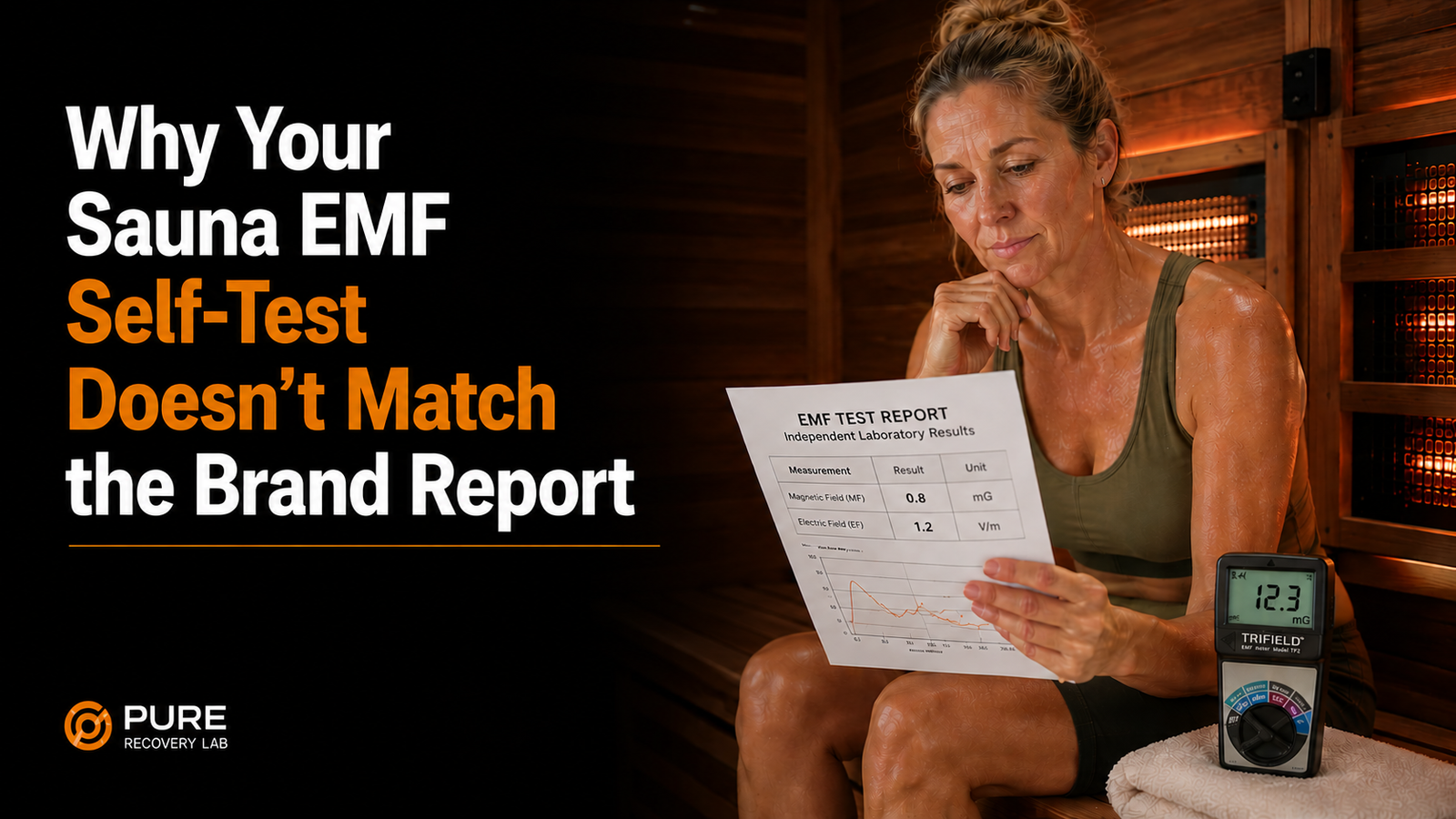
If your self-test reads higher than a brand’s sauna EMF report, you’re probably not being lied to — you’re measuring in a different place under different conditions. A sauna EMF report and a consumer self-test almost never use the same distance, temperature, or heater. A credible sauna EMF report needs four things: a named independent lab, measurements at seated body position (not floor level), readings at operating temperature, and separate figures for both magnetic field (mG) and electric field (V/m). Most brands only satisfy two or three of these.
A pattern that shows up repeatedly in sauna forums: someone downloads a brand’s sauna EMF report, sees 1 mG Vitatech-certified, feels confident — then picks up a Trifield TF2 after the sauna arrives, tests it at chest height while sitting inside, and reads 8, 12, sometimes 18 mG. Who’s right?
Usually both. They’re just measuring different things. Understanding why is the single most useful thing you can know before spending $2,000–$8,000 on a low-EMF sauna.
Why Your Self-Test Doesn’t Match the Sauna EMF Report
This isn’t a story about brands lying. It’s a story about how EMF measurements work — and how the same sauna can produce wildly different numbers depending on where, when, and how you measure it.
1. Testing distance is different
EMF drops off rapidly with distance. A brand that measures at 24 inches from the heater will report a much lower number than someone holding a meter at chest height 6 inches from the back panel. One documented case showed the same sauna reading 2.5 mG at floor level and 18 mG at seated chest height — a 7× difference, same machine, same meter.
Many brands measure at “seated distance” in their reports, but that phrase can mean anything from 6 to 24 inches. Without a specific distance stated in the report, the number is unverifiable.
2. The sauna was cold during testing
Heaters draw maximum current during warm-up and while maintaining temperature. An infrared sauna tested cold — before it reaches operating temperature — will produce lower EMF readings than one tested at 130–140°F under real-use conditions. Some brand reports don’t specify test temperature at all. If it’s not stated, assume the worst.
3. The wrong heater was tested
A typical infrared sauna has a back panel, side panels, a front panel, and sometimes a floor panel. The heater you sit closest to — the back panel — is where your EMF exposure is highest. Some brands submit only their side or floor heaters for testing, where readings are naturally lower. The report is accurate. It’s just not measuring your actual exposure.
4. Only magnetic field was reported, not electric field
mG measures magnetic field. V/m measures electric field. These are two separate things, and a sauna can have low mG and high V/m simultaneously. Many brands report only magnetic field readings. A Trifield TF2 measures both — so if your meter is picking up electric field that wasn’t in the brand report, the numbers won’t match.
5. Consumer meters vs. lab instruments
Professional lab meters like those used by Vitatech are calibrated to tighter tolerances than consumer meters. A Trifield TF2 is a solid consumer tool, but readings can vary by ±20–30% compared to lab instruments at the same location. Small differences between your reading and the brand report are expected. Differences of 2× or more warrant a closer look at the testing conditions.
6. Third-party certified ≠ complete picture
This is the one that surprises most buyers. Seeing “Vitatech third-party verified” feels like a guarantee — independent lab, professional equipment, no reason to doubt the number. But Vitatech only tests what the brand pays them to test. The brand chooses which heater, which distance, how many measurement points, and whether to include electric field or only magnetic field.
Vitatech’s numbers are accurate. The question is whether they reflect your actual exposure while sitting inside the sauna.
A brand can truthfully say “Vitatech-certified, 0.8 mG” — and that number can be 100% accurate at the specific distance and heater tested — while your real-world exposure at seated chest height from the back panel is 6–10 mG. Neither party is lying. The brand is reporting a real measurement. You’re measuring your actual use conditions. These are different things, and the gap between them is where buyer confusion lives.
What a Credible Sauna EMF Report Actually Needs
Once you understand why the numbers diverge, the question becomes: what would a sauna EMF report need to include to actually reflect my real exposure? Four conditions.
① A named, independent testing lab
Vitatech Electromagnetics is the industry standard for infrared saunas — accredited, experienced, and widely recognized. A few other credible labs exist (SGS, Intertek, TÜV Rheinland), but Vitatech does the majority of sauna EMF work in the US. Any brand citing an unnamed lab, or “internal testing,” or “factory certification” without a third-party name attached should be treated with skepticism regardless of the number they show you.
② Measurements at seated body position
The report must specify the exact measurement distance. “At the heater surface” and “at seated distance” are not interchangeable — a reading of 0.3 mG at the heater face (SaunaSpace’s methodology) tells you something different from 0.8 mG at 6-inch seated distance (Sun Home’s methodology). Neither is wrong. But you need to know which one you’re looking at.
Floor-level measurements are useless for buyers. If a report doesn’t state where the meter was placed, call the brand and ask. A brand confident in its data will tell you immediately.
③ Testing at operating temperature
The report should state what temperature the sauna was at during testing. 130–140°F is realistic operating temperature for most FIR saunas. Testing at room temperature or during warm-up produces readings that don’t reflect daily use. This detail is often buried in the methodology section — look for it.
④ Separate readings for MF (mG) and EF (V/m)
Magnetic field and electric field are independent. A sauna engineered to cancel magnetic fields can still have high electric field emissions from unshielded wiring. Any report that only lists mG is incomplete. The best reports (Clearlight’s Vitatech report, Sun Home’s Vitatech report) list both measurements at multiple positions. If you only see one number, ask the brand for the complete report.
How the Main Brands Stack Up
With those four criteria in mind, here’s how the brands we cover perform on report transparency — not EMF performance, but whether their documentation actually answers the question.
| Brand | Testing Lab | Distance Stated? | MF + EF Both? | Full PDF Public? | Report Quality |
|---|---|---|---|---|---|
| Clearlight | Vitatech | ✅ Seated position | ✅ | ✅ | Strong |
| Sunlighten | Vitatech | ✅ Seated position | ✅ | ✅ | Strong |
| Sun Home | Vitatech | ✅ Multiple distances | ✅ | ✅ | Strong |
| SaunaSpace | Geovitals (in-house) | ⚠️ Guard face only | ✅ | Partial | Technically credible, not independently audited |
| Dynamic | Self-reported | ⚠️ Distance unclear | ❌ mG only | ❌ | Incomplete |
| JNH | Third-party (unnamed) | ⚠️ Not specified | ❌ mG only | ❌ | Incomplete |
Based on publicly available documentation as of May 2026. “Strong” = satisfies all four criteria. “Incomplete” = one or more criteria missing. This table rates report quality, not EMF performance.
The three premium brands — Clearlight, Sunlighten, Sun Home — all publish full Vitatech sauna EMF reports with methodology, distance, and both field types. You can download and read them. That’s the standard to hold all brands to.
SaunaSpace is a different case. Their EMF engineering is genuinely different (incandescent bulbs in Faraday-cage guards rather than carbon FIR panels), and their in-house Geovitals testing is technically credible. The limitation is that it hasn’t been independently audited the way Vitatech tests have.
Dynamic and JNH are the most common budget options in our coverage area. Neither publishes a complete third-party EMF report. That doesn’t mean their EMF is dangerous — it means you can’t verify what you’re buying from documentation alone.
If You Still Want to Self-Test
Consumer self-testing is a reasonable step, especially if you’ve already purchased and want to verify. A few practical notes:
- Use a Trifield TF2 ($170). It’s the most widely used consumer EMF meter with reliable accuracy at ELF frequencies. Avoid meters under $50 — they produce unstable readings that can’t be trusted for a purchase decision.
- Test at operating temperature. Let the sauna run for at least 20 minutes before testing. Cold-sauna readings don’t reflect real use.
- Test at chest height, at your actual seated position. Hold the meter where your back and sides face the panels, not in the center of the cabin or at floor level.
- A 2× difference from the brand report is normal. Instrument variation between consumer and lab meters accounts for this. A 5× or greater difference at the same distance warrants a conversation with the brand.
- Test both modes on the Trifield TF2. Standard mode measures magnetic field (mG). Switch to the electric field mode and check V/m separately.
Frequently Asked Questions
Why is my sauna’s EMF higher than what the brand advertises?
Almost always because you’re measuring at a different distance or position than the brand tested. The most common cause: brands measure at seated distance (12–24 inches from the heater), while users naturally hold their meter close to the panel surface. The same sauna can read 2 mG at 18 inches and 15 mG at 2 inches. Check the brand’s report for the stated measurement distance before concluding there’s a discrepancy.
Does “Vitatech certified” mean the EMF report is trustworthy?
Vitatech’s testing is accurate and professional — but they only measure what the brand pays them to measure. A Vitatech report is as good as the testing protocol the brand requested. Check that the report specifies measurement distance, test temperature, the specific heater tested, and includes both mG and V/m readings. If any of those are missing, the report is incomplete regardless of who conducted it.
What’s the difference between EMF (mG) and ELF (V/m)?
mG (milligauss) measures magnetic field strength. V/m (volts per meter) measures electric field strength. These are separate phenomena and require different shielding approaches. A sauna can have low magnetic field (mG) and high electric field (V/m) simultaneously. Always look for both measurements in any EMF report — a brand that only reports one number is giving you an incomplete picture.
Does ETL or UL certification mean a sauna has low EMF?
No. ETL and UL certification covers electrical safety — proper grounding, fire hazard compliance, wiring standards. They have nothing to do with EMF levels. A sauna can be ETL-certified and emit 30+ mG. These are separate certifications testing completely different things.
Which sauna brands publish their full EMF test reports?
Clearlight, Sunlighten, and Sun Home all publish complete Vitatech PDF reports with methodology and raw data. SaunaSpace publishes partial Geovitals data. Dynamic and JNH do not publish full third-party reports as of May 2026.
How much difference between brand report and self-test is acceptable?
Up to 2× difference is within normal range given the accuracy gap between consumer meters (like Trifield TF2) and professional lab instruments. A difference of 5× or more at the same stated distance and position is worth raising with the brand — ask them to clarify the exact conditions of their test.
- Infrared Sauna EMF: What the Research Actually Shows — start here if you haven’t assessed the underlying EMF research yet
- Best Low EMF Infrared Saunas — how the main brands compare on actual EMF performance
- Clearlight EMF Levels — full breakdown of Clearlight’s Vitatech report by model
- Sunlighten EMF Levels — SoloCarbon panel readings across the mPulse and Signature series
- SaunaSpace EMF Levels — why SaunaSpace’s 0 mG claim is technically different from FIR brand claims
- Low EMF vs Regular Infrared Sauna — is the EMF difference worth the price premium?