
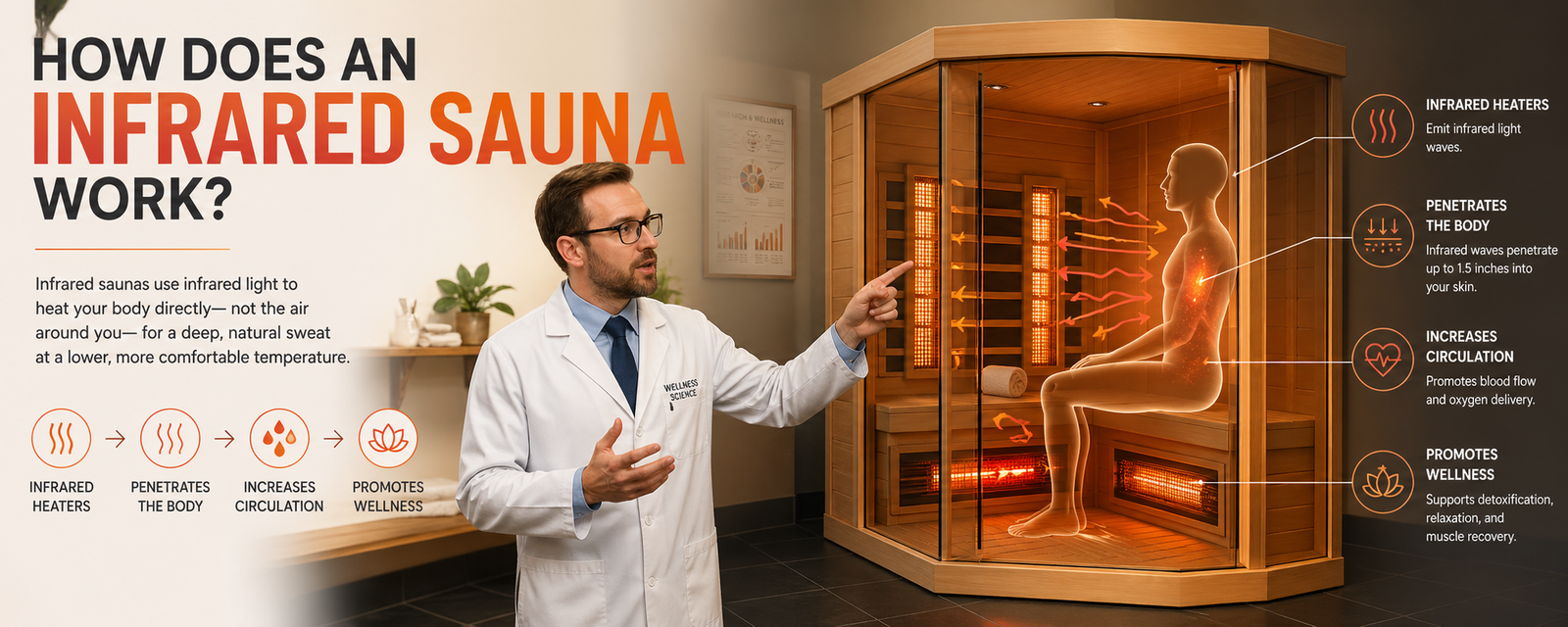
You’ve read that infrared saunas “heat the body directly.”
But that alone doesn’t explain why one person sweats within 15 minutes while another sits for 30 and barely feels warm.
The difference comes down to physics, physiology, and engineering — not marketing claims. This guide covers exactly how infrared saunas work, what the science actually says about NIR, MIR, and FIR wavelengths, why some saunas underperform, and what to look for before you buy.
Why Infrared Saunas Feel Different From Traditional Saunas
Two types of people search for answers about infrared saunas.
The first is deciding whether to buy one. They’ve seen wattage numbers, “full spectrum” claims, and ceramic-vs-carbon debates — but none of it translates into a clear picture of what actually makes a sauna work.
The second already owns one. They expected to sweat. They sat inside for 20 minutes and felt warm but not much else. Now they’re wondering if they bought the wrong product, or if they’re using it wrong.
Both groups are asking the same underlying question: what is this thing actually doing to my body, and why does the experience vary so much?
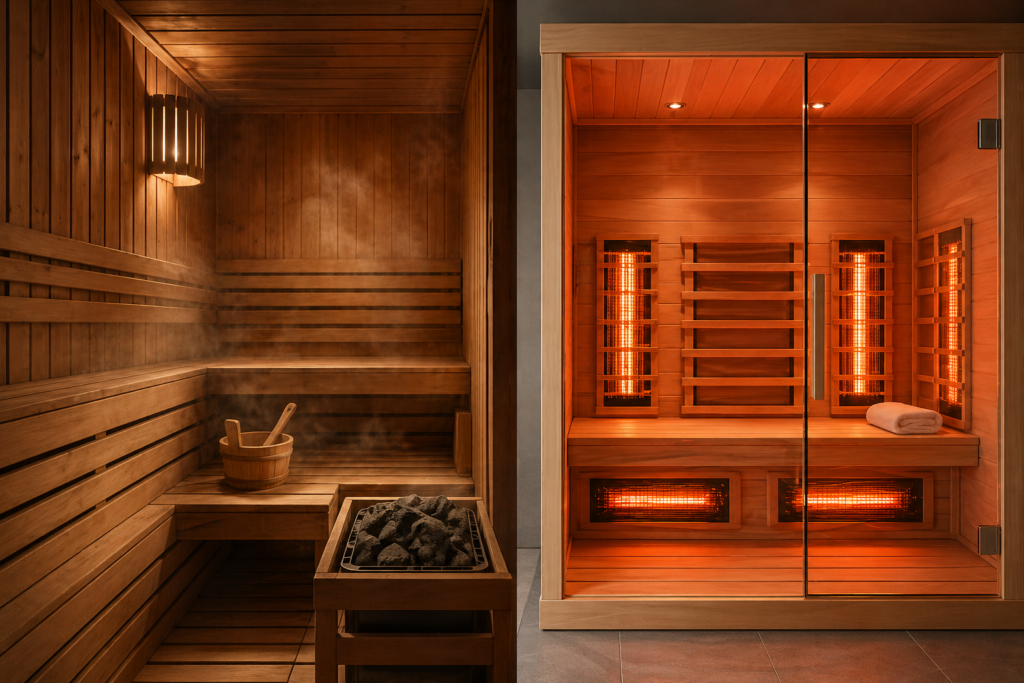
Traditional saunas heat the air to 150–195°F. That superheated air surrounds your body and forces an intense, immediate response. Infrared saunas work entirely differently — they skip the air and deliver energy directly to your skin. This is why infrared saunas typically run at 110–140°F yet still produce a meaningful heating effect. The experience is more gradual, less immediately intense, and far more dependent on session length than most people expect.
What Infrared Energy Actually Is
Infrared radiation is a form of electromagnetic energy. It sits between visible light and microwaves on the spectrum, covering wavelengths from roughly 700 nanometers to 1 millimeter.
Unlike conduction (touching a hot surface) or convection (hot air moving around you), infrared transfers energy through radiation — the same mechanism by which the sun warms your skin on a cold day. The air temperature can be near freezing, yet direct sunlight feels warm because infrared energy is being absorbed by your skin, not the air.
This is the core principle behind infrared saunas: the energy is absorbed by your body’s tissues — particularly by water molecules — and converted into heat at the point of absorption.
Key distinction: Traditional saunas heat the air first (typically to 150–195°F), and that hot air heats your body through convection. Infrared saunas skip that step — the radiation travels directly from the emitter to your skin. This is why infrared saunas can operate at lower air temperatures (typically 110–140°F) while still producing a meaningful heating effect.
NIR vs MIR vs FIR: What the Science Actually Says
The infrared spectrum is divided into three sub-bands. They differ in wavelength, penetration depth, and how they interact with the body. This is where a lot of marketing language gets the science wrong — sometimes significantly.
Near infrared (NIR) — 700 nm to 1,400 nm
Near infrared has the deepest tissue penetration of the three bands. Research on NIR in therapeutic contexts — including low-level laser therapy and photobiomodulation — shows it can penetrate several centimeters into tissue, reaching muscle and even bone depending on wavelength and power density.
In sauna applications, NIR is typically delivered by focused lamp sources such as halogen or incandescent bulbs rather than large panel emitters. The intensity is generally low relative to therapeutic devices, so its contribution to full-body core heating is limited.
NIR’s area of genuine scientific interest in sauna contexts is photobiomodulation — the interaction between specific wavelengths (particularly around 630–850 nm) and mitochondria in cells. There is peer-reviewed research supporting effects on cellular energy production and local tissue recovery, though evidence specific to sauna-format NIR exposure remains early-stage.
Common marketing error: Many sauna brands describe NIR as interacting “mainly with the skin surface.” This is incorrect. NIR penetrates deeper than FIR, not shallower. The confusion likely stems from conflating penetration depth with heating contribution, which are different things.
Mid infrared (MIR) — 1.4 μm to 3 μm
Mid infrared sits between the other two bands in both wavelength and penetration. It is absorbed by soft tissue more readily than NIR but less superficially than FIR.
In commercial saunas, MIR is often included in “full spectrum” systems. Its primary contribution is to muscle-layer warming and local circulation. It is a supporting element rather than the primary driver of the sweating response. Claims about MIR and joint health are present in marketing materials, but peer-reviewed evidence specific to MIR sauna exposure is limited — we note this honestly rather than overstate it.
Far infrared (FIR) — 3 μm to 1,000 μm
Far infrared is the primary heat driver in the vast majority of infrared saunas.
FIR is efficiently absorbed by water molecules. Since human tissue is largely water, FIR is absorbed at the skin surface — with effective penetration depth of roughly 1–2 mm in most conditions. This is shallower than NIR, not deeper.
The heating mechanism is therefore surface-first: FIR warms the skin, heat conducts inward via normal tissue conduction, and core temperature rises gradually over the course of the session. One reason FIR is so effective in sauna applications is that human skin emits FIR at a peak wavelength around 9–10 μm — this creates efficient energy exchange between the emitter and the body, with less energy wasted heating the air in between.
| Band | Wavelength | Tissue penetration | Primary role in sauna | Evidence quality |
|---|---|---|---|---|
| NIR | 700 nm – 1.4 μm | Deepest (muscle layer) | Photobiomodulation, local recovery | Early-stage, promising |
| MIR | 1.4 – 3 μm | Moderate | Muscle warming, circulation | Limited sauna-specific data |
| FIR | 3 μm – 1 mm | Shallow (1–2 mm) | Primary heat driver, sweating response | Well-established |
This is why “full spectrum” saunas often sound more impressive than they perform. The label describes what wavelengths are present — not whether the system delivers enough total energy to actually heat your body.
How Your Body Responds to Infrared Heat
Understanding the chain of events inside your body explains most of the variation people experience — including why sweating sometimes takes a long time to begin, or doesn’t begin at all.
The heating chain
FIR is absorbed at the skin surface → skin temperature rises → heat conducts inward through tissue layers → blood circulating near the skin carries warmth toward the body’s core → core temperature begins to rise → the hypothalamus detects the increase and activates thermoregulation → sweat glands activate to dissipate heat through evaporation.
This process takes time. The skin-to-core conduction step alone typically requires 15–25 minutes of sustained exposure before the sweating threshold is crossed, depending on individual physiology and environmental conditions.
The threshold that matters
Sweating is not a gradual response — it is threshold-driven. The hypothalamus triggers meaningful sweating when core body temperature rises by approximately 0.5–1°C (roughly 1–2°F) above the individual’s baseline. Below that threshold, you feel warm but sweat production remains minimal.
This is why session duration matters more than air temperature in infrared saunas. A session that ends at 15 minutes may never cross the threshold. The same person in the same sauna at the same temperature, staying for 30–40 minutes, will often sweat substantially.
Individual variation
Several physiological factors affect how quickly a person crosses the sweating threshold:
- Body composition: individuals with higher body fat may experience slower core temperature rise due to the insulating properties of adipose tissue
- Hydration: adequate hydration is required for efficient sweat production — dehydrated individuals sweat less and feel hotter
- Acclimatization: the body adapts to repeated sauna use over several sessions; first-time users typically sweat less than regular users at the same exposure level
- Baseline metabolic rate: higher metabolic rate generates more endogenous heat, which can accelerate threshold crossing
Practical insight: If you used an infrared sauna for the first time and didn’t sweat much, that is expected. The body’s thermoregulatory response typically improves noticeably after 4–6 sessions as acclimatization develops. Don’t evaluate a sauna’s performance based on your first two or three sessions.
Why You’re Not Sweating in Your Infrared Sauna — And How to Fix It
This is the most common frustration with infrared saunas, and it almost always comes down to a straightforward physical model.
If you remember one thing from this guide, it’s this: Infrared sauna performance is not about temperature — it’s about whether enough energy reaches your body and stays there long enough.
If energy lost matches or exceeds energy delivered, core temperature never rises enough to trigger sweating.
Energy delivered: three limiting variables
Total power output is the starting point. A sauna with insufficient wattage relative to its cabin volume simply cannot generate enough infrared flux to overcome heat losses.
Circuit limitations matter in home installations. A standard 15-amp household circuit at 120V supports around 1,800W maximum before tripping. Many two-person infrared saunas draw 1,400–2,000W, meaning the circuit — not the sauna spec — becomes the bottleneck. A 240V dedicated circuit roughly doubles available power.
Heater efficiency varies by element type. Not all wattage becomes usable infrared radiation — some is lost as conduction heat to the heater housing or convection heat to air.
Energy lost: three key pathways
Ambient temperature is the most underestimated factor. An infrared sauna placed in a cold garage in winter is fighting a much larger thermal gradient than the same unit in a climate-controlled room. The cabin must work significantly harder to maintain internal temperature, leaving less net energy for body heating.
Cabin sealing affects how much warm air escapes. Gaps around doors, ventilation openings, and joints between panels all create pathways for energy loss. Construction quality varies significantly between manufacturers.
Wood and panel insulation determines how much heat conducts outward through the walls. Thicker panels with appropriate wood species retain heat more effectively than thin single-layer construction.
Heater element types: a practical comparison
| Element type | Heat distribution | Typical power density | Common issues |
|---|---|---|---|
| Ceramic tube | Uneven (point source) | Moderate–high | Hot spots near element, cooler zones further away |
| Carbon fiber panel | Even (large surface) | Lower per unit area | May require longer warm-up to reach target temperature |
| Carbon crystal panel | Very even | Higher than carbon fiber | Higher manufacturing cost |
The “uneven” experience many users describe — hot on one side, cool on another — is almost always a consequence of element placement relative to the body, not a malfunction. Infrared radiation is directional: it only heats surfaces it directly strikes. Unlike hot air, it does not circulate and equalize. Panel layout design determines whether you are evenly covered or partially exposed.
Two saunas with nearly identical specs can feel completely different in real use — and the heater layout is usually why.
Many buyers focus on “full spectrum” labels and heater counts — and miss the factors that actually determine whether a sauna delivers. We’ve tested and ranked the top home infrared saunas based on power output, heater coverage, and EMF levels.
Why the Same Sauna Feels Different for Different People
Acclimatization explains a large share of user experience variation over time. In the first few sessions, the body has not yet optimized its thermoregulatory response to infrared exposure. Sweat onset is slower, and the threshold feels harder to reach. After four to six sessions, most users report noticeably faster sweat onset and a more consistent experience. This is not the sauna changing — it is the body adapting.
Hydration state at the time of the session has a measurable effect on sweat volume. Entering a session already mildly dehydrated suppresses the sweat response and increases the perception of heat stress without increasing the actual benefit.
Time of day also plays a minor role. Core body temperature naturally peaks in the late afternoon (around 4–6 pm for most people), which means the threshold for sweating is slightly easier to cross at that time compared to early morning sessions.
What to Look for Before You Buy an Infrared Sauna
Infrared sauna marketing focuses heavily on wavelength claims and heater counts. These are secondary. The primary determinants of real-world performance are more structural.
Power relative to cabin size
Total wattage only means something in relation to the cabin volume it needs to heat. A 2,000W sauna in a single-person cabin performs very differently from a 2,000W sauna in a four-person cabin. Assess the wattage-per-cubic-foot ratio rather than the raw wattage number.
Electrical circuit compatibility
Confirm what circuit your installation requires before purchase. A unit rated for 240V on a 120V circuit will not perform as specified. This mismatch is a common source of disappointing real-world results that gets blamed on the sauna itself.
Panel coverage of the body
Look at the placement of emitters, not just their number. Panels behind the back, under the bench, and on the side walls provide more complete coverage than panels concentrated in one location. Ask for the emitter layout diagram before purchasing.
Cabin construction quality
Door seal integrity, panel thickness, and join quality directly affect heat retention. Look for thick-walled construction and tight door seals. These are difficult to assess from product photos but can be evaluated through hands-on reviews and independent testing.
EMF levels
Electromagnetic field emission from infrared heaters is a legitimate consideration for frequent users at close range. Look for units with independently tested and published EMF measurements from third-party labs — not manufacturer self-reports. Low-EMF design is achievable and some manufacturers prioritize it transparently; others do not address it at all.
Not sure whether “low EMF” actually matters? Most buyers focus on the wrong metrics. We analyzed real milligauss levels, safety standards, and how brands present EMF data — read the full breakdown here.“Infrared Sauna EMF: Real Numbers, Safety Limits, and What Brands Don’t Tell You(2026)”
Wood species and VOC emissions
Sauna cabins are typically constructed from cedar, hemlock, or basswood. At operating temperatures, lower-quality materials or adhesives can off-gas volatile organic compounds. Look for saunas specifying low-VOC or formaldehyde-free construction, particularly in the adhesives and panel sealing.
Most buyers focus on the wrong specs. The ones that matter most — power-to-volume ratio, heater placement, cabin seal quality — rarely appear in the marketing.
How to Get Consistent Results From Any Infrared Sauna
These guidelines apply whether you are using a new unit or trying to improve results from an existing one.
- Preheat for at least 15–20 minutes before entering. Infrared panels need time to reach stable output, and a preheated cabin reduces the heat deficit your body needs to overcome at the start of your session.
- Target 30–45 minutes per session once acclimatized. Shorter sessions often fail to push core temperature past the sweating threshold. Begin with 15 minutes in your first few sessions and extend gradually.
- Use the sauna in a room at or above 65°F (18°C). Cold ambient environments significantly increase heat loss through the cabin walls and reduce effective heating.
- Hydrate before and after. 14–17 oz (400–500 ml) of water before the session supports sweat production and prevents the performance drop that comes with mild dehydration.
- Allow 4–6 sessions before evaluating performance. Acclimatization takes time. Early sessions consistently underperform later sessions in terms of sweat response — this is physiological, not a product defect.
- Sit close to the emitter panels where practical. Infrared intensity follows an inverse square relationship with distance — moving closer to the panels meaningfully increases the energy flux reaching your body.
Before you buy — check this first
Infrared sauna performance comes down to one thing: whether enough energy is delivered to your body, retained in the cabin, and sustained long enough to push your core temperature past the sweating threshold. The wavelength marketing, the heater counts, the “full spectrum” labels — these matter far less than power-to-volume ratio, heater placement, and cabin seal quality.
Most buyers don’t find this out until after the purchase. You now know what to look for.
If you’re ready to choose: → Best infrared saunas for home use 2025 · Clearlight vs Sunlighten: which is worth it?
About Pure Recovery Lab
Pure Recovery Lab focuses on breaking down real performance factors behind recovery equipment — especially what most brands don’t explain clearly.
Transparency
This article may contain affiliate links. We may earn a commission at no extra cost to you.