
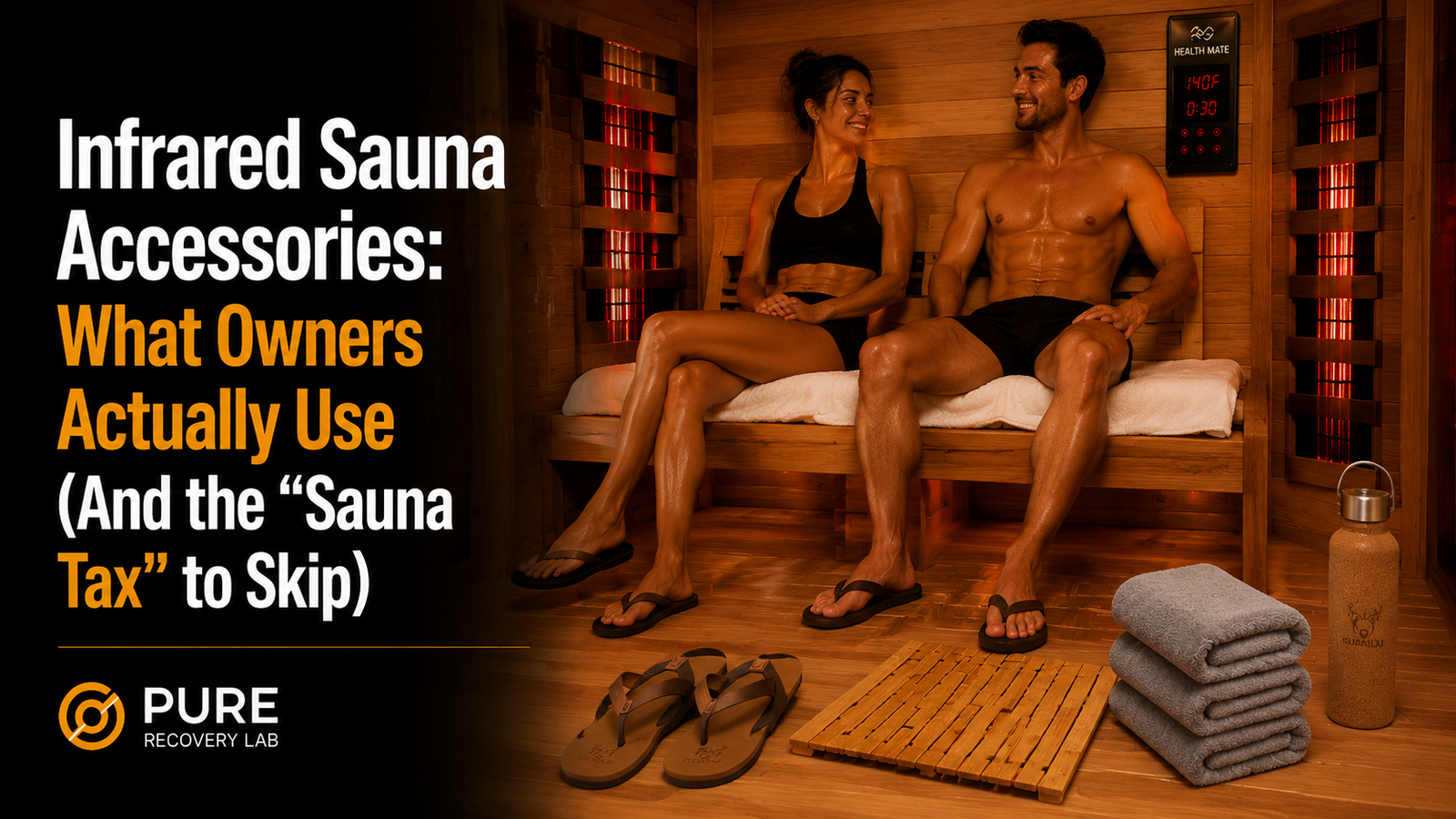
You only need five infrared sauna accessories — natural-fiber towels, a backrest, an insulated water bottle, floor protection, and roughly $100 total. Almost none of them need the word “sauna” on the label, and the ones that do usually cost two to ten times more for the same thing. We went through what actual owners on r/infraredsauna say they use daily, checked the materials science behind each pick, and flagged where the “sauna tax” kicks in.
Here’s the thing about infrared sauna accessories: the sauna itself cost you $2,000–$6,000, so a $30 add-on feels like nothing — and sellers know it. Slap “for saunas” on a product title and the price doubles. This guide is built the other way around: start from what owners actually reach for every session, then find the version that does the job without the markup.
The five, at a glance:
1. Cotton towels — about $9 each, natural fiber only
2. Cedar backrest — the one item worth a real premium
3. Insulated water bottle — cork-wrapped, stays grabbable in the heat
4. Bamboo mat or flip flops — the floor heater is no joke
Total for the whole kit: roughly $100–150.
The Real Must-Haves
1. Towels — but only natural fibers
Every owner thread starts with towels. One folded under you on the bench, one for wiping sweat. But there’s a detail most accessory lists skip, and one owner on r/infraredsauna put it bluntly: synthetic fabrics like spandex and polyester leach at higher temperatures — so whatever toxin-release benefit you’re chasing in the sauna, you’re partially reintroducing through your towel.
That rules out most “sauna towels” sold as such (frequently microfiber — a synthetic). What you want is boring: 100% cotton, big enough to cover the bench, thin enough to dry fast between sessions. A 4-pack of oversized cotton bath towels runs about $9 per towel — less than half what single “sauna seat towels” in synthetic blends sell for.
100% cotton oversized 4-pack — check price on Amazon →
2. A backrest — the upgrade owners regret not buying sooner
The most common comfort complaint in every owner thread isn’t heat — it’s sitting bolt-upright against a flat wooden wall for 30 minutes. One owner posted a photo of exactly the fix: an S-curved wooden backrest. Another wrote that the open-slat back was the point — it lets heat keep moving instead of blocking the rear panel.
Material matters more here than anywhere else in the cabin, because this is bare skin against heated wood. Cedar is the traditional answer for a reason: non-resinous, the lowest heat conductivity of any common sauna wood, naturally moisture-resistant (we cover why skin-contact parts should be resin-free in our sauna wood guide).
Our Pick: Canadian Red Cedar S-Curve Backrest
✓ Non-resinous cedar — no sap bleed at any sauna temperature ✓ S-curve supports the lower back, open slats keep heat moving ✓ Non-slip pads, no installation
Cedar is aromatic — most people love it; skip it if you’re scent-sensitive. Click below for current pricing.
On a budget? This pine S-curve version runs about half the price with 300+ reviews. Pine is a resinous wood we’d avoid in a 190°F traditional sauna — but at infrared temperatures (165°F max, most sessions cooler), resin bleed is rarely a practical issue.
3. An insulated water bottle — because regular steel gets too hot to grab
Owners consistently mention bringing an insulated cup of water or electrolyte drink into their 20–30 minute sessions — and “insulated” is doing real work in that sentence. Infrared radiation heats metal surfaces the same way it heats you, so a regular steel bottle’s outer wall becomes too hot to grab mid-session.
Cork-wrapped bottles solve it with straightforward physics: cork conducts heat at a fraction of the rate of steel, so the outside stays grabbable while the vacuum-insulated interior keeps water cold through the full session. Dehydration is the #1 reason sessions end early — this is the accessory that most directly buys you more minutes in the heat.
Cork-wrapped sauna bottle — check price on Amazon →
4. Floor protection — the one nobody warns you about
The single most vivid warning in any owner thread: the infrared heater in the floor will torch the bottom of your feet after half an hour. That owner’s solution? The cheapest flip flops Amazon sells. His words: life saver.
Two ways to handle it, both cheap:
A bamboo floor mat (~$20) covers the floor heater zone with a natural, heat-tolerant material — bamboo conducts heat slowly, so it stays comfortable underfoot where the bare heater panel doesn’t. One note we checked before recommending: the rubber grip dots on the underside face down against the floor, shielded by the bamboo slats, and cabin floor level runs only 110–130°F — the coolest layer in the whole cabin, far below any temperature where rubber off-gasses. The mold complaints you’ll see in reviews come from bathroom use; in a sauna, fold it and set it out to dry after sessions and that problem doesn’t apply.
Foldable bamboo mat — check price on Amazon →
Or just wear flip flops. A $10 pair with a cushioned foam footbed puts an insulating layer between you and the floor heater, zero maintenance. (This one’s the men’s version — the same search turns up women’s equivalents at the same price.)
Cushioned flip flops (~$10) — check price on Amazon →
The “Sauna Tax”: When One Word Doubles the Price
This is the pattern owners keep flagging, and once you see it you can’t unsee it.
One owner’s example: paraffin oil, used to treat interior sauna wood so it doesn’t dry out. Buy 100% paraffin oil labeled “for saunas” — about $100 a gallon. Buy 100% food-grade paraffin without that word in the title — about $15. Same substance.
Another owner went shopping for a sauna mat and found the market split into $15–30 generic mats and $250–350 “authentic” sauna mats. His conclusion after using the sauna for a month: the expensive ones solve a problem that doesn’t exist.
The rule that protects you: judge accessories by their material list, not their title. Natural fibers, solid wood, bamboo, food-grade oils, stainless steel — these do the job at commodity prices. The word “sauna” in a product title adds targeting, not function. The only place we’d pay a genuine sauna premium is skin-contact wood (the backrest above) — because there, the wood species actually is the function.
And keep the actual goal in view: accessories exist for exactly one reason — to make you use your sauna more often and more comfortably. The moment a product’s price stops serving that goal and starts serving the word on its label, it’s off the list. Everything we picked above is the rational version.
Nice to Have, Not Necessary
Owners mention these fondly, but nobody calls them essential: a mini fridge next to the sauna for cold towels and water (one owner with rosacea swears by it), a eucalyptus oil diffuser, ambient LED lighting synced to relaxation mode, and a wall hook or towel shelf by the door. A felted wool sauna hat shows up surprisingly often too — several owners use one to keep the top of the head from overheating and to protect hair from drying out with frequent use. It’s a traditional-sauna habit that carried over, and at infrared temperatures it’s a comfort choice, not a requirement.
What to Skip
Three things we’d leave in the cart: anything microfiber or spandex-blend marketed as sauna seating (that’s the material problem from section one, sold at a premium), any mat or cushion priced over $100 (see: sauna tax), and any electronics you care about — phone batteries and 140°F cabins are a bad marriage, which is also why a $10 pair of flip flops beats a $200 “smart sauna accessory kit” every time.
Bottom Line
The whole kit — cotton towels, cedar backrest, insulated bottle, bamboo mat or flip flops — lands around $100–150, and the backrest is the only place the price reflects real function. Everything else is commodity goods doing commodity jobs.
And remember what the accessories are actually for. The biggest benefit an infrared sauna offers comes from one thing: consistent use — making it part of your life, not an occasional event. Every accessory on this list earns its place by making that easier. Make yourself comfortable in there. Just don’t let comfort become a burden on your wallet — because per every owner thread we read, the upgrade that actually matters is showing up more often, not gearing up more expensively.
Frequently Asked Questions
Do you really need special accessories for an infrared sauna?
Mostly no. Of the five infrared sauna accessories owners actually use daily, only the backrest benefits from being sauna-specific (wood species matters for skin contact). Towels, bottles, mats, and footwear all work better and cheaper as ordinary versions in the right materials.
What should you not bring into an infrared sauna?
Synthetic fabrics (they leach at temperature), phones and electronics (140°F+ damages batteries), glass containers, and anything you’d mind sweating on. Metal jewelry heats up fast too — most owners take it off.
What do you sit on in an infrared sauna?
A folded 100% cotton towel on the bench. Skip microfiber and synthetic-blend “sauna seat cushions” — natural fiber against skin is the whole point at these temperatures.
Are sauna hats necessary for infrared saunas?
No — they’re a traditional-sauna carryover. Some infrared owners still like felted wool hats for head-heat comfort and hair protection with frequent use, but at 120–165°F they’re optional, not protective equipment.
Sources
Owner experiences paraphrased from two discussion threads on r/infraredsauna (must-haves thread · new-owner accessories thread), checked July 2026. Material guidance on sauna woods draws on our infrared sauna wood guide. Floor-heater cautions align with manufacturer manuals, including Dynamic Saunas’ owner documentation. Product specs from Amazon listings as of July 2026.